
Journalists working in Latin America face labor precarity, gender disparities, mistreatment in the workplace and other threats to their safety and well-being. Some self-censor and few seek help from the government. Despite this, they look to each other for support and remain committed to supporting democratic and just societies through their work.
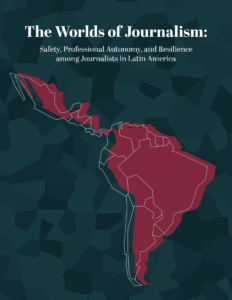
More than 40 professors, scholars and graduate students working in Latin America worked on the ebook.
These are among the main findings of a new ebook, “The Worlds of Journalism: Safety, Professional Autonomy, and Resilience among Journalists in Latin America,” which is now available to download for free in English, Spanish and Portuguese.
Published by the Knight Center at the University of Texas at Austin, in collaboration with the School of Communication and Department of Journalism and Media Management at the University of Miami and the Center for Global Change and Media at UT Austin, the ebook is based on surveys with more than 4,000 working journalists in 11 countries in the region that were carried out from 2021 to 2024 as part of the World of Journalism Study (WJS). Since 2007, the WJS said it has looked at the state of journalism around the globe, “focusing on journalists’ professional views, working conditions and the role of journalism in a changing world.”
“We needed a clear picture of the universe of Latin American journalists,” Rosental C. Alves, director of the Knight Center for Journalism in the Americas, wrote in the ebook’s foreword. “While research on journalism in Latin America has grown, its scope is often limited. To my knowledge, there has never been a comprehensive census of journalists in the region.”
In addition to the survey results, the ebook also offers first-hand perspectives written by journalists working in Mexico, Costa Rica, Venezuela, and Argentina.
In total, more than 40 professors, scholars and graduate students working in the region contributed to the data presented in this volume, edited by Summer Harlow, associate director of the Knight Center; Sallie Hughes, journalism professor and department chair of Journalism and Media Management at the University of Miami School of Communication; and Celeste González de Bustamante, founding director of the Center for Global Change and Media.
“This trilingual book from the Knight Center is more than a collection of data—it’s a bridge between rigorous scholarship and accessible knowledge,” Harlow told LatAm Journalism Review (LJR). “It empowers journalists, researchers and citizens alike to understand the forces shaping media and democracy across the region.”
Hughes emphasized that making the study accessible to journalists is a way to repay them for the time and trust they placed in the researchers.
“This was a way that we could share our results with them and not be extractive with our research,” she told LJR.
She said she also hopes policymakers, media owners, journalism associations and the public will also consult it.
“We hope will help explain to the public throughout Latin America and to hopefully receptive politicians and policy-makers the importance of the work that these journalists are doing,” she said.
The study found that on average, journalism is a male-dominated profession in the region with just four in 10 journalists surveyed identifying as female.
When asked an open-ended question about identification with a cultural community, just 6% of surveyed journalists said they identified with an Indigenous group or as an Afro-descendant. The ebook notes these percentages are significantly lower than regional averages in the population at-large.
The journalism workforce itself has a high level of formal education or specialized training in journalism and legacy newspapers are still the main employer, with digital outlets gaining ground.
It’s important to note that the Worlds of Journalism Study survey respondent base includes only people who work at least 50% of the time as a journalist or receive at least 50% of their income from journalism.
Hughes said these parameters are important for creating a sample that could be compared across countries.
Almost half of the journalists surveyed experience some form of labor precarity, which involves contractual insecurity, accelerated pace of work and the need to work in multiple paid jobs to make ends meet, according to the ebook.
The book highlights Chile and Mexico for the high number of journalists working without permanent, full-time contracts. However, professionals working in Andean countries have the least secure contractual arrangements, it reported.
And about half (47%) of those surveyed said they receive some of their income from jobs outside journalism. Peru tops that list, with just 16% saying they get 100% of their income from journalism.
When it comes to pace of work, journalists reported contributing content to 3.7 different platforms “often” or “very often,” according to the study results presented in the ebook.
The Worlds of Journalism Study survey also measured safety and well-being of journalists, using journalists’ reports of workplace mistreatment and their concern for “physical, emotional-mental and financial well-being” due to work.
The three most prevalent types of aggressions against journalists reported included demanding or hateful speech, surveillance and workplace bullying.
More than half of the journalists surveyed reported experiencing demeaning or hateful speech at least sometimes and more than a quarter said they were surveilled. Fifteen percent said they were bullied by sources, supervisors or coworkers “sometimes,” “often” or “very often.”
Brazil stood out with the highest rankings in all three categories of aggression, and Peru had some of the lowest levels.
However, regionally, women journalists reported higher levels of workplace bullying than their male colleagues reported. Further, nonbinary journalists disproportionately reported being bullied as well, according to the ebook.
Meanwhile, across the region, men reported more frequent experiences of surveillance and hate speech. However, the book noted the pattern is not seen in every country.
Most surveyed journalists said they were worried about their emotional and mental well-being because of work. Additionally, more women journalists than men said they were worried about all forms of safety.
About half of all respondents also were concerned about their financial stability.
In general, journalists in the region said they respond to safety and well-being challenges by looking to colleagues for social support and collective safety, and by self-censoring. Very few said they go to the government for protection, the book reported.
Researchers measured how the surveyed journalists felt about their roles as they pertain to journalism and democracy. They divided these roles in terms of those commonly associated with a liberal model of the press, which included journalists supporting an “informed and engaged citizenry through neutral reporting of affairs,” and a democratic model, in which journalists “support positive social change.”
The highest levels of support were recorded for liberal roles including “shine a light on society’s problems” (93%) and “provide analysis of current affairs” (86%). Also scoring high were the social change roles of “let people express their views” (87%) and “promote peace and tolerance” (86%).
Throughout the region, most journalists report "a great deal of freedom" to choose what stories they cover or how they report them, but this varies by country. Also, some countries, like El Salvador, Colombia, and Bolivia, for example, still report low levels of overall media freedom in their countries, despite the individual autonomy.
The book concludes on a cautiously optimistic note concerning "journalism's potential to help strengthen democracy in the region.”
It says the journalists surveyed “appear acutely aware of the structural and contextual challenges they face. Yet, they exhibit notable occupational resilience - often choosing collaboration over self-censorship and actively seeking support from colleagues and news organizations to navigate threats more safely.”
On Jan. 22 at 9:30 a.m. CST, the Knight Center is hosting a free webinar in Spanish with book authors of chapters on Mexico, Costa Rica, Chile, Ecuador, Argentina and Colombia. Registration is free. A second webinar will be held in English at 9:30 a.m. CST on Tuesday, Feb. 3 with authors of chapters on El Salvador, Peru, Bolivia, Brazil and Venezuela.


