
Just over one year ago, journalist Pablito Aguiar boarded a plane for the 1,750-mile journey that would traverse Brazil, from the southern city of Porto Alegre north to Altamira, in the heart of the Amazon basin.
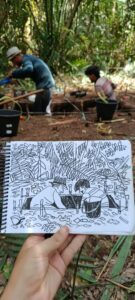
Pablito Aguiar sketches during an expedition of the Amazonia Revelada team. (Photo: Courtesy Pablito Aguiar)
He was headed to visit the team at news outlet Sumaúma, which specializes in reporting on the Amazon.
There was no promise of employment; only the guarantee that he would be "well received."
He’d reported for the media outlet before in 2024, covering historic floods that killed at least 184 people and devastated the state of Rio Grande do Sul, where he’s from.
“One day, Pablito sent me a message saying he was coming to Altamira with a one-way ticket,” Eliane Brum, co-founder of Sumaúma, told LatAm Journalism Review (LJR). “He walked through the door of our newsroom and became indispensable. He created Sumaúma, along with us. His talent is as immense as his kindness.”
Aguiar's reporting methods and materials are unconventional. While his work is backed by interviews and he uses a notepad, pens, recorder and cell phone like his colleagues, what sets the 37 year old’s journalism apart is that it takes form in the style of comics. This was the case when he started working at a local newspaper in the interior of Rio Grande do Sul, and he continues it as a full-time reporter for Sumaúma.
Augusto Paim, Porto Alegre–based journalist and researcher, told LJR that while there are numerous examples of comics journalism produced within professional newsrooms worldwide, Aguiar’s work is unique.
“Pablito’s case [with Sumaúma] is exceptional because it establishes a permanent space for comics journalism within an already established media outlet,” said Paim, author of “Pequeno manual da reportagem em quadrinhos” (Small Manual of Comics Journalism) who received his doctoral degree in comics journalism from Germany’s Bauhaus University.
Aguiar’s most recent reporting project recounts the 15 days he spent with an expedition of archaeologists and riverside residents in the Riozinho do Anfrísio Extractive Reserve.
In 68 rectangles of colorful drawings accompanied by speech bubbles, Aguiar narrates how this team with the Amazônia Revelada project identifies and records archaeological sites dating back 15,000 years.
“I record everything with photos, videos, sound, audio. I don’t draw [during the investigation],” Aguiar told LJR. “I create a somewhat abstract idea of what the narrative will be. It’s like a puzzle: I put the story together. The drawing is the hardest part. It takes about two days for each page and it’s very painful. After the drawing is done, I add color.”
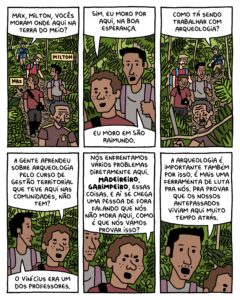
A comics journalism section that Pablito Aguiar reported about the Amazonia Revelada expedition. (Courtesy: Sumaúma)
In the meantime, Aguiar’s script passes through editors and fact-checkers at Sumaúma.
But this all takes time. The report on archaeological sites in the Amazon Rainforest was developed over three months and finally published on Feb. 2, 2026.
“Comics have a different pace, and I’m understanding that within a newsroom,” Aguiar said. “I don’t have the same agility as someone who writes a text, for example. So I need to understand that I won’t see my product completed as quickly as other colleagues. I have to understand the pace of comics to try to explain it more clearly to them. While we don’t fully understand it, we have trust and respect. It’s working out well. I really like the feedback.”
Brum said she had never worked on comics journalism before, but that Aguiar’s work follows the same editorial routine as the team’s other productions: he pitches story ideas or receives proposals, goes out into the field, consults with editors, submits a script and then draws.
“This experience is entirely in line with Sumaúma's mission, which aims to be a space for experimentation with language,” Brum said. “I think comics journalism also has great potential to break through bubbles and reach other audiences, something we really need to do in Brazil.”
Growing as a journalist
Aguiar has a degree in visual communication and has always worked in newspapers. Back in Porto Alegre, he was part of the newsroom of the website O Sul, which at the time still had a print edition. In his hometown of nearby Alvorada, he worked at newspaper A Semana. Initially, he was a layout artist and cartoonist, until he proposed a series of comic strip profiles about residents of the city to the editor.
Since then, his interest in journalism has only grown.
“[Aguiar] takes an interest in ‘small’ stories—those that generally hold no appeal for conventional journalism, yet capture the attention of alternative journalistic traditions, such as literary journalism. Pablito turns small stories into big stories—or rather, he reveals the grandeur of stories deemed small within conventional journalism,” Paim said.
Among his main inspirations are the books and reporting of Brum, who moved to Altamira from São Paulo in 2017 and founded Sumaúma in 2022 with Jon Watts, global environment editor for British newspaper The Guardian, with the aim of covering the Amazon Rainforest and “re-centering the world.”
Aguiar frequently turns his comics journalism reporting into books.
He published his longest project to date as a freelance journalist. It’s a series of interviews with 14 residents of Porto Alegre published on social media between 2017 and 2023. The book “Conversas em Porto Alegre,” came out at the end of 2023, a few months before the historic floods. He fondly remembers the period of solitary production, but believes that joining the Sumaúma newsroom made his reporting even better.
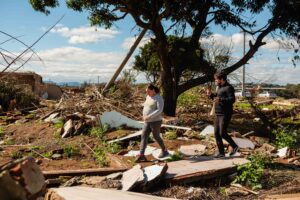
Pablito Aguiar covering the historic floods in Rio Grande do Sul. (Photo: Carolina Leipnitz)
“It’s a process that only enriches the work. Like: ‘change this headline,’ ‘write this here,’ ‘write that here.’ For me, it’s a great privilege. I’m learning a lot, growing as a journalist. I had never participated in an editorial meeting before; the first one I participated in was here. I thought it was the coolest thing in the world. People exchanging good stories, you know? It’s very exciting. I came here for this.”
Viviane Zandonadi, editorial workflow coordinator at Sumaúma and one of the site's editors, celebrates the unusual reach of Aguiar's work.
“Pablito found an intelligent and subtle way to tell stories that are both simple and profound,” Zandonadi told LJR. “Especially on social media, but not only there, his publications break through audience bubbles, attracting readers from all over the world.”
Currently, Aguiar is working on a report about the three days he spent accompanying a pilgrimage in honor of people who died protecting the Amazon Rainforest, such as the American nun Dorothy Stang, murdered in 2005 in the city of Anapu, in Pará. He also plans to publish a book in the coming years compiling all the reports he produced for Sumaúma, focusing on this period living in Altamira.
"But it will take time," he said.
This article was translated with the assistance of AI and was reviewed by Teresa Mioli.


