
Before Luis Enrique Núñez began anchoring two online newscasts, he spent years piecing together a living — and pursuing his dream of becoming a journalist.
Núñez, 34, anchors a general newscast and another aimed at young audiences in his hometown of Buenaventura, the largest port on Colombia’s Pacific coast. His path has included selling prepaid phone minutes on the street and helping run a small family business making an artisanal sugarcane liquor called viche.
“You need to have that business going, plus another income, plus another income,” Núñez said with a laugh on a phone call with LatAm Journalism Review (LJR). “I do this mostly out of love, because journalism is not going to make you rich.”
He’s far from an exception in Colombia. A survey published this year by the Fundación para la Libertad de Prensa, or FLIP, found nearly half of journalists earn most of their income outside the profession. Another study, by the Universidad del Rosario, said more than half are considering leaving journalism because of precarious working conditions.
“Yes, I’ve thought about leaving,” Núñez said. “The first time was when my son was born. He was born in July, in the middle of the pandemic, and I had no work. It’s not the same for two adults to say, ‘OK, today we’ll eat rice with eggs and tomatoes,’ as it is to have a baby crying for milk, diapers and everything else.”
Still, journalism is the work that drives him, a craft he continues to invest in as he juggles whatever it takes to afford staying in it.
Núñez has been restless since he was a child — “always wanting to get ahead,” his mother, Rosa Caicedo, told LJR.
He earned technical degrees in metallurgy, accounting and finance, and foreign trade. He supported himself by doing a bit of everything, or as he likes to joke, by “brewing all kinds of teas.”
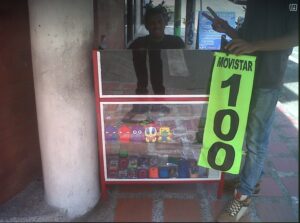
Luis Núñez used to sell minutes of cellphone airtime on the street. (Photo: Courtesy)
His first break in media came in 2010, when he was invited to host “Aló DJ” on the local channel Telebahía. To pay for reporting, editing and conflict-coverage courses, he turned to one of the most common hustles in Colombia in the early 2000s: selling minutes of cellphone airtime on the street.
Wearing a vest advertising the service, he and Caicedo would set up on a corner outside Rico Marisco, a busy restaurant near Buenaventura’s port. And business was good. At their peak, they rotated through 10 cellphones and, on their best days, sold about COP $300,000 pesos (USD $80, roughly) in minutes.
“I would tell customers that in three years I would have my journalism degree and be on TV,” Núñez recalled. “It’s an anecdote I love to tell because seven years later, I made it a reality.”
Caicedo said she always supported her son’s ambitions, even if she worried about what they would demand of him.
“I didn’t like it because here they don’t value journalists very much,” she said. “They don’t pay them well. They have too much work. I didn’t think he would be able to live off it.”
Núñez, convinced of his path, returned to local TV in 2018 as a production assistant and content creator at the local Canal 2 Telemar. A year later, he, his wife and three partners launched the production company KVelez Producciones. They named it using the first letter of his nickname, Kike, and the last name of his wife, Darlyn Tatiana Zapata Vélez.

Luis Núñez as a news anchor. The newscast is also broadcast on local channels. (Screenshot)
Today, Núñez hosts KVelez Informa, which he describes as the region’s “first entirely online newscast,” as well as Tu Zona Click, a program geared toward young people. He also posts regular reports on Facebook. He covers issues including displaced communities, human rights, culture, tourism and public works.
“Our work is essentially to show the reality of the city,” Núñez said. “We also try to highlight communities across the Colombian Pacific on our digital platforms, to support local leaders, spotlight artists, support the region and show the positive side of the city.”
Through the production company, he added, they’ve also bid on public contracts and developed media plans for local governments.
Around the time he launched the production company, Núñez helped start another family venture. In 2018, he and his mother created Casa Núñez, which sells curao, pipilongo and creams made from viche, a sugarcane liquor developed by Afro-Colombian communities along the Pacific coast.
Caicedo, who learned as a child to make viche-based products from a friend, handles production. Núñez helps bottle the drinks, coordinate distribution and manage the business’s social media accounts.
He estimates most of his income comes from KVelez Producciones, with additional earnings from the family’s viche sales and other odd jobs he still takes on. He also works on community projects. In 2022, his company trained 40 young people from Buenaventura’s San Antonio 2 neighborhood in photography, editing and news presentation.

Casa Núñez made this special production for a birthday celebration. (Photo: Courtesy)
At times, safety concerns have made him question whether to stay in journalism. He said he’s had to relocate within the city at least four times because he’d received threats, and that most recently, he was extorted. “In Buenaventura we have a saying: ‘A journalist who hasn’t had at least three threats isn’t doing their job right,’ ” he said.
Núñez said he hopes to eventually export his family’s viche — and continue serving his community through journalism. His mother, despite her early reservations, said she’s his “number one fan” and never misses one of his newscasts.
“You think this work pays really well, that you’ll live off it, but in reality, it doesn’t,” he said. But “now, thanks be to God, we have a name and recognition. Thanks to that we’ve gotten a bit further, we’ve earned a place in local media and everything we’ve built.”
This is the second installment in a series about journalists who supplement their income with work outside the profession. You can read the first story here.
This article was translated with the assistance of AI and reviewed by Jorge Valencia.


