
Populist regimes in Latin America lead journalists to use access to information laws less. However, journalists in countries in the region with less press freedom are the ones who make the most use of these laws.
This is according to a transnational study that examined the influence of factors such as populist leadership, press freedom indices and the characteristics of laws, on the perceptions and experiences that journalists in Latin America have regarding access to information.
"Understanding these dynamics is crucial for safeguarding transparency and empowering journalists to hold power accountable—cornerstones of democracy in the region,” Summer Harlow, one of the study authors, told LatAm Journalism Review (LJR).
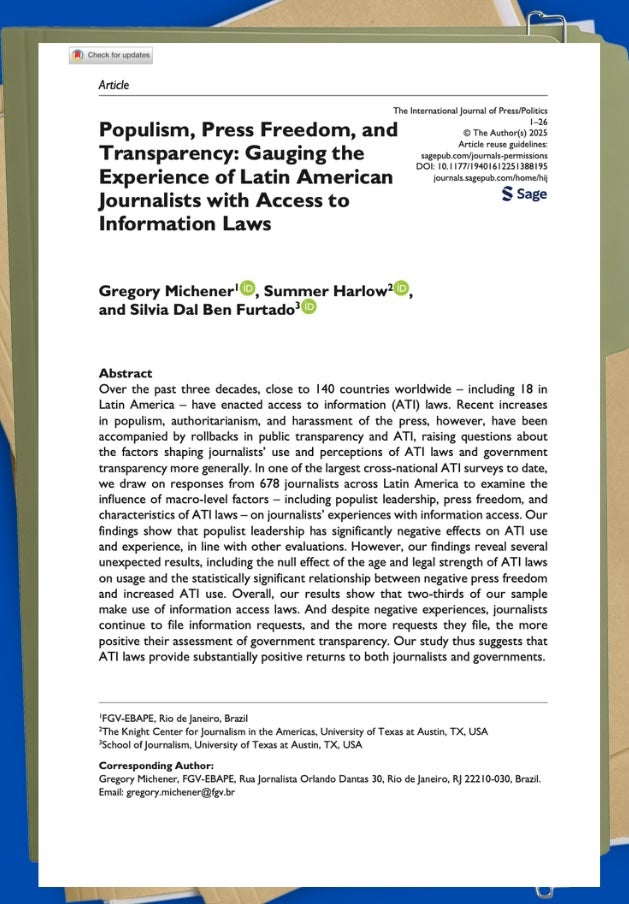
The study was conducted over two years and was based on a survey administered to more than 1,000 journalists in Latin America. (Photo: Screenshot and Canva)
The study was conducted over two years by researchers Gregory Michener, from the Brazilian School of Public and Business Administration at the Getúlio Vargas Foundation; Harlow, associate director of the Knight Center for Journalism in the Americas, which enabled the study; and Silvia Dal Ben Furtado, from the University of Texas at Austin.
The study was based on a survey administered to more than 1,000 journalists in Latin America, from which the responses of 678 journalists who said they were actively practicing the profession, either independently or in the media sector, were considered.
The survey showed that journalists in Latin American countries with low scores in Reporters Without Borders' (RSF, for its acronym in French) World Press Freedom Index tend to make greater use of access to information laws.
“It’s the opposite of what we thought we'd find,” Michener told LJR. “We see significant uses [of access to information laws] in places like Guatemala and Peru, like a lot of requests, now. Even though these places are not particularly good for press freedom.”
Guatemala has a score of 48 out of 100 in the 2023 RSF ranking, which was used for the study, while Peru's score is 52 points.
Michener said one possible explanation is that journalists in countries with lower levels of press freedom probably resort to information access mechanisms to avoid confronting government officials directly.
In the case of investigative journalists, they often use access to information requests to gather data in the initial stages of their reporting so that when they have to question an official, they do so backed by information, thus reducing risks, the author said.
“In investigative journalism, you need to get a lot of information before you can ask good questions,” Michener said. “They basically can say, ‘look, I already know this, and this, and this.’ Because if they know that you're trying to find out about something, it can be dangerous.”
In 2019, Michener documented how public officials in Brazil were using Google and social media to search for the names of individuals requesting public information in order to discriminate in their responses based on political profiles, affiliations or identities. This, he argued, undermines the effectiveness of freedom of information laws and discourages citizens from exercising their right to access public information.
In this regard, Michener said that in the region it is becoming increasingly common among journalists to use "proxies," or intermediaries, to protect the identity of someone requesting public information.
In Latin America, several organizations submit access to information requests on behalf of journalists so the journalists do not have to reveal their identity. Michener cited as an example the Brazilian journalism agency Fiquem Sabendo, which specializes in access to public data.
“They don't necessarily have to use their own identity,” Michener said. “They can go through a proxy, and they should actively seek out proxies.”
This finding could suggest that journalists in contexts of weak press freedom feel more compelled to fulfill their responsibility as "watchdogs" of power, the study indicated.
According to the study, in Latin America, populist regimes have been characterized by attacking journalists, silencing critical media outlets and undermining freedom of the press. The study took into account the definition of populism understood as an ideology within the authoritarian-democratic spectrum that divides society between "the pure people" and the "corrupt elite".

Researchers Gregory Michener (L), Summer Harlow (C) and Silvia Dal Ben Furtado (R). (Photo: UT Austin Journalism School and X)
The authors found that the longer a country has been under a populist regime, the less journalists in that country use access to information laws. Professionals interviewed from countries with populist governments responded that they consider making requests for access to information under those circumstances to be a futile effort. They also responded that they consider access to information laws to be ineffective.
“Latin America is one of the regions that has more populist leaders in the world,” Furtado told LJR. "[These leaders] try to really affect the answers, delay answers, or use these answers in a political way to really conduct the narrative that will be told about them and about their governments by the media sector. [...] When journalists see that the [access to information] law is being used politically, the answers or the information they get from the laws lose credibility.”
As an example, Furtado cited Nicaragua, where, despite the existence of an access to information law since 2008, the control that the regime of Daniel Ortega and Rosario Murillo has over public information is extreme, and there is no institutional mechanism to enforce said law.
“Although Nicaragua has an [access to information] law, journalists don't really use it because they know that all the information they will get through an [access to information] request would be really pro-government information, and not really credible,” Furtado said.
The results indicated that the strength of access to information laws was not necessarily associated with greater use. For the study, the authors considered the Global Right to Information Rating from the Centre for Law and Democracy (CLD), a measure of the strength of access to information laws that takes into account more than 60 criteria, including their scope, application procedure and appeals process.
The Latin American access to information laws that received the lowest ratings on that list are not necessarily the least used in the region, as the survey showed.
“The strength of a law doesn't mean a lot, at least for usage or perceptions of the law's efficacy, which shows us that, with perseverance, journalists can have returns, even though their laws are not that great,” Michener said. “That’s the case of the Dominican Republic, which I think has got one of the worst scoring laws in the hemisphere.”
The Dominican Republic's access to information law has a score of 58 out of a maximum of 150 in the CLD measurement.
Something similar happens with regard to the age of access to information laws in Latin America. The literature analyzed for the study, Michener said, shows that older laws tend to become obsolete and generate less interest among journalists. However, the survey results found evidence to the contrary.
The study results show a sense of optimism surrounding the access to information laws in the region, according to the authors, as they could indicate that even the laws considered weakest can be useful for journalism.
Approximately two-thirds of the journalists surveyed said they use access to information laws in their countries. Countries such as Chile, El Salvador and Guatemala stood out for their exceptionally high use of transparency systems by journalists, according to the study.
"I think ATI laws still play an important role in the region,” Furtado said. “And all these journalists, they are heavy users and are always trying to access public information and cross analyze different sources of information to find inconsistencies, to find issues, they're not just doing good work, but they play an important role in society."


