
Solutions journalism can offer a respite from the saturation of misinformation and bad news that the information ecosystem in Latin America is experiencing.
That’s according to Katherine Stanley Obando, editor in chief and cofounder of El Colectivo 506, a digital magazine based in Costa Rica that specializes in solutions journalism. For this reason, the publication did not hesitate to turn to artificial intelligence (AI) to strengthen its efforts to promote this approach among journalists in the region.
El Colectivo 506, in collaboration with the Reynolds Journalism Institute at the University of Missouri in the U.S., created Luz, a free, publicly accessible, trilingual chatbot that guides journalists in developing solutions journalism reporting ideas.
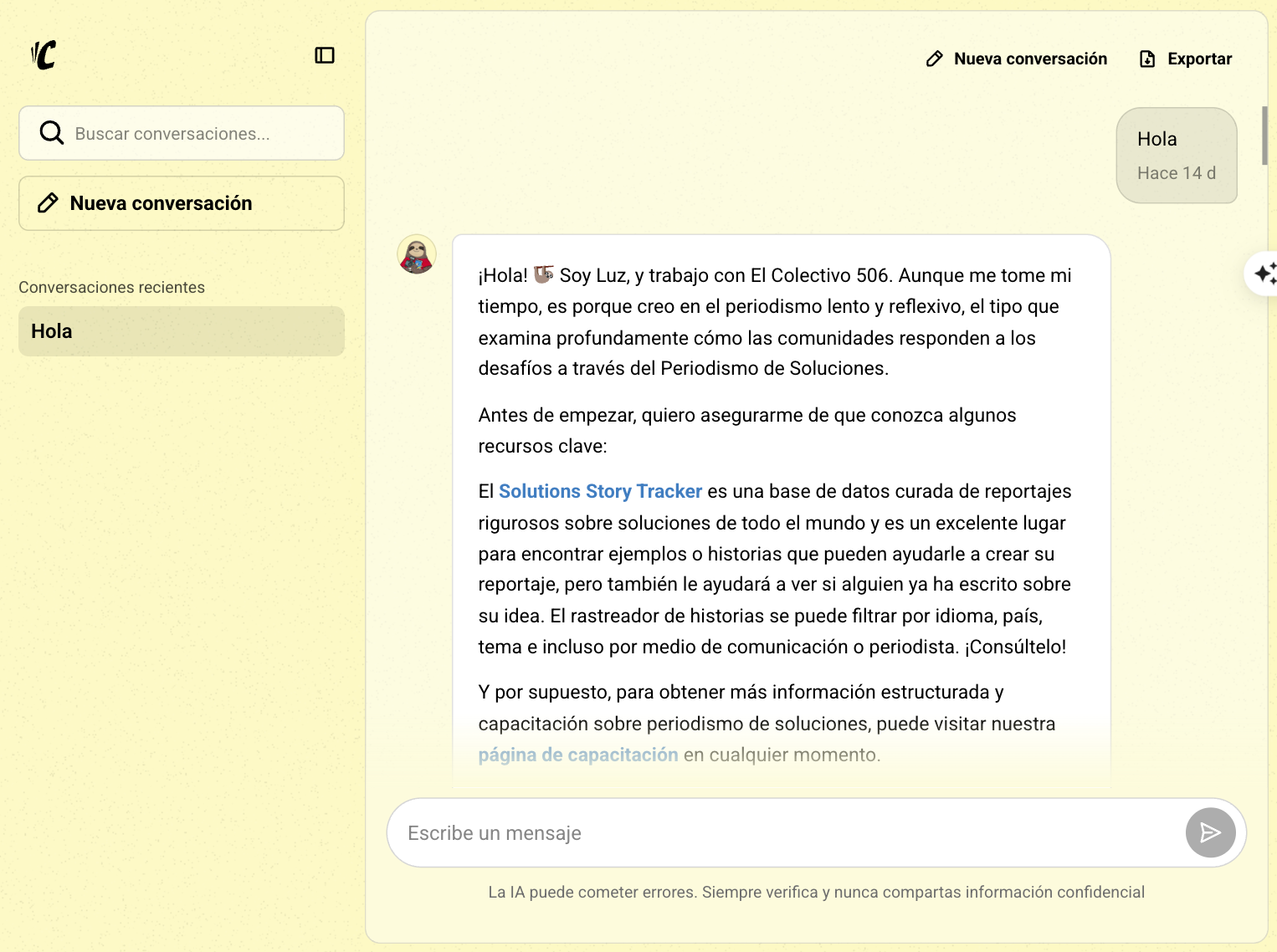
The chatbot works in English, Spanish, and Portuguese, and is free and publicly accessible. (Photo: Screenshot)
“Maybe there wouldn't be a piece of solutions journalism about a tragedy, or war, or authoritarian regime, but this practice has helped us process even those pieces of news and think of new angles that we might take, or other questions we might ask,” Stanley Obando told LatAm Journalism Review (LJR). “[Solutions journalism] can be transformative for journalists [...]. Even if a journalist does a piece of solutions journalism once a year [...] we feel that it can offer a respite and sort of a new breath.”
El Colectivo 506 defines solutions journalism as that which focuses on investigating and reporting how individuals and communities are responding effectively to their problems. According to the organization, solutions journalism offers a comprehensive view by including evidence of impact, exploring the limitations of the responses and sharing lessons that can be replicated elsewhere.
In addition to publishing in-depth solutions journalism pieces in English and Spanish, El Colectivo 506 has programs to train, support and fund Latin American journalists working on projects with this focus.
In the solutions journalism webinars it regularly offers, the organization faced a limitation. By the time participants shared their story ideas, only a few had the opportunity to receive feedback. Out of more than 100 participants, time only allowed for three or four to receive feedback, Stanley Obando said.
The editor said it is important that participants leave the webinars with well-defined proposals, as many of them are looking to apply for scholarships like the one her organization offers.
“We made this live pitch feedback session kind of the heart of the set of the session. [...] And those moments are usually really helpful because people would show misconceptions,” Stanley Obando said. “So we said, ‘Okay, we need another way to have people kind of kick the tires of their ideas for solution stories.’”
That's when she and Mónica Quesada, graphic editor and cofounder of El Colectivo 506, realized that AI could be helpful. So they included a chatbot proposal in their application for the Reynolds Journalism Institute’s scholarship program. And although they weren't selected, the institute showed interest in the tool and offered support for its development.
Through the institute, Stanley Obando and Quesada contacted Refact.ai, the AI development agency that ultimately created the chatbot, with support from the Solutions Journalism Network (SJN).
The result was a chatbot capable of helping journalists develop pitches in Spanish, English or Portuguese for potential solutions journalism stories to propose to editors or apply for grants, Stanley Obando said. It was also designed to support professors and trainers of solutions journalism who want to help their students deepen their understanding of the methodology of this type of journalism.
Luz's mascot is a sloth —an emblematic animal of Costa Rica— alluding to the deliberate and thoughtful nature of solutions journalism. The chatbot was launched on Jan. 8, 2026, and publicly presented in a videoconference on Feb. 4.
The cofounders of El Colectivo 506 invited experts in solutions journalism to test the tool.
One was Argentine journalist Carolina Gil Posse, who is part of SJN's network of trainers in solutions journalism in Latin America. Gil Posse put herself in the shoes of a reporter who seeks to turn an idea for a solution to a problem into a news article.

Luz's mascot is a sloth, alluding to the deliberate and reflective nature of solutions journalism. (Photo: El Colectivo 506)
“I tested her with a very vague idea about a topic I know in depth and have quite a bit of information about,” Gil Posse told LJR. “The idea was to test the interaction with Luz, see what she would offer me and how she would lead me to refine the idea a bit.”
Gil Posse, who also trains Latin American journalists in climate crisis coverage with a health focus for the international organization Health Care Without Harm, asked Luz for possible solutions journalism stories about how the health sector as a whole contributes to climate change.
After Luz suggested narrowing the topic to something more specific and asked questions to refine the initial idea, the chatbot offered some examples of topics that could be used to tell the story, without mentioning specific cases to investigate. The tool also directed the journalist to sources that might be useful for developing her story.
“In that ‘pivoting’ process with the tool, the journalist can emerge stronger, and the idea can emerge stronger,” Gil Posse said. “Luz is a great ally because she’s the person with whom you can discuss an idea and begin to shape it, work on it and find out what the weak points are or what other aspects you should think about a little more in order to make a good pitch.”
Gil Posse also highlighted the warmth and kindness with which Luz communicates ideas.
Luz was created using technology from OpenAI, the AI research company that developed the GPT family of models: large language models trained on massive volumes of text to understand and generate natural language. This technology is the foundation of generative AI tools like ChatGPT.
The chatbot was configured using a custom set of instructions — known as a “system prompt” — developed by Refact.ai specifically for solutions journalism, Stanley Obando said.
These instructions incorporated SJN’s solutions journalism methodology, including the four pillars that guide this approach: response, insight, evidence and limitations.
A compilation of the main lessons learned from El Colectivo 506 was also integrated, along with other resources from the SJN and transcripts of interactions with journalists, in order to guide the bot on how to structure its responses.
Stanley Obando said that Luz was also trained to direct users to the SJN's Story Tracker, a database with more than 17,000 solutions journalism articles.
“If I start brainstorming with the chatbot and I'm saying ‘there's polarization in this country, but I don't see a solution and I don't know of any entities that are addressing it,’ she'll probably say ‘one of the things you could do is look at the Story Tracker,’” Stanley Obando said.
The journalist said that Luz was not created to build the "pitch" for the journalist, nor to be a source of data on specific stories, but to ask the necessary questions so that the journalist herself can refine her proposal.
Gil Posse said she hopes Luz will help journalists who are unfamiliar with or aren’t specialized in solutions journalism to use this approach and enrich coverage in all types of news media with new angles.

El Colectivo 506 is a bilingual digital magazine specializing in solutions journalism, based in Costa Rica. (Photo: Colectivo 506)
“[Luz could] fill an information gap by helping to tell another part of the story that we don't usually see in media, which is how we are responding to social problems, which is the goal of solutions journalism,” Gil Posse said.
Stanley Obando ruled out the possibility that Luz would replace the training webinars of El Colectivo 506. On the contrary, she said the organization plans to integrate the chatbot into these sessions to strengthen feedback and brainstorming opportunities.
In 2026, they will also transform Luz's interface into a solutions journalism training unit, where training videos and toolboxes from both El Colectivo 506 and SJN will be available, she added.
“In the next few months we'll be adding videos there so that it's kind of a one-stop shop,” Stanley Obando said.
The commitment of El Colectivo 506 to the Reynolds Institute is to maintain the chatbot as publicly accessible and free for five years. The organization anticipates that the costs of maintaining Luz will be relatively low, although they understand that this commitment, beyond financial support, involves monitoring the tool's proper functioning and its continuous improvement.
“All of us working with AI, in any of the capabilities this new resource offers, are very aware that it’s like ‘having a child’: there’s a commitment to the robot’s maintenance and training that must be constant,” Quesada told LJR. “People [who have used the tool] have told us about some limitations they encountered while working with Luz. Now it’s up to us to take advantage of all that information, systematize it and share it with the programming and maintenance team to improve the chatbot.”
El Colectivo 506 hopes that in the future the tool will attract the attention of potential investors to improve it and keep it available for longer.
“We are happy to take on these efforts because they are another step in our mission as a media outlet and as a community, although of course we will strongly embrace any offer of support or collaboration to achieve Luz's mission,” Quesada said.
This article was translated with AI assistance and reviewed by Teresa Mioli


