
Eduardo Anizelli photographed the aftermath of a massive raid on more than a dozen favelas in Rio de Janeiro that left at least 122 people dead.
Eduardo Anizelli, a Brazilian photojournalist for newspaper Folha de S.Paulo, had spent the morning of Oct. 28 covering what would become the country’s deadliest police operation.
Having filed his first images of the clashes in communities that make up the Penha’s favelas, in the north zone of Rio de Janeiro, he headed to the hospital “to document the arrival of the bodies,” as he told LatAm Journalism Review (LJR).
A report by Folha de S.Paulo, published in the early afternoon of Oct. 28, had already tallied the deaths of more than 60 people. But a tip at the hospital would lead Anizelli to the rest of the story.
“I started talking to some mothers there, and they told me that there were bodies – which hadn’t been reported on – in a wooded area,” Anizelli said.
Back at the area, the photojournalist and some other colleagues attempted to make their way to the supposed spot where the bodies were, but police prevented them from advancing.
“The police stopped us by firing three shots into the air,” he said. “They wouldn’t let us pass.”
The operation ended that evening after 17 hours of chaos involving shootouts, injured bystanders, barricades erected by criminal groups and the killings of at least 122 people.
Otavio Valle, photo editor at Folha, told LJR that one of the paper’s legendary drivers, Orlando de Souza, eventually helped Anizelli confirm the existence of the bodies in an isolated area of the complex.
At 5:30 a.m. on Oct.29, Anizelli went to the square where the bodies were being taken. With the help of the community, he managed to climb up to the wooded area, where he documented dozens of bodies being recovered by family members.
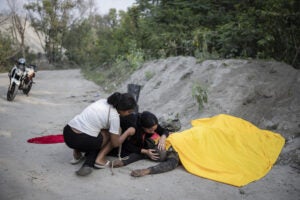
Woman after finding her husband among the dead. Eduardo Anizelli /Folhapress
Back at St. Lucas Square, Anizelli decided to use a tool he rarely employed when covering operations: a drone. Both police and organized crime see it as a security threat.
“We needed to take a drone shot—straight down, at ninety degrees—to show how many people were lying there,” he said.
The resulting photo shows a row of corpses lined up in the center of a narrow street, most with their torsos exposed, some covered with bloodied cloths. Onlookers flank the row bodies.
It was published on the cover of the Oct. 30 issue of Folha de S.Paulo.
“When you have worked in photo editing for many years, you can immediately recognize which image encapsulates the story,” Valle said. “As soon as the drone photos arrived, I opened them in our image management software in the larger view and thought: this is a World Press Photo.”
Indeed, Anizelli’s coverage of “Operation Containment” was recognized by the World Press Photo Foundation in its 2026 Photo Contest as part of the South America – Stories category.
The jury said Anizelli’s photo series, “Those who carry the dead,” provides essential documentation of a major breaking news event, conveying the magnitude of the incident —including what unfolded over two days in the city and the favelas— as well as its impact on the community.
Eduardo Anizelli. Portrait credit: Bárbara Campos
“The work stands as a powerful record, emphasizing the importance of bearing witness to ensure that such events are not forgotten nor repeated,” the jury said.
Valle said he, Anizelli and the Folha team were very careful during the editing process, given that part of the raw footage showed mutilated bodies.
“Our intention was merely to show the scale of the operation—which would be the most violent in the country—but not to offend or disturb family members, friends and readers with graphic images,” he said.
The Penha and Alemão favelas, which are home to about 110,000 people and are a stronghold for the international criminal organization known as the Red Command, were raided by 2,500 civil and military officers. Officials said it was an operation to execute 100 arrest warrants.
The raid was hailed a success by officials with the state of Rio de Janeiro, but was called a massacre by critics, including President Luiz Inacio Lula da Silva.
None of the names of those killed were featured on the 100 arrest warrants, as reported by news outlet The Guardian. Five of the 122 fatalities were police.


