
Pablo Piovano, in an independent project, documented the impact of agrochemicals on children and workers in rural Argentina.
The first time photographer Pablo Piovano began documenting the reported effects of agrochemicals in Argentina was in 2014. At the time, he was working as a photojournalist for the media outlet Página 12 and had gone to cover a conference led by the Network of Physicians in Fumigated Towns. The organization was one of the few voices speaking out against — though with little impact — the effects of chemical fumigation on children and communities under their care.
At the congress, Piovano listened to a rural teacher recount how the school where she worked was fumigated and how the children suffered both physically and emotionally.
“What she said was so compelling that I wanted to go see her in Entre Ríos,” Piovano told LatAm Journalism Review (LJR).
The first trip he took was to a location 249 miles from his home in Buenos Aires—specifically, to the home of Fabián Tomasi. Tomasi is regarded—not only in Argentina but worldwide—as one of the foremost activists against the use of agrochemicals. In 2005, Tomasi worked for an aerial fumigation company, opening containers of chemicals and mixing them with water to supply the aircraft tasked with spraying the soybean fields. He was diagnosed with severe toxic polyneuropathy, a condition that ultimately took his life in 2018.
“Fabián gave his life, his body—a body deeply ravaged; his appearance recalled Nazi concentration camps,” Piovano said. “And in a way, the Argentine fields are extermination camps, with their massive use of chemicals.”
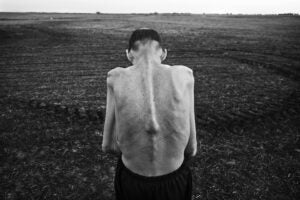
Pictured here in Entre Ríos, Argentina, Fabián Tomasi was "a global symbol of the fight against agrochemicals," as reported by photojournalist Pablo Piovano. (Photo: Pablo Piovano)
Using his own resources and driving his own car, Piovano spent his month-long vacation traveling at least 932 miles through various towns, where he encountered “a very grim reality.” Piovano was deeply shaken by the bedridden children and the many cases of cancer affecting both children and adults. Everyone he spoke with, he said, agreed on one thing: they were located right next to agricultural fields.
This marked the beginning of a journey spanning nearly ten years —Piovano returned to the site for the last time just last year— during which hundreds of families opened their doors to him so that he could photograph those who said they were directly affected by chemicals used to spray the fields; work that, this year, earned him a World Press Photo award in the Long-Term Projects category for South America.
“What happens with these stories in which pain appears — which is not our pain, but the pain of another [...] — is that, over time, there is a learning process for walking along a very fine line, where it is necessary to have a certain composure [...] so as not to break. But, at the same time, it is necessary to have sensitivity in order to tell with dignity everything that is shown to us,” Piovano said. “The most private parts of a person are being opened to us.”
Images as symbols of resistance
Argentina's agricultural production underwent a transformation in 1996, when the country approved its first transgenic crop: soybeans resistant to the herbicide glyphosate. The approval process in Congress has long been marred by allegations of irregularities—such as the fact that the debate took place in the early hours of the morning, or that documents submitted in English by interested companies, such as Nidera and Monsanto, asserted that glyphosate was harmless, Piovano said. In 2015, the International Agency for Research on Cancer, which is part of the World Health Organization, classified glyphosate as “probably carcinogenic to humans.” The herbicide has even been banned or restricted in some places; however, it is approved for use in many countries. Yet, it is just one agrochemical under scrutiny around the world.
By 2022, Argentina led the world in the use of agrochemicals. According to figures from Argentina’s National Institute of Agricultural Technology —published by Sudestada— 580 million liters of agrochemicals were dumped annually across the country’s territories and populations. This means that nearly 13 liters of agrochemicals are applied per inhabitant each year.
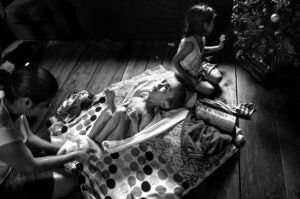
Photojournalist Pablo Piovano documents Argentine mother Cándida Rodríguez with her son, Fabián Piris, who has hydrocephalus. While she was pregnant, Cándida handled agrochemicals on tobacco plantations, a practice linked to elevated rates of birth defects. Piovano reported that along National Route 14, communities surrounded by intensive agricultural spraying recorded more than 1,200 cases of birth defects. (Photo: Pablo Piovano)
When he returned to Buenos Aires after that first trip, Piovano found very little space in media to publish his photographs—and, more generally, to report the effects that agrochemicals were having on people.
In 2014, the topic could not be found in many media outlets. The images Piovano had taken weighed heavily on him. So, in order to get them published, he sought an initial grant that enabled him to return to the countryside. He then secured an invitation to a festival in Italy to showcase his photos.
From that point on —and now as a freelancer— Piovano has dedicated himself to the subject. For just over seven years, he’s traveled constantly along the famous Route 14, which stretches from Buenos Aires all the way to Misiones, nearly reaching the border with Brazil. He has received various accolades—such as those from the Philip Jones Griffiths Foundation and the Manuel Rivera Ortiz Foundation—which, in turn, have sustained this work. In 2017, he published the book “El costo humano de los agrotóxicos” (The human cost of agrotoxins) and has held various exhibitions in countries such as Argentina and Mexico.
He said tracking agrochemicals has always gone hand in hand with other disciplines—such as science and, of course, medical professionals, who “had to take on the role of whistleblowers before journalists did.” However, he clarifies that he was not the first to cover this issue, as many colleagues have been tracking it for years.
The power of bearing witness
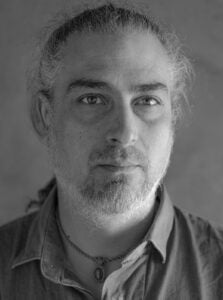
World Press Photo recognized Argentine photographer Pablo Piovano for his work documenting effects of agrochemicals. (Photo: Sebastian Belaustegui)
The change, Piovano said, lies in the fact that there is now more space for media—he himself has published in outlets such as Rolling Stone—and that the subject is at least being discussed.
“I cannot unsee that,” said Kira Pollack, global jury chair of World Press Photo, regarding Piovano’s story. “It has such a strong signature it’s the kind of thing that inspires you to want to make pictures.”
Piovano—who has been working in parallel on other projects driven by his video production company, Lawen—says he believes his work should be available to anyone who needs it. In particular, he strives for it to be useful. In fact, whenever he begins a new project, he asks himself what contribution it can make.
“Because, in a sense, we chronicle an era and a specific stage in the life of a region. In this instance, we speak of the Argentine countryside—a place steeped in history—which is currently undergoing a transformation in its productive model that has shifted many things, not least the health of its people,” he said.
He highly values the recent World Press Photo recognition—having already won one in 2024 for his work with Mapuche Indigenous peoples—regarding it as the professional recognition that it is.
Nevertheless, the greatest value lies in the communities themselves appropriating his work – for example, when he sees his photographs featured on banners at protests, and even inside Congress during votes on the issue.
“When an image can become a symbol of resistance, or help awaken awareness, for me, that is a sign of victory,” Piovano said.
This article was translated with AI assistance and reviewed by Teresa Mioli


