
In an information ecosystem where misinformation circulates faster than fact-checkers can respond, increasingly precise and efficient tools are needed to verify content, detect hoaxes and understand how false narratives spread.
The following list brings together five tools that media outlets and fact-checking organizations use for tasks ranging from tracking disinformation and analyzing its dissemination patterns, to recovering deleted content and analyzing audiovisual material.
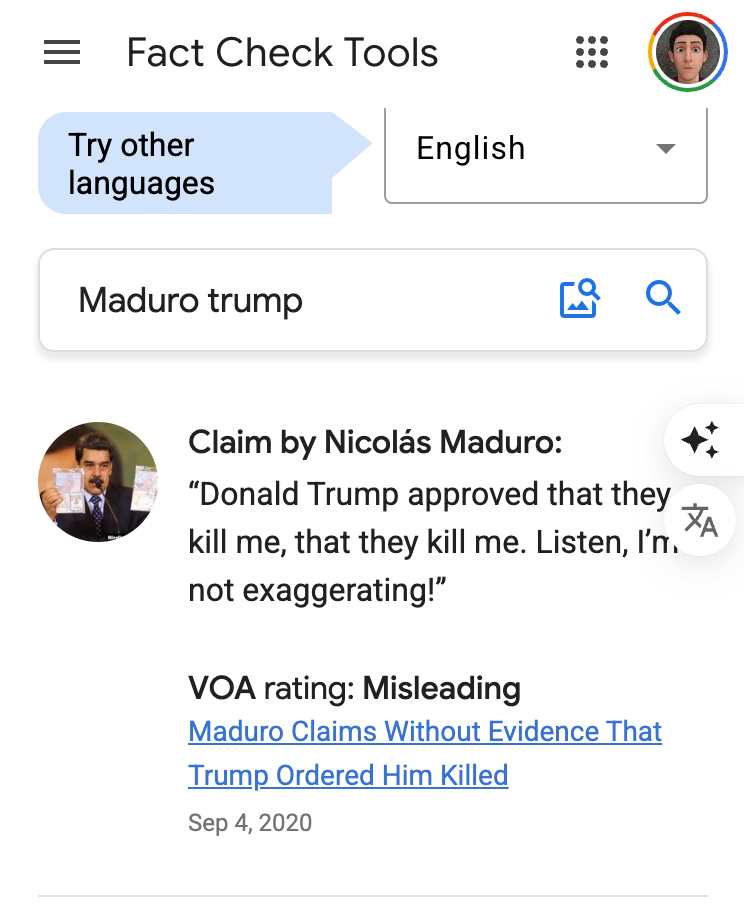
Fact Check Explorer allows users to insert a phrase, piece of data or a link to check if someone has already verified it. (Photo: Screenshot)
Google has developed an ecosystem of fact-checking tools, some for fact-checkers specifically and others for the general public. The flagship tool is Fact Check Explorer, a specialized search engine that compiles claim reviews from multiple fact-checking organizations worldwide, including Chequeado (Argentina), Bolivia Verifica (Bolivia), El Sabueso (Mexico) and Cotejo.info (Venezuela).
Fact Check Explorer allows any user to insert a phrase, piece of data or a link to check if someone has already verified it, and with what rating (“true”, “false”, or “misleading”).
The Fact Check Markup Tool allows you to add a structured data "tag" to fact-checking articles so that search engines like Google can easily recognize them. This way, when someone searches for related information, Google displays these articles as verified results and prioritizes them to offer greater transparency to users.
Media outlets interested in using the Fact Check Markup Tool must verify their website on the Google Search Console platform. In addition, Google also offers APIs (application programming interfaces) for media developers to integrate verification functionalities into their own platforms.
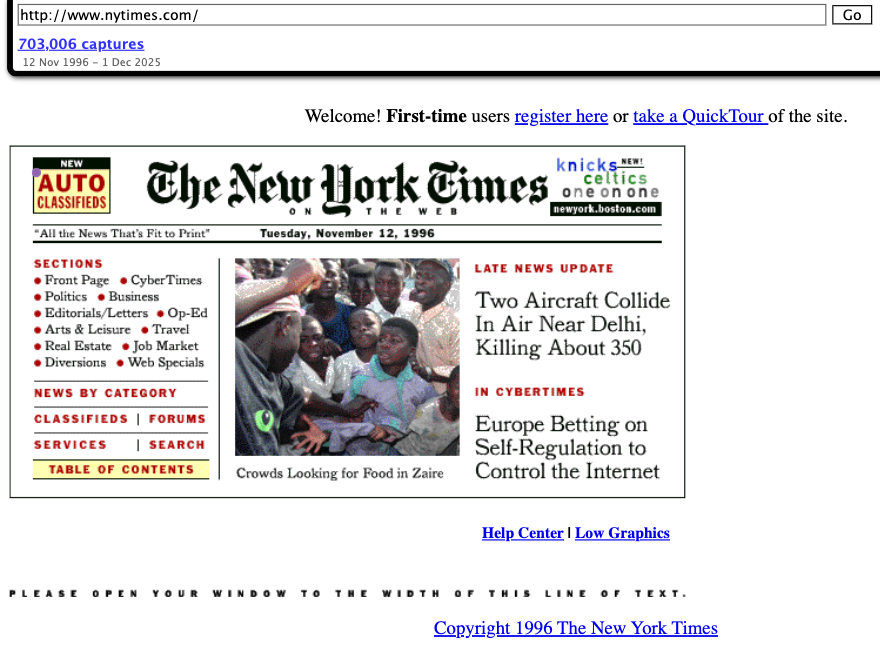
The Wayback Machine allows users to browse archived versions of millions of web pages. (Photo: Screenshot of Archive.org)
Archive.org is a non-profit digital library that collects and preserves copies of websites, software and other digital resources. Its best-known feature, the Wayback Machine, allows users to browse archived versions of millions of web pages. It is free to access and functions as a permanent history of the internet.
This platform, created by Brewster Kahle, an engineer and pioneer in developing technologies to preserve and democratize access to information, allows journalists and fact-checkers to consult past versions of web pages, even when the content has been modified or deleted. This is extremely helpful for identifying suspicious changes, verifying the original context of a publication, or tracking the evolution of a misleading narrative.
In the task of verifying deep fakes, Archive.org helps to compare manipulated material and verify if viral content already existed in another context or time, thanks to its massive collection of videos, images and digitized files.
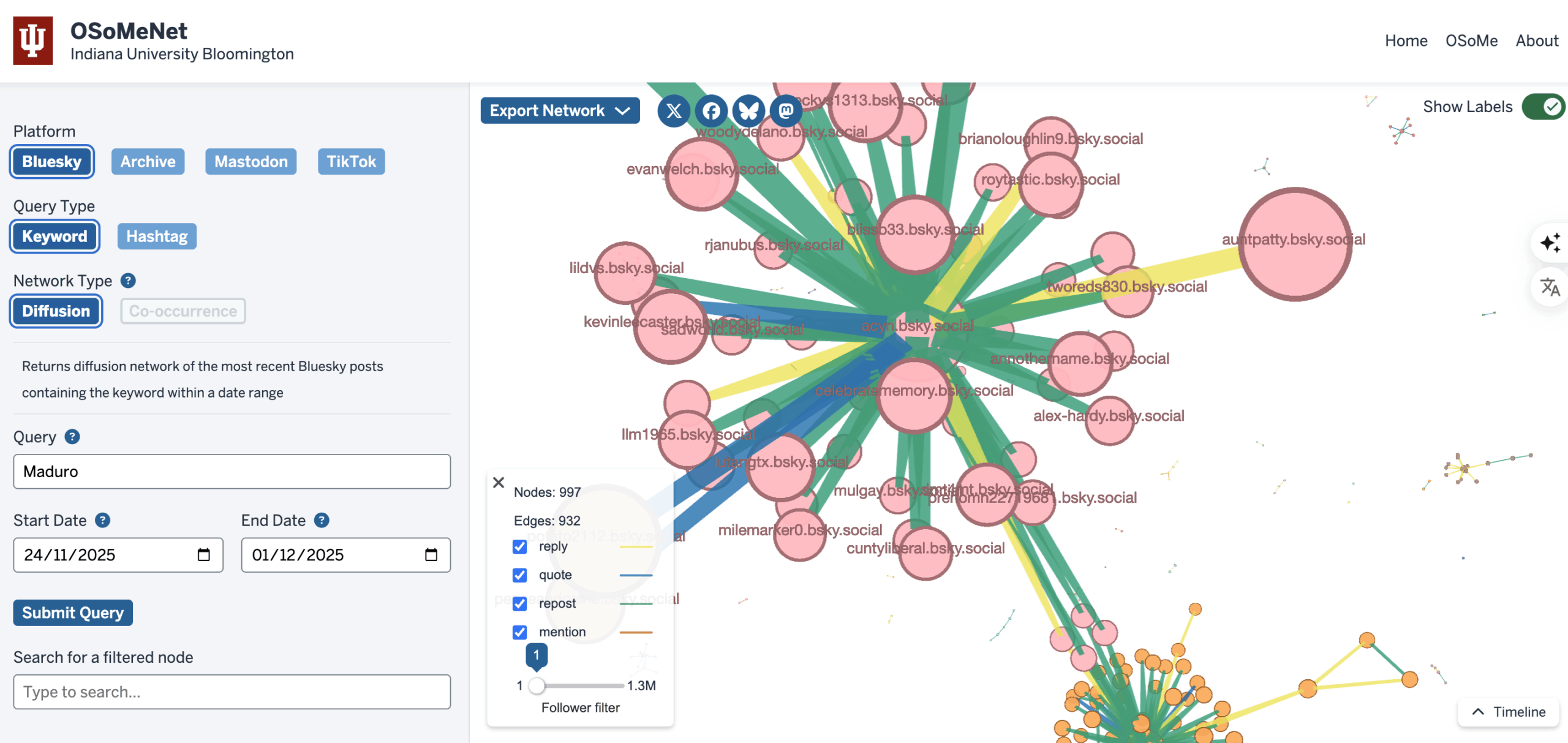
OSoMeNet helps users examine how certain narratives are disseminated online. (Photo: Screenshot of osome.iu.edu)
OSoMeNet is a tool that helps visualize content diffusion patterns on social media platforms such as Bluesky, Mastodon and TikTok. It consists of a map showing diffusion networks (how a unit of information flows from user to user) and co-occurrence networks (which topics or hashtags are related to each other in online discussions).
The tool was developed by the Observatory on Social Media (OSoMe) at Indiana University, the same academic team that created Hoaxy, the predecessor tool of OSoMeNet that also permitted the calculation of a bot score that measured the likely level of automation in the dissemination of content on Twitter.
Hoaxy, which was used by newsrooms around the world to produce landmark reports, was discontinued in part because it relied on the free API of Twitter (now X), which was subsequently disabled. However, many of its features were integrated into OSoMeNet, said Ben Serrette, director of IT and engineering at OSoMe.
“OSoMeNet allows users, including journalists, to examine how certain narratives are disseminated online,” Serrette told LatAm Journalism Review (LJR). “For example, researchers can more easily identify which influential accounts are amplifying a topic, see if there is any kind of coordinated effort, or even discover other related topics they may not have been aware of.”
In the fight against false or misleading information, OSoMeNet allows tracking of how a fake news story is shared and who is mostly spreading it, facilitating the identification of disinformation campaigns.
It also includes a timeline feature that displays posting activity over time, allowing you to see how an online narrative evolves.
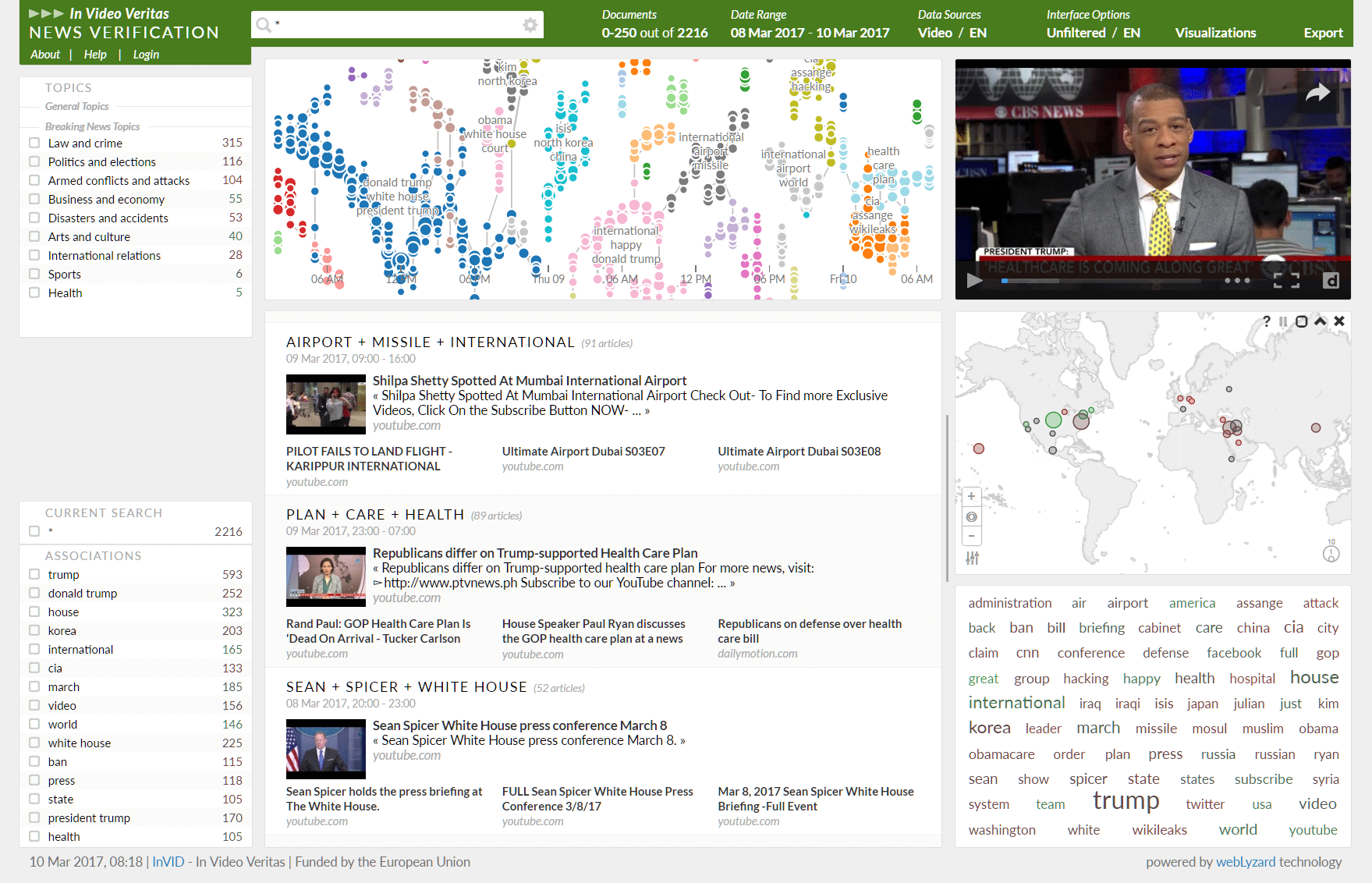
InVid includes a set of tools that allow users to obtain contextual information from videos on Facebook, X and YouTube (Photo: Screenshot)
InVID is a platform designed to detect, authenticate and verify the reliability and accuracy of video content shared on social media. It was developed by a multidisciplinary consortium that included academics, technologists and European journalistic organizations such as Agence France-Presse (AFP) and Deutsche Welle, as part of the Horizon vera.ai project, which aims to use AI to combat disinformation.
It includes a set of tools that allow users to obtain contextual information from videos on Facebook, X and YouTube, perform reverse searches, and fragment clips from these platforms – as well as from Instagram and Daily Motion – into keyframes.
They also allow users to read metadata from videos and images, and even check the copyright of audiovisual content. InVID also includes forensic analysis capabilities for images suspected of having been manipulated.
The platform consists of several applications, but the most notable is the browser extension, which allows users to integrate the tool's functionalities directly into their workflow. The extension is free and open-source, and it works in Chrome and Firefox.
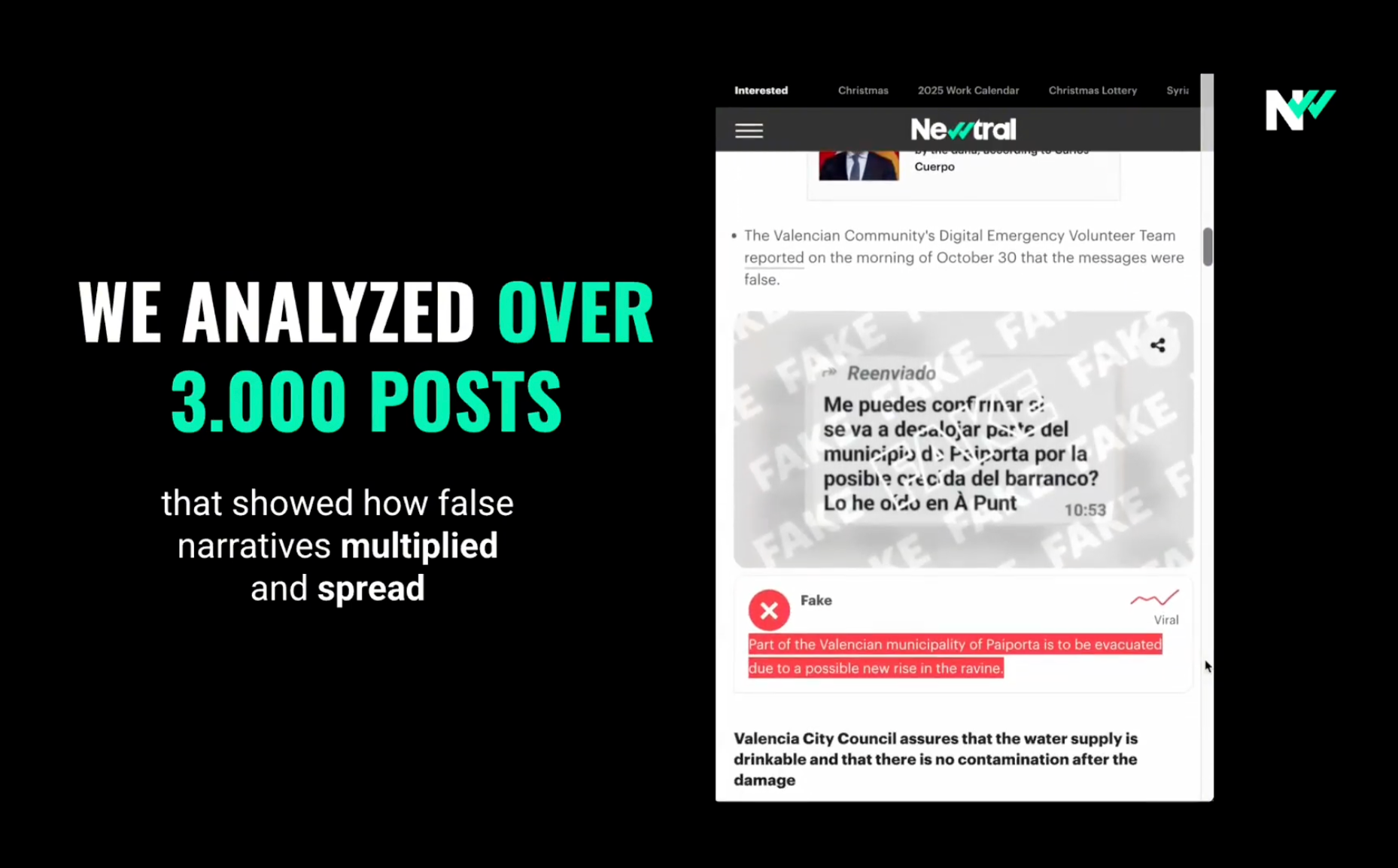
FactFlow uses AI to detect patterns of misinformation in text, audio, video and images on Telegram. (Photo: Screenshot)
When severe storms and flooding struck several cities in Spain in 2024, false narratives about the supposed consequences of the disaster spread rapidly on social media. The speed of the misinformation outpaced the ability of fact-checkers to respond, jeopardizing the trust and safety of residents, according to Sara Estevez, a prompts engineer at the journalism and technology organization Newtral.
To better respond to situations like that, Newtral created FactFlow, a tool that uses AI to detect patterns of misinformation in text, audio, video and images on Telegram, one of the most used social networks in Spain for the dissemination of potentially dangerous viral content.
During FactFlow's presentation at the 2025 Global Summit on Disinformation in September, Estevez said the tool has reduced to seconds the time fact-checkers spend monitoring potential viral disinformation on Telegram. Furthermore, users have been able to identify disinformation channels they hadn't previously detected, she added.
The tool, developed as part of JournalismAI's 2024 Innovation Challenge, also offers useful functionalities for investigative journalists in tasks such as obtaining information on disinformation actors and networks through a control panel that allows for specific searches, filtering of results and monitoring of disinformation trends.
The tool uses the open-source artificial intelligence model Qwen, which was trained on more than 1 million messages collected by Newtral fact-checkers from more than 2,000 suspicious accounts and channels on Telegram, Estevez said.
For now, FactFlow is only available to academics and fact-checkers at Newtral, but the organization plans to scale its use to other newsrooms in the near future, as well as integrate it with other platforms, such as TikTok and X, Diana Cid, Newtral's project coordinator, told LJR. Interested newsrooms can send an email to proyectos@newtral.es.
This article was translated with the assistance of AI and reviewed by Teresa Mioli


