
When U.N. Secretary-General António Guterres held his only interview just before the UN climate summit, or COP30, in Belém, Brazil, he stressed the role of native communities in protecting nature and fighting climate change.
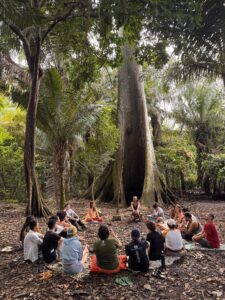
Sumaúma is a trilingual journalism project founded in 2022 that reports from and about the Amazon. (Photo: Courtesy Soll/Sumaúma)
“The voice of Indigenous communities is an essential component of COP,” Guterres said, “and should inspire the measures that are indispensable if we want to avoid a climate catastrophe.”
Wajã Xipai, 19, is one of those voices and an author of the interview with Guterres. He’s part of a new generation of storytellers training with the Amazon-focused outlet Sumaúma to combine western journalism ethics with Indigenous narrative traditions to rewrite the story of the rainforest.
He told LatAm Journalism Review (LJR) that he was lost thinking about what to ask. What could he, a teenage Indigenous journalist, ask such an influential figure?
Then it hit him: the questions should come from within, an Indigenous person from the Xipaia people, born and raised in a village in the Amazon forest.
That perspective led Wajã, alongside Jon Watts, a veteran environmental reporter for The Guardian and co-founder of Sumaúma, into the interview with Guterres.
Xipai’s first question came from the perspective that Indigenous people from the Amazon are paying the price for “global greed,” while at the same time, the region was hosting its first COP.
Xipai asked Guterres how he would persuade leaders at the summit in the city of Belém to address the imbalance in which communities that protect the rainforest suffer violence and death, while distant countries benefit from the destruction of their territories?
According to the UN, this was the secretary-general’s first-ever exclusive interview with an Indigenous journalist from the Amazon.
"There is a big difference between the way I ask, the way I talk to people, and the questions I asked Guterres, and those asked by any other white journalist that comes from centers of power and the centers of money, like the United States or London,” Xipai later told LJR. “It would be completely different.”
Watts was pleasantly surprised with the questions and the results of the interview.
“He [Guterres] was being addressed with questions that I imagine he's never previously had to consider,” Watts told LJR. They were “questions that get to the fundamentals of why the world is the way it is and how it could be different.”
This interview and coverage of the COP30 comes at the three-year anniversary of Sumaúma, a trilingual journalism project founded by five journalists – three Brazilian, one British and one Peruvian.
Sumaúma’s journalists have aimed to amplify the voices of the Amazon region and “Amazonize” the world, especially since the Amazon has been, for decades, a tough place for local voices to emerge with truly local stories that avoid cliches and stereotypes.
Sumaúma co-founder Eliane Brum told LJR in 2022 that one of their focuses was to develop a co-training program where journalists from legacy media could teach their practices and collaborate with people from the rainforest to combine it with Indigenous ways of telling their stories.
“We want to create another type of journalism,” she told LJR. “And these people that will train us and that we will also train will make up the newsroom.”
That core idea was the basis for the program Mycelium, in which Xipai is one of 23 “forest journalists” to have participated since 2023. The first group included 14 people from the Xingu basin, and a second group in 2025 included 9 from the entire Amazonian basin, which covers 8 states, 1.93 million square miles, three biomes and more than half of the Indigenous people in Brazil.
Xipai quickly enrolled after he first started in media projects related to documentaries at the Sakamena Network of the Xipai Youth. He said he rapidly understood that the co-training was for real: the mentors from legacy media outlets were open to exchange with the trainees and vice-versa.
Tiago Rogero, a Brazil correspondent for The Guardian, participated. He had created the massively popular Querino Project, a series of podcasts and feature stories that offer an Afro-centric look at Brazil’s history. He called Mycelium a “revolutionary idea,” especially considering that Brazilian journalism is mostly done by white, sometimes wealthy, people from the Southeast.
“Mixing the responsibility of quality journalism with their unique perspectives is groundbreaking,” Rogero told LJR. “I know it’s cliche when someone comes back from an experience like that saying they learned more than they taught. But I feel that's how it was.”
One of Xipai’s core insights is that he learned the technical aspects of journalism at Mycelium and now as a reporter at Sumaúma, but that since an early age, he was already experienced in storytelling from his village elders. He said he feels he can intertwine one form of storytelling with the other and that he doesn’t have to choose only one.
“Should I do journalism the way I think it should be done, as I learned from the elders of my people, or should I simply try to do this kind of journalism, which is bureaucratic journalism, in another language (a non-Indigenous language)? I remember being very confused about this,” he said. “During the process, I came to understand that it's not possible, there's no way I can abandon the way I tell the story to adopt the way non-Indigenous people tell stories”.
For Xipai, the story that best demonstrates his worldview is “For the Moth and I, mere survival is not enough.” Combining reporting and personal storytelling, he recalls how he moved to Altamira, the city in the middle of the forest that “persecutes trees,” and identifies with a moth through a completely different worldview that puts all beings on the same level.
“This is really beautiful,” Watts said. “It's constantly surprising the kind of stories they come up with and their willingness to mix different kinds of media, different ways of storytelling.”
Multimedia artist Soll also trained with the Mycelium program, though he never before imagined being a journalist. Born and raised in Altamira beside the trans-Amazonian highway, he discovered himself as an artist through a collective of marginalized poets and through sheer experimentation with visual arts.
"My entire trajectory is present in the work I developed during Mycelium and later, as a reporter for Sumaúma,” he told LJR. “The program gave me the tools to dissolve the boundaries between the art I like to do and journalism”.
His piece ‘Heaven, hell and the burning threat to Quilombola rituals’ combines photos, video and text into a canvas with multiple layers to describe how drought, heat and storms caused by global warming and the destruction of nature have disrupted the ‘half-moon’ religious traditions in communities in the Lower Amazon region.
“I always let myself be guided by what I hear. I really like the theme of memory, and the words I hear drive my stories,” Soll said. “I always start from the idea that the people who will help me tell the story will be that community, those people I listened to, their memories, their ways of describing their world.”
For Watts, the western journalism tradition dictates that the reporter needs to focus on facts without being imaginative. Creativity was almost a bad word, he said.
“You need to find the facts, but when it comes to telling the story in a persuasive way, it's kind of useful to think outside the box in how you present information, how you present the facts,” he said. “And I love the way the Mycelium program hasn't really been tied down by western journalistic conventions. So they're kind of free to experiment and to break boundaries and to cross over from one genre to another.”


