
Dalila Rodríguez feels afraid every time she leaves her university, located in the State of Mexico, late in the evening and starts walking back home to Mexico City. When she first arrived from her hometown of Saltillo, in the north of the country, a professor warned her to be careful: the area where the university is located was especially unsafe for women.
In 2015, the State of Mexico became the first entity in the country to activate the Alert of Gender Violence against Women (AVGM, for its Spanish acronym), an emergency mechanism established by the Mexican government in regions with high rates of serious crimes against women and where local authorities cannot guarantee adequate protection. The alert requires the implementation of urgent measures, such as special police operations, surveillance in public spaces, and the establishment of victim support units, among others.
However, Rodríguez says that on her way to the Metro station, she never saw the purple patrol cars for the special police unit created as a result of the AVGM. Her fear led her to investigate how the State of Mexico was using the budget allocated for the protection of women. She discovered a pattern of opacity that makes it impossible to know clearly where the money ends up and hinders verification of the real impact of the alert.

Dalila Rodríguez and Kineret Rivera took part in Data Talents with a report on the funds allocated to protecting women in the State of Mexico. (Photo: Courtesy Factual/Distintas Latitudes)
Rodríguez and her colleague Kineret Rivera published the report “Ten years after the AVGM in the State of Mexico, violence skyrockets, transparency vanishes and the budget plunges into darkness.” The reporting project was part of their participation in Data Talents, a data-based journalism lab for young people held this year under the auspices of the organizations Factual-Distintas Latitudes, SocialTIC and Escuela de Datos.
As part of this initiative, a group of journalists under 25 learned to investigate and tell data-driven stories even when public information is incomplete or inaccessible, and to fill those gaps with qualitative information in a way that allows them to explore previously invisible phenomena. All of this took place in a country where the federal system guaranteeing transparency was dismantled this year.
In March, Data Talents invited 99 young people to receive basic training in data journalism, data visualization and digital security. The participants proposed 27 data-driven reporting projects on climate change, migration and gender. Three of these were selected to receive financial support and mentorship in editorial production and data management.
“While data journalism has gained traction among Latin American journalists, there remains a need to train young journalists in data management and in a vision of how data can serve journalism,” Juan Manuel Casanueva, director of SocialTIC, told LatAm Journalism Review (LJR). “We know that communication and journalism programs don’t include a data component, or if they do, it’s only addressed in a workshop or by a single professor.”
He added that this training element is still lacking in Mexican universities, even though data journalism has been around in Mexico for at least 10 or 15 years.
The three selected teams developed their respective reports over four months, which were published in September on the Distintas Latitudes website.
The Data Talents participants had to navigate challenges in accessing public information on their respective topics, whether due to cumbersome processes or the non-existence of the data, Casanueva said.
Part of the program's mentoring focused on teaching them how to fill those gaps in public information with data from other sources and how to tell stories based precisely on information that does not exist or cannot be accessed.
“Making sense of the pieces of publicly available official information is the most complex thing,” Casanueva said. “When there is no [public information], you have to ask the uncomfortable questions: ‘Why is this information not available when there are perceptions, when there are testimonials, when there are demands regarding this or that problem?’”
The authors of the report on gender violence made multiple requests for access to public information right at the time when the National Institute for Access to Information (INAI), the autonomous body in charge of guaranteeing and protecting the right of access to public information in Mexico, was dismantled after a controversial constitutional reform.
Its functions, including the administration of the National Transparency Platform, the digital system that allowed relatively easy access to public information, were assumed by an agency of the Executive Branch. This change has led to complications for journalists and citizens who want to access government data.
“The first difficulty we faced was this whole mess surrounding the Transparency Law reform, and we no longer had our main source [of public data],” Rodríguez told LJR. “I went to look at the National Transparency Platform, and with the new agency, a lot of data disappeared.”
Participants of the Data Talents program learned that identifying sources in public institutions, specialists in their subject matter, and victims or protagonists of the story, and reporting directly with them, are ways to overcome the lack of public data, Casanueva said. Although the data from these sources may not be structured, it can also help fill those gaps, he added.
“That challenge is part of journalism, they have to face it,” Casanueva said. “[The teams] had to complement the qualitative with the quantitative and vice versa.”
Rodríguez said that, to fill in the missing information, she and her co-author gathered data from websites of institutions such as the Women's Secretariat and managed to interview the congresswoman who chairs the Gender Violence Alert Declarations Committee in the Congress of the State of Mexico.
They also used a digital platform developed and managed by Rivera since the pandemic, called Mapa Fuimos Todas (We Were All Map), which collects and maps reports of harassment and bullying of women in public spaces in the country.
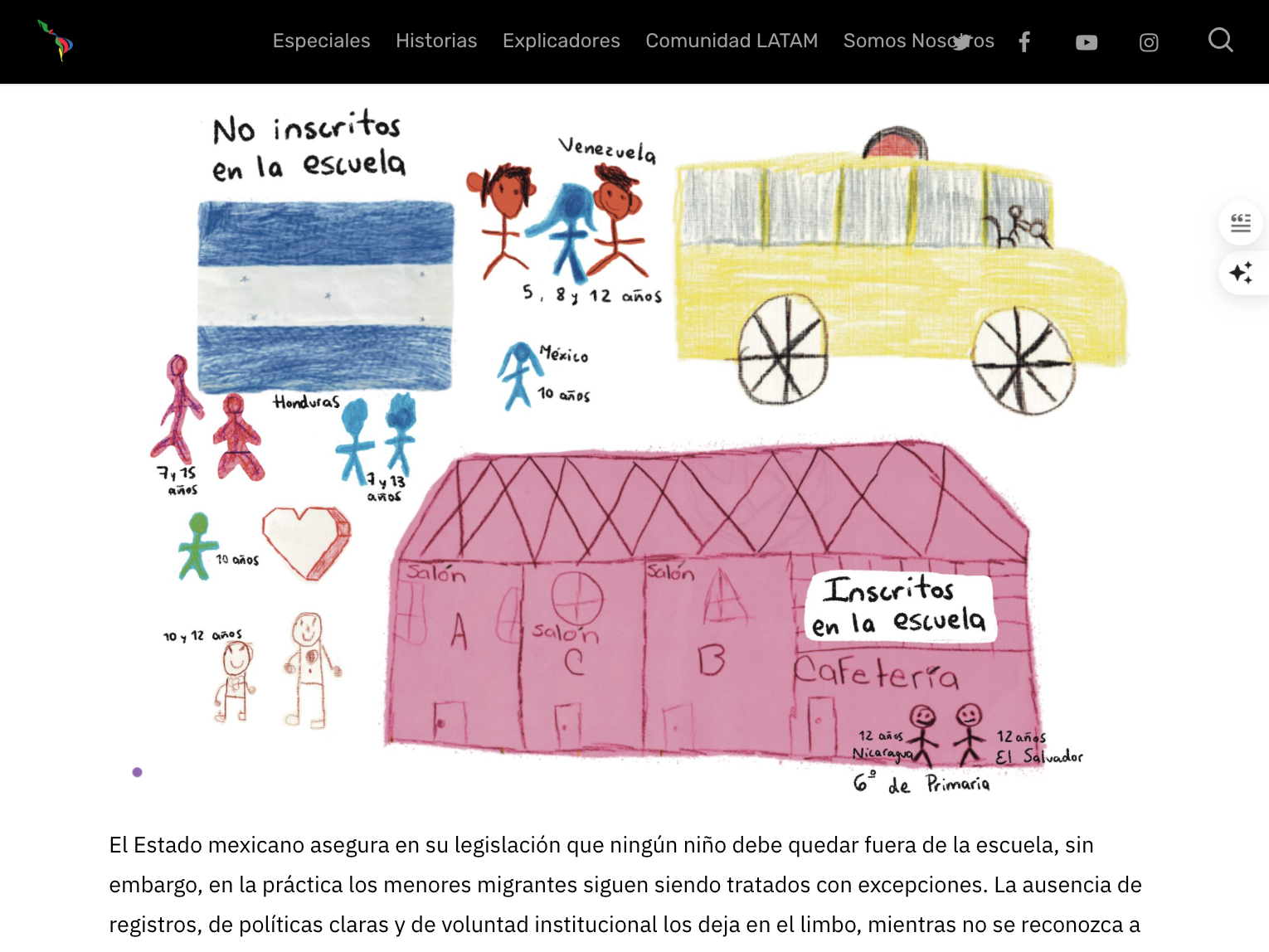
The authors of the Data Talents report “Migrating Also Means Leaving School” asked migrant children to draw how they felt at school in Mexico. (Photo: Screenshot of Distintas Latitudes' website)
With that, the team was able to report that, despite the fact that millions of dollars have been allocated to improve the safety of women in the State of Mexico since 2015, the impact has been minimal: femicides have increased and the funds intended to protect women are diverted to low-impact projects or cannot be traced.
“Ultimately, the goal from the beginning is to adapt to what you find and, based on that, think about the product,” Javier Roque, editor of Distintas Latitudes who helped the teams in the editing process, told LJR. “With that information, you have to be as concise as possible and see what can be clearly concluded and what cannot, and make that very clear in the investigation.”
Data gathered from direct sources or testimonials is often not statistically representative or descriptive of the phenomenon being investigated, Casanueva said. However, it does provide valuable evidence for the story, he added.
Another report published as part of Data Talents was “A way of telling the sea,” by Bruno Cruz, which addressed the impact of global warming and human practices on the Mesoamerican Reef System, which extends from Quintana Roo, in Mexico, to Honduras.
Cruz complemented hard data on the deterioration of the reef with testimonials from fishermen who have seen for decades how this marine ecosystem has deteriorated and how this has impacted their lives.
“The fact that there is no official data on a phenomenon doesn't mean it doesn't exist. That's where you come in, by going to do the reporting with people who are actually experiencing that situation,” Casanueva said. “Official, national fishing data, which is handled at the port level and in general volumes, won't give you the level of detail that fishermen's testimonies can.”
During his studies in Environmental Science, Cruz specialized in the marine ecosystem of his native Quintana Roo, which led him to become familiar with reliable data sources on the subject. During his research for the Data Talents project, he found that data from Mexican government institutions regarding the reef are insufficient.
Fortunately, much of the information he needed was found in academic literature and public databases of international organizations such as the NOAA Coral Reef Watch in the United States, he said.
“There is some [public] data, but the existing data really leaves much to be desired,” Cruz told LJR. “There are government and autonomous institutions that monitor the reefs, but they are quite limited due to a lack of resources.”
The third report from Data Talents, “Migrating also means leaving school,” is about the educational lag faced by hundreds of migrant children due to bureaucracy and legal gaps in the state of Jalisco. This project faced the greatest difficulties in finding public data, Casanueva said.
The underage migrant population in Mexico is practically invisible in statistics from the country's migration and education systems, Casanueva said. Therefore, the authors of the report, Yoseline Delgadillo, Sara Ezzy and Diego Aguirre, had to give greater weight to the testimonies of the children themselves and of specialists, he added.
The team visited educational institutions and shelters to learn about life there and even asked children to express through drawings how they felt at school.
“There is no survey of how migrant children experience school in Mexico, but at least we can report on it and ask them to ‘draw me how you feel here,’” Casanueva said.
The Data Talents training also included a visualization component, in which participants learned how to use tools to create graphics. They also learned how to better explain things with graphics and where they should be placed in the narrative flow of a report, Casanueva added.
Conducting journalistic investigations that combine the rigor of data with the power of voices and testimonies of affected people is more necessary than ever in Mexico, now that the solid transparency system no longer exists, the Data Talents participants agreed.

A graduate in Environmental Science, Bruno Cruz wrote a data-based story about the deterioration of the coral reef in his hometown, Cancún. (Photo: Courtesy Factual/Distintas Latitudes)
The initiative opens a space for young journalists who do not yet have positions in formal media to train in data journalism and share their stories, Roque said.
The resulting reports have left their creators with positive feelings. The authors of the story on gender violence, for example, said that the congresswoman they interviewed asked them to share their findings to strengthen an audit being conducted on the use of resources allocated to improve women's safety in the State of Mexico.
Casanueva said the participating organizations intend to hold Data Talents again next year, but they need to secure the necessary resources. He also said the three winning research projects employed methodologies that could be applied in other Mexican states, and even in other regions of the continent.
“All three projects have the potential to be replicated and to delve deeper into these phenomena,” Casanueva said. “In these areas, there is a lack of information, both due to availability and a lack of transparency, which generates more suspicion than certainty.”
This article was translated with the assistance of AI and reviewed by Teresa Mioli


