
Journalist associations and human rights groups in Brazil are criticizing President Luiz Inácio Lula da Silva’s decision to appoint a controversial television host and politician to host two news programs on the federal government’s public broadcasting networks.
Lula tapped José Luiz Datena — a veteran broadcaster and former São Paulo mayoral candidate — to host a weekly interview show on TV Brasil and a daily morning program on Rádio Nacional, both part of the federal media conglomerate Empresa Brasil de Comunicação, or EBC.
Datena, known for his larger-than-life persona, gained notoriety during a televised debate in 2024, when he slammed a metal chair against a rival mayoral candidate who referenced accusations of sexual misconduct against Datena. He has also long drawn criticism for what many see as the sensational tone of Brasil Urgente, the news program he helmed on the channel Band São Paulo until 2024.
Lula announced his appointment of Datena on Nov. 2 from his offices in the Palácio do Planalto in Brasília, according to Folha de São Paulo. “The two have been friends for decades,” Folha reported.
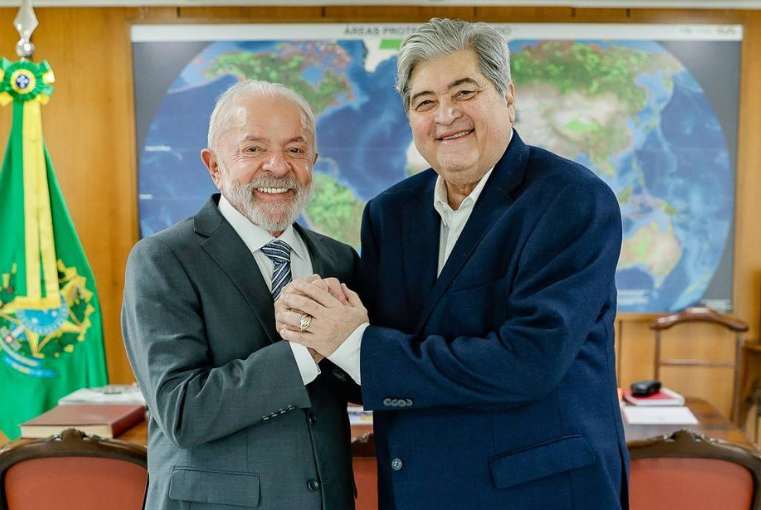
Brazilian President Luiz Inácio Lula da Silva invited controversial television host and politician José Luiz Datena to host two news programs on the federal government’s public broadcasting networks. (Photo: Presidência do Brasil)
The decision has prompted unusually sharp pushback. Pedro Rafael Vilela, president of the EBC Editorial and Programming Committee and the Brasília union president, told LatAm Journalism Review (LJR) that Datena is the antithesis of what public broadcasters should be programming.
His appointment, Vilela said, “revealed illegal and undue interference by the federal government's top brass in the programming of public broadcasters.”
“The combination of all this,” he added, “marks a humiliating episode for the Brazilian public communication project.”
Human rights groups were also vocal in their criticism. The National Council of Human Rights said that Datena represents a prime example of sensationalism, directly contributing in “associating violence with racial and socioeconomic stereotypes, and directly or indirectly violating the dignity of large segments of the Brazilian population, including the poor, women, LGBTQIAPBN+ individuals, Black people, those living in favelas and marginalized communities.”
Eugenio Bucci, former president of Radiobras, which became incorporated into the EBC, does not dismiss the criticisms, but said that the discussion has to be deepened.
“If he is hired for his communication skills on the broader theme of public safety and changes his style, then you might have something potentially interesting,” Bucci, a professor at the Advanced Studies Institute at the University of São Paulo, told LJR.
Other academics, however, disagree. Akemi Nitahara, an EBC employee and herself a doctoral student at Fluminense Federal University, told LJR that for such a hiring to work, it would require “a complete change of [his] profile, which would not make sense for someone with such a reputation and a distinct professional brand.”
Asked by LJR about the growing uproar, Datena said he’s committed to being an independent voice, and that he has already lost jobs because of it.
“I have always defended what is constitutional (the people) and have always been against extremes of any kind”, he told LJR. “I have never bowed down to a boss. My boss is the people. I have the right to work wherever I want if I am invited. I never wanted to be unanimously accepted, not even Christ was.”
Even researchers that do not study communication or journalism like Bruno Paes Manso, a researcher on violence at University of São Paulo, had views on the impact of such a figure.
Manso assessed Datena historically represents a school of sensationalist police journalism that orbits around the issue of fear, good and evil binaries and sometimes celebrates police violence.
“This style has been criticized for a long time within the journalistic debate on urban violence and public security,” Manso said, explaining that this also represents a striking contrast with the current government’s overall positions that, in theory, would view those issues under a different light.
Datena started his career in police journalism, emerging in popularity during the 80s and 90s.
In 2013, as host of Brasil Urgente, Datena was heavily criticized for showing images of victims on the floor of a nightclub that caught fire and compared the scene to Nazi gas chambers.
The history of sensationalism on Brazilian TV was covered in a 2024 book about the host Jacinto Figueira Júnior, known as the Man with the White Shoes, who gained ratings over decades of mixing facts with hoaxes. His work led to the likes of Datena, according to author Mauricio Stycer.
"A very clear characteristic of these programs is to try to stoke fear, a feeling that stimulates the audience," Stycer told LJR last year. "They also don't always try to follow basic journalism rules, such as showing all sides, not making unfounded accusations, not forcing people to give interviews, nor sticking the microphone in the face of someone who has just been arrested."


