
This year started on a tragic note for journalists in Latin America and the Caribbean. By the end of January, five journalists had already been killed in the region. Regrettably, it was a harbinger of things to come.
As 2025 draws to a close, records show the murders of at least 17 journalists, raising red flags for press advocates.
This represents more than a quarter (26.87%) of murders of journalists killed around the world for practicing their profession, according to the annual report from Reporters Without Borders (RSF, for its initials in French).
“Latin America once again plays a sadly prominent role,” Artur Romeu, director of the Latin America office for Reporters Without Borders, told LatAm Journalism Review (LJR).
Most killings in the region took place in Mexico, the second most dangerous country for journalists in the world, behind only Gaza, RSF reported.
Nine journalists were murdered in Mexico in 2025.
“This is particularly sad considering that it is the first term of President Claudia Sheinbaum, who made important commitments to strengthen protection policies,” Romeu said.
In addition to the alarming figures in Mexico, which Romeu said surpass "any conceivable benchmark in terms of violence against the profession," the region as a whole is raising red flags.
One of RSF's findings is the involvement of organized crime and groups responsible for creating vast areas of silence in places where journalists investigate crime and the relationship between political power and criminal groups, as is often the case in Mexico.
In other countries in the region, Romeu said, it’s possible to see the same modus operandi: journalists from small media outlets or who publish on their own Facebook pages, who are hyper-local and lack the institutional support of a large newsroom, are "particularly exposed" and are often murdered by hitmen.
This can be seen in Ecuador, home to a growing security crisis and the murders of two journalists this year. It’s also happening in Peru, a country that had no record of journalists killed since 2016, and before that, during the internal armed conflict in the 1990s.
“There have already been three [murders] so far this year in Peru, and this is something absolutely unprecedented for the country,” said Romeu, who explained that the report only includes two killings because the third crime occurred after the report was finalized. Additionally, in Peru, on Dec. 13, journalist Mitzar Castillejos survived an assassination attempt.
Colombia and Honduras, with the murders of one journalist in each country, also share this modus operandi, Romeu said. This is very different from what is happening in Palestine, "the scene of a war, which is a very different context," Romeu added.
“The organization is drawing attention to this pattern of direct involvement of organized crime as controllers of areas and regions of the country where they impose their own laws of silence,” Romeu said. “They send signals by murdering journalists, signals that indicate the topics that cannot be discussed, the code of silence regarding the operation of their groups, and their often close relationships with public officials.”
The Committee to Protect Journalists (CPJ) also recorded an increase in the murders of journalists in the region, Cristina Zahar, CPJ's Latin America coordinator, told LJR. Although its official report will be released at the beginning of next year, by mid-December, CPJ had recorded 12 killings of journalists in the region, compared to 7 in 2024. This represented a 71% increase, Zahar said.
“The increase in the number of journalists murdered in Latin America in 2025, compared to 2024, is alarming. Even though only two cases are clearly linked to journalistic work, according to our data, the fact that it is so easy to kill journalists in the region is worrying,” Zahar said. “Impunity undoubtedly contributes to this terrible situation.”
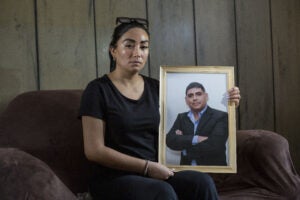
Nelly Caico, widow of Peruvian journalist Gastón Medina. (Photo: César Zamalloa/Hildebrandt en sus trece)
The two cases "confirmed" by CPJ were the murders of Gastón Medina (in Peru) and Salvadoran journalist Javier Hércules (which occurred in Honduras).
It’s important to note that criteria for recording the murder of a journalist differs from one organization to another. For that reason, counts may vary.
Press advocates are also noting a deterioration of freedom of expression as a whole in the region. According to a new report from UNESCO, freedom of expression there declined by 6.86% from 2012 to 2024. The sharpest deteriorations, it noted, were in media self-censorship, restrictions on media outlets and academic and cultural freedom.
“These trends signal not only increasing pressures on journalists and independent media, but also a weakening of institutional environments that traditionally foster debate and pluralism,” the report said.
One cross-cutting element that RSF highlights in its annual report, Romeu explained, is that hatred and impunity are "driving forces that legitimize violence" against press professionals worldwide.
“Criticism of the media is healthy, but hatred fuels violence,” Romeu said. “And it is necessary that as a society we understand the reasons why journalists are murdered: they are murdered because they are inconvenient for those who benefit from silence.”
In the region, Romeu cited various leaders as examples. Javier Milei in Argentina has said that "the problem" is that journalists are not hated enough; while in Nicaragua and Venezuela, Daniel Ortega and Nicolás Maduro, respectively, usually label journalists as "traitors to the homeland" or "sellouts."
“This type of rhetoric creates permanent hostility towards the press, and that hatred has clear political motivations,” Romeu said. “It paves the way for more disinformation, propaganda and less public scrutiny of those in power.”
Below, LJR presents the names of journalists killed in 2025 as reported by UNESCO, RSF, CPJ, the Inter-American Commission on Human Rights' Special Rapporteur for Freedom of Expression, and local organizations. It is not clear in all cases whether the crime was related to their work as journalist
Jan. 17: Jesús Guerrero Calletano (Mexico)
Jan. 19: Diomedes Farid Manrique (Colombia)
Jan. 20: Gastón Medina (Peru)
Jan. 24: Óscar Gómez Agudelo (Colombia)
Jan. 24: Alejandro Gallegos (Mexico)
Feb. 20: Jesús Alberto Camacho Rodríguez (Mexico)
March 2: Kristian Zavala (Mexico)
March 4: Patricio Aguilar (Ecuador)
March 14: Raúl Irán Villarreal Belmont (Mexico)
March 21: Ismael Alonzo González (Guatemala)
May 7: Raúl Celis López (Perú)
May 15: José Carlos González Herrera (Mexico)
May 27: Luís Augusto Carneiro da Costa (Brasil)
June 1: Javier Hércules (Honduras)
June 1: Carlos Gilberto Aguirre (Honduras)
June 23: Salomón Ordóñez Miranda (Mexico)
July 7: Ángel Sevilla (Mexico)
July 7: Melvin García (Mexico)
July 9: Ronald Paz Pedro (Mexico)
Aug. 21: Xavier Ramos (Ecuador)
Oct. 25: Miguel Ángel Beltrán (Mexico)
Oct. 28: Fernando Álvarez Vera (Ecuador)
Nov. 26: Darwin Baque (Ecuador)
Dec. 5: Fernando Núñez (Peru)
Dec. 16: Jorge Agustín Zapeta Aguilar (Guatemala)
This article was translated with the assistance of AI and reviewed by Teresa Mioli. It's been updated to correct the date of death for Miguel Ángel Beltran.


