
A group of digital media outlets in Mexico are joining forces to combat stigmatizing narratives and insecurity faced by the press in that country, as well as to promote the sustainability of local journalism.
Territorial is the name of the alliance formed by 17 independent media outlets located in 12 states across the country. Throughout this year, the group plans to launch a series of initiatives to raise awareness among audiences about the importance of local journalism in Mexico, a country whose government has implemented a policy of discrediting, attacking and intimidating the press.
“This particular regime considers the media its enemies. [Former President] López Obrador, more so than [current President Claudia] Sheinbaum, always tended to generalize. That ultimately erodes public perception and creates a [stigmatizing] narrative,” journalist Mely Arellano, vice president of the Territorial’s board, told LatAm Journalism Review (LJR). “What we want to do is reconnect with our communities and remind them that the work we do is fundamentally for their benefit, so they have the information they need to make informed decisions.”
Abrimos hilo| ¡LES TENEMOS NOTICIAS! @TerritorialADM lanza un programa por YouTube y un podcast para contar el país desde los estados pic.twitter.com/r2cu8FTVJV
— Territorial Alianza de Medios (@TerritorialADM) January 20, 2026
Arellano is co-director of the news site Lado B (from the state of Puebla), one of the media outlets that make up the alliance along with Istmo Press, El Muro, and Página 3 (from Oaxaca); Chiapas Paralelo (from Chiapas); Amapola (from Guerrero); La Marea (from Veracruz); Zona Docs, Letra Fría, and Perimetral (from Jalisco); Revista Espejo (from Sinaloa); PopLab (from Guanajuato); Raíchali and La Verdad Juárez (from Chihuahua); Elefante Blanco (from Tamaulipas); Pie de Página (from Mexico City); and Escenario Tlaxcala (from Tlaxcala).
Territorial is the evolution of the media alliance formed in 2018 by the organization Periodistas de a Pie, which was founded in 2007 to improve the quality of journalism in the country. While the Periodistas de a Pie media alliance successfully promoted various projects together, the organization was primarily focused on supporting and training journalists, whereas Territorial's objectives are centered on established media outlets, explained Rocío Gallegos, director of La Verdad de Juárez and president of Territorial’s board.
In late January, the alliance plans to launch an awareness campaign about the importance of local journalism in order to reposition the name of each media outlet in their respective states and thus recover the social capital of their audiences, Arellano said.
The goal of the campaign, which will be titled "Estamos Aquí” (We Are Here), is also to remind people what it means to be an independent media outlet in the current context of Mexico’s states, the challenges they face, and their role within the national media ecosystem, Gallegos said.
“We want to tell our audiences that we are here, that even though major media outlets may be closing down their bureaus [in the states] and eliminating coverage of what's happening in our states, we are here and we will continue doing our job,” Gallegos told LJR. “We want to highlight the importance of this type of journalism, our local journalism, which has even won awards.”
To achieve this, Gallegos added, it is necessary to help people recognize which media outlets they can trust, given the proliferation of media and social media pages of dubious credibility that abound in Mexico’s interior.
These pages, she said, contribute to spreading misinformation within communities. Therefore, Territorial's campaign will include media literacy elements.
“One thing that's very important to us in this campaign is explaining to people which media outlets they can trust. We want them to pay attention to whether the outlet has a directory, who is writing the articles,” Gallegos said. “In the face of this wave of misinformation, the campaign will try to explain to them how the media ecosystem works, our role, the role of the audience, and the issue of misinformation, and how you can tell if the media outlet you're reading is trustworthy or not.”
The campaign also seeks to raise awareness about the importance of funding local journalism and to motivate people to contribute financially in recognition of the work done by reporters in the regions, Arellano said.
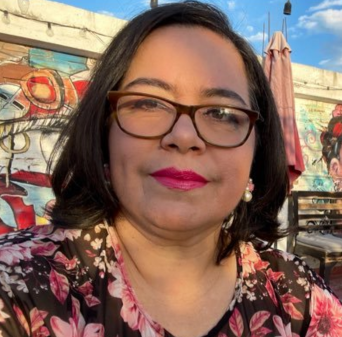
Lado B director Rocío Gallegos is the president of Territorial’s board. (Photo: Rocío Gallegos on X)
This, she added, is not only to benefit the media outlets that are part of Territorial, but also independent local journalism in general.
“We're not going to tell them to ‘donate to Territorial,’ but rather, ‘you have a local media outlet that you know, you know its journalists, it's where you get your news, it's the one you message on Facebook when something happens to ask a question, so then donate to that media outlet that you trust,’” Arellano said.
Territorial will launch a biweekly podcast in which they will discuss the stories behind the participating outlets’ journalistic work, the challenges journalists face when reporting in the states, the efforts to secure funding and the conditions under which independent media outlets operate, Gallegos said.
The podcast will be complemented by a weekly program analyzing current events, "Reporte Territorial," which will be broadcast live on YouTube, as well as a newsletter that will be sent every Friday with a curated selection of content from the media outlets that make up the alliance.
Although Territorial will be established as a civil society organization and will have the capacity to apply for funds to finance its activities, the member media outlets will retain responsibility for their own funding, Arellano said.
However, the alliance will promote the exchange of strategies and initiatives to improve the sustainability of each organization, she added.
“No one has found a magic formula [for sustainability], and neither have we, but if we work in partnership, we can start to improve even our internal processes and help each other in certain areas,” Arellano said. “There is knowledge we can share, and there are things we can do together.”
As Periodistas de a Pie did, the new alliance will also seek to provide training on this and other topics to strengthen member media outlets. Outlets also will support each other on different projects, Gallegos said.
In addition, the members of Territorial will seek to work together to address other problems that threaten journalism in Mexico. One of them, Gallegos said, is the violence created by organized crime. Several of the member media outlets are located in states heavily affected by this type of violence, such as Veracruz, Sinaloa, Chihuahua, Tamaulipas and Chiapas.
Judicial harassment, a threat against the press that has worsened in the last year in Mexico, is another factor under scrutiny by the media outlets that make up Territorial.
The organization Article 19 documented that in the first half of 2025, 51 cases of legal proceedings against journalists and media outlets were recorded in Mexico. Furthermore, in recent months, legislative initiatives have been introduced in the country, both at the national level and in some states, which, according to specialists, would have the effect of censorship.
In particular, the alliance said it was paying close attention to the accusations of gender-based political violence that some officials have used to accuse critical journalists and media outlets in the country.
Such is the case of journalists Carlos Martínez Caamal, Abraham Martínez and Hubert Carrera, who last year were forced by a court to publicly apologize to the governor of the state of Campeche, Layda Sansores, for making comments considered political gender-based violence.
Arellano said that some media outlets in the alliance have faced these types of accusations, but have chosen not to make them public until the legal proceedings are concluded.
Por si ustedes no lo saben, nosotros estamos en las comunidades de Chihuahua, Tamaulipas, Sinaloa, Guanajuato, Jalisco, Veracruz, Puebla, Tlaxcala, CDMX, Guerrero, Oaxaca y Chiapas pic.twitter.com/xDKjRekTvA
— Territorial Alianza de Medios (@TerritorialADM) January 20, 2026
“We see that it's a weapon being used in all states and at all levels, and that's an issue that also concerns us,” Arellano said. “What we're trying to do there is implement different kinds of strategies in partnership, obviously with lawyers, that allow us to develop legal strategies to file injunctions, and so on.”
The government's increasing lack of transparency is another threat that Territorial will seek to address. In the first year of Sheinbaum's presidency, the autonomous body that guaranteed access to public information was dismantled. Since then, journalists and citizens have faced difficulties in obtaining data from the government.
“Clearly, transparency is a major annoyance for the Morena regime,” Arellano said. “And we see this even in databases of all kinds, containing economic information, export data, or crime statistics, which the federal government regularly made available, and which this government simply stopped updating two or three years ago.”
To overcome these challenges as an alliance, the best strategy is to work collaboratively and amplify what's happening in each state across all member media outlets, Gallegos said. This includes simultaneously publishing certain reports and sharing information with media organizations outside the alliance.
“These are stories that have an impact here in our territories, and often, due to the sheer volume of information, they don't get covered in national media,” Gallegos said. “We ensure that what happens in our region is reported by the 17 media outlets that are located in different regions of the country.”
This article was translated with AI assistance and reviewed by Teresa Mioli


