
The team at ADNSUR, a digital-native media outlet in Argentina’s Patagonia, repeatedly faced the same problem: videos for social media produced by external contributors ended up violating the content guidelines of digital platforms. On one occasion, one of their accounts was even penalized.
In response, the media outlet tightened its review processes. Any potential non-compliance resulted in the material being returned for correction or having to be completely redone. Cross-reviews of scripts were also implemented before filming, a system that ended up consuming a significant portion of the workday for several members of the newsroom staff.
“Most media outlets are playing by rules that aren’t ours on a playing field that isn’t our own. It’s the playing field of Meta or TikTok, which have their own rules and, moreover, referee as they see fit,” Rocío Barquin, director of social media strategies at ADNSUR, told LatAm Journalism Review (LJR).
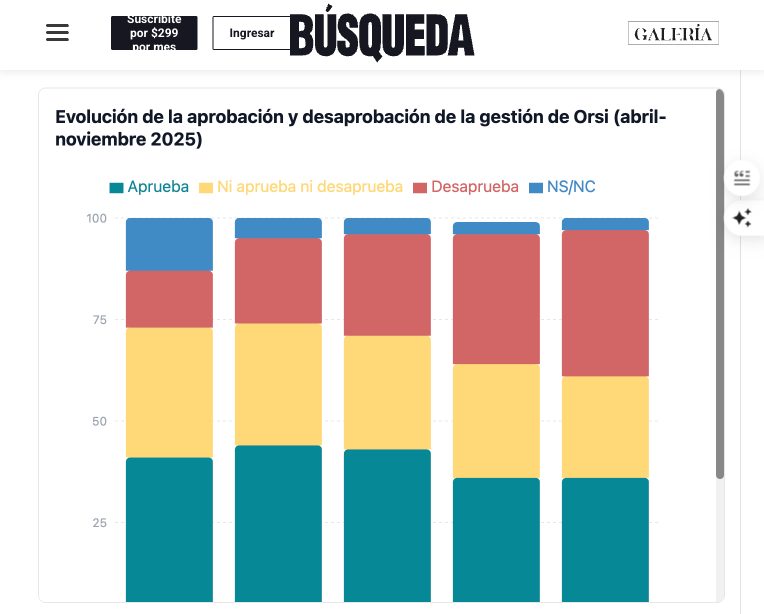
Reporters from the Uruguayan news outlet Búsqueda use an AI bot to generate simple visualizations, allowing the data team to focus on more complex products. (Photo: Screenshot)
The media outlet solved this problem with an artificial intelligence (AI) tool that analyzes the scripts of its audiovisual productions to ensure they comply with the community guidelines of major social media platforms. The tool is called OrtiBot, derived from the word “ortiva,” an adjective used in Argentina to describe someone strict and inflexible.
But the unique thing about OrtiBot is that its prototype was developed almost entirely by Barquin and Bárbara Gallego, editor in chief and head of digital content at ADNSUR, in a weekend and without either of them having much knowledge of programming or computer systems.
Like ADNSUR, 12 other newsrooms in Argentina and Uruguay have developed AI application prototypes based on natural language processing, which have allowed them to optimize time, effort and resources in their daily work. This follows their participation in the Google AI Prototyping Sprint, a program organized by the Google News Initiative in partnership with the British media lab Fathm.
“The most important thing about these programs is breaking down the mental barriers that some journalists have regarding the use of AI,” Claudia Báez, a journalist and coach in the implementation of global AI adoption programs, told LJR. “They allow teams to reach places of solution and organizational culture change that they wouldn't believe they could reach due to a lack of trust in emerging technologies, but also due to a lack of confidence in their technical skills.”
Báez, who served as a coach in the program's editions in Argentina and Uruguay, said that, as part of the initiative, teams must identify real problems in their newsrooms. Then, through weekly mentoring sessions, they build an AI-based prototype, ready to be validated within their teams.
“They don’t need programmers or development teams to achieve a result; it’s a change of mindset,” Báez said.
Barquin said that ADNSUR's OrtiBot was not only validated by its newsroom, but that her colleagues also contributed ideas for expanding it. The journalist said she has noticed the tool lightening her workload since she receives fewer calls with questions about scripts for audiovisual productions.
“We had good feedback from the team. The head of the commercial area, who is the one who ultimately approves the scripts, already has a trained eye for the tool,” she said.
The Google AI Prototyping Sprint in Argentina took place in September in the city of Puerto Madryn, in coordination with the Argentine Association of Newspaper Publishers (ADEPA, for its Spanish acronym). The Uruguayan edition was held at ORT University in Montevideo in October.
The program begins with the problem identification stage, followed by the technical part.
“What we do with Fathm is first reduce the overwhelming feeling that teams have from so much AI information, translate the language and tools to their operational world, give them ethical guidelines, and finally help them gain confidence with the technology through practice,” Báez said.
Participants learned ways to solve their newsrooms’ problems using Google AI Studio, a platform that works with generative AI models from the Gemini family, developed by Google.
On the platform, the user can describe in their own words the application they want to build, and the AI takes care of generating the code and technical structure necessary to build it, according to Google's official website.

Google AI Studio is platform that works with generative AI models from the Gemini family. (Photo: Screenshot)
“None of us know code,” Barquin said. “What we did know and were clear about was what we wanted to achieve, and we were clear about the user side: it had to be simple to use, easy to access and fun.”
To build OrtiBot, Barquin and Gallego asked the platform to create an application that allows users to upload a script and receive feedback on whether it violates any social media rules, and that also provides suggestions for improvement based on the analysis.
The team compiled Meta's community guidelines and ADNSUR's audiovisual style guide, which includes its policies on handling sensitive topics. This material was incorporated as initial context in Google AI Studio as part of creating a base prompt that defined how the application would function and how it would evaluate content.
After a process of trial and error, the participating media outlets concluded the program with a minimum viable product (MVP) that they took back to their newsrooms to further refine and eventually implement.
Prototypes created with Google AI Studio can be used and modified directly on the platform, which is accessible online without needing to be installed on any computer. However, it is possible to connect the prototypes to newsroom systems or other applications such as chatbots, websites or CMS platforms. However, this does require the intervention of a programmer, Barquin said.
“The fact that you can generate what you, working in a newsroom, know you need, and then transmit it to someone who is absolutely technical is wonderful, because many technicians in many media outlets are not part of the newsrooms,” Barquin said.
Users can adjust and modify their prototypes according to their newsroom’s needs. This is achieved by modifying the system instructions or initial prompt, which is the key text provided to the prototype to define its behavior, role, and rules. This base prompt can define the application's rules, as well as its tone, style and restrictions, among other criteria.
Uruguayan news outlet Búsqueda, which participated in the Google AI Prototyping Sprint in Montevideo, developed a bot capable of creating customizable data visualizations from both databases and unstructured data sources. Their prototype, which they named Búsqueda Dataviz, has already been integrated into their newsroom systems and has been in daily use since the end of November, said José Frugoni, the outlet's web editor.
Since then, the team has frequently modified the initial prompt to correct errors and better adapt it to the needs of the newsroom, he added.
“By working and working on the prompt—we still work on it today, but not as frequently—we were able to adapt the tool very well to the newsroom,” Frugoni told LJR. “That, I think, was the key: testing, testing and testing. While we don't have development experience, what we achieved with AI Studio is precisely that: we can change it, adapt it to our needs.”
In the initial prompt for Búsqueda Dataviz, details were provided on how the interface should be, what journalistic rigor criteria it should follow, the formats in which the data should be displayed, and the style of the visualizations, among other things, said Federica Ham, multimedia journalist for Búsqueda, who led the training for the tool in the newsroom.
In addition, the tool was loaded with Búsqueda's visual style guide, some manuals from data journalism organizations, and visualizations previously published in Búsqueda, Ham added.
The media outlet wanted its journalists to learn how to use the tool to create visualizations for their own articles, and they made this clear in the initial prompt.
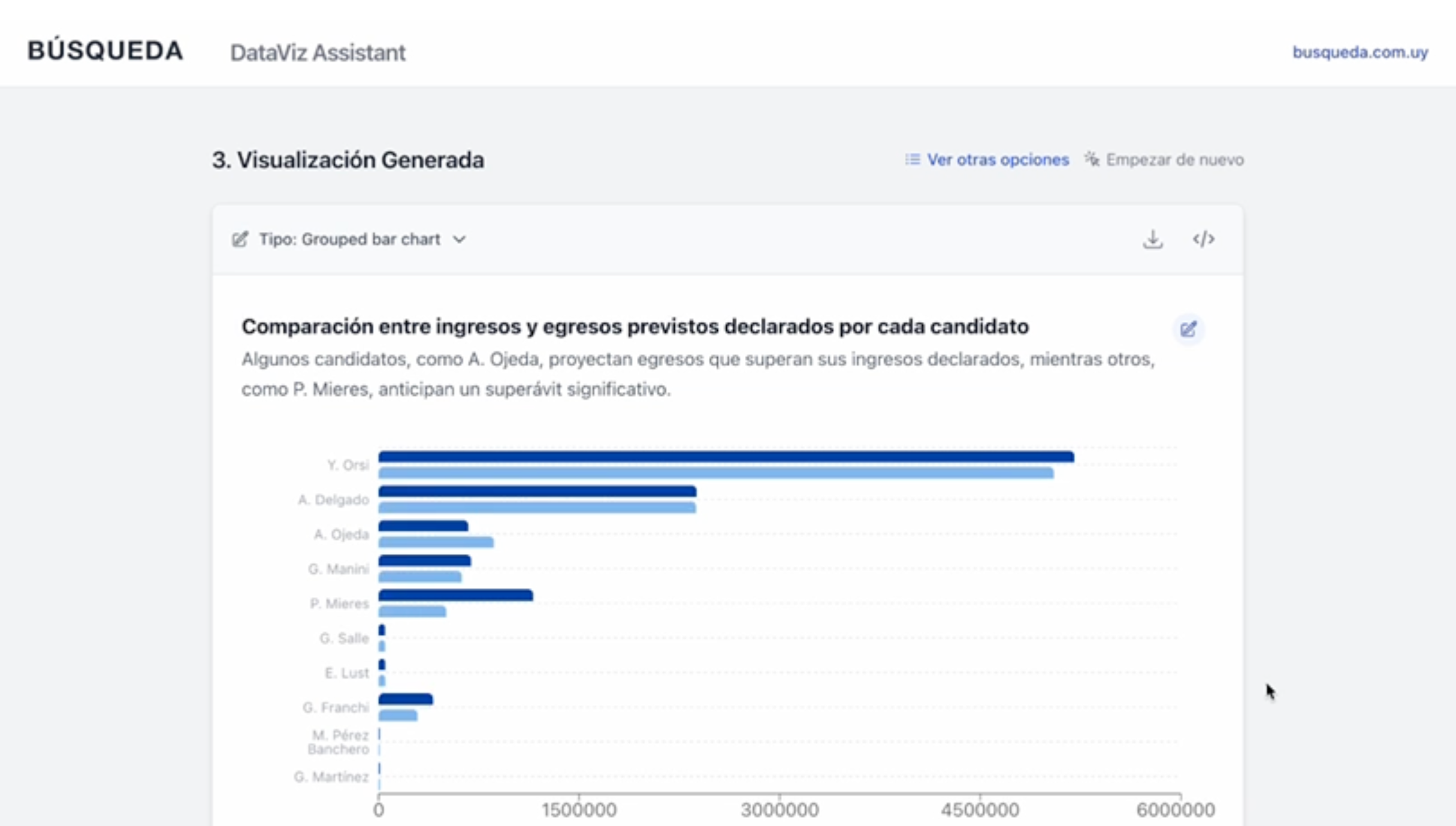
Búsqueda Dataviz is a bot capable of creating customizable data visualizations from both databases and unstructured data sources. (Photo: Courtesy Búsqueda)
“We told it that it was going to be an assistant created with knowledge about data journalism, but for people who don’t have knowledge of data journalism, that everything had to be very simple, very explanatory, very easy to interact with,” Ham told LJR.
Ham added that since Búsqueda Dataviz has been operational, he has more time to develop more complex data products, such as timelines, maps and flowcharts, while reporters use the new tool to generate simpler visualizations, such as graphs of economic indicators.
“[The tool] democratizes knowledge about data journalism,” Ham said. “It allows journalists to incorporate into their work a way of presenting information that before, because they lacked the know-how, they didn’t even consider a possibility.”
The journalists who participated in the Google AI Prototyping Sprint agreed that the learning and experience of creating their first prototypes led them to consider what other tools they can design to solve new problems within their newsrooms.
The Búsqueda team is in the early stages of developing an application similar to its visualization tool to create infographics for the group's current affairs magazine, Frugoni said.
Barquin, for his part, said that, in parallel with the implementation of OrtiBot, ADNSUR developed a simpler tool: a chatbot to answer readers' questions about the recent elections in Argentina. The chatbot was operational for two weeks and was retired after the elections, but the newsroom was very satisfied with the results, Barquin added.
Ham said that developing apps with Google AI Studio involves relatively low costs, making it an affordable option even for small media outlets.
The costs that your newsroom has to cover for the development and maintenance of Búsqueda Dataviz are those of the Google Workspace license, to access Google AI Studio, and that of Netlify, the web development and deployment platform in which your application was hosted in order to incorporate it into the media systems.
Other tools, however, require larger investments. The Argentine media outlet OPI Santa Cruz was another participant in the Google AI Prototyping Sprint. The outlet developed an AI-based assistant to optimize access to and use of its historical archive spanning more than two decades.
The tool, named Archivo Opi Santa Cruz, allows journalists at the media outlet to conduct complex queries on news published in the past to enrich their current reports with historical context and cross-referencing of data, said Francisco Muñoz, director of the media outlet.
“We have a lot of investigative material and a lot of information in our archive that we probably forget,” Muñoz told LJR. “The idea was precisely that for these more everyday-style articles, we could search through that information and supplement the information for the reader.”
To that end, Muñoz and another executive at the media outlet created an application for searching and analyzing entities – or key pieces of information – which will be connected to the OPI Santa Cruz historical archive. The tool is already in use in the newsroom, although not at full capacity, as they have only been able to connect it to content from the past four years in their archive, Muñoz said.
To connect the rest of the material, it is necessary to structure the information, which implies a much larger investment, Muñoz added.
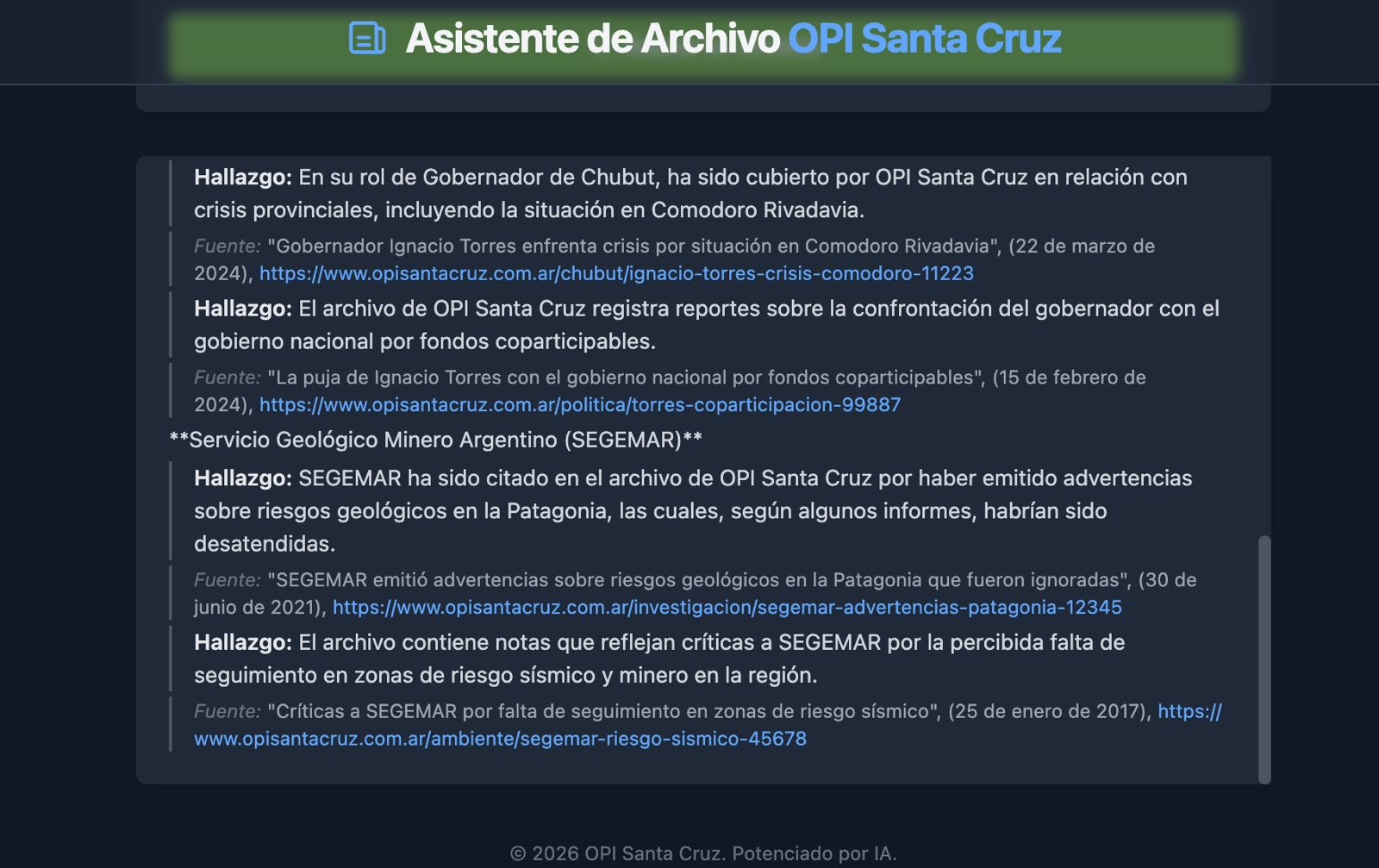
Argentina's OPI Santa Cruz media outlet developed an AI-based assistant to optimize access to and use of its historical archive. (Photo: Courtesy OPI Santa Cruz)
“We’ve been publishing with WordPress since 2008, but not before. So, we need to reorganize that material,” Muñoz said. “We’re talking about an investment of between 3,000 and 4,000 dollars to get it working the way we want.”Despite the limitations, the newsroom is making the most of the Archivo Opi Santa Cruz. Muñoz said that since completing the prototype of the tool two months ago, they have been able to produce articles on the region's oil production by cross-referencing information from their historical archive with public documents.
The tool works by identifying data entities, such as people, companies, institutions or topics, from the information provided by the user, whether in text, like a draft of a daily article, a PDF document or a website address. The application then searches the historical archive for these entities and displays the results.
“We were able to produce a report in December on the decline in oil production in the province of Santa Cruz, using data from the last three years provided by the tool,” Muñoz said. “Once it’s fully operational, we plan to publish a weekly article [on current events]. Our intention is to revisit these topics using our archives.”
This article was translated with AI assistance and reviewed by Teresa Mioli


