
“You polarized society, president.” “Here you have denigrated and stigmatized journalists.” “I would like to ask that there be no favoritism, president.”
These phrases, spoken into the microphone at presidential press conferences, have made Reyna Haydee Ramírez one of the most uncomfortable and controversial voices in Mexican journalism.
From those morning press conferences — the “mañaneras” introduced by former President Andrés Manuel López Obrador and continued by his successor, Claudia Sheinbaum — Ramírez has publicly questioned corruption, human rights violations, censorship and unequal treatment of the press. Her interventions have prompted tense responses from the country’s highest podium, direct disqualifications and digital harassment campaigns, in a context marked by the stigmatization of critical journalism in the official discourse of the self-styled Fourth Transformation, or 4T.
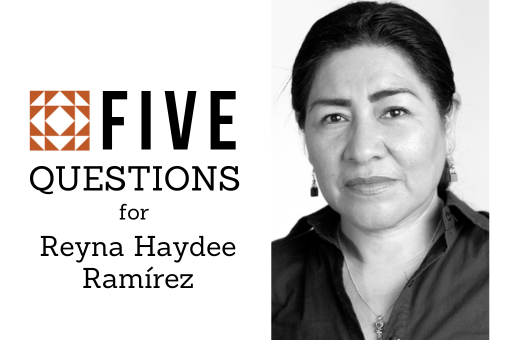
But for her, confronting power is nothing new. With more than 30 years in the profession, Reyna Haydee, as colleagues and public officials alike call her, has faced threats, slander, information black outs and forced displacement under governments of different political stripes.
She currently works independently, reporting for community radio stations and online outlets focused on human rights. In a conversation with LatAm Journalism Review (LJR), Reyna Haydee reflected on the costs of confronting power and the challenges independent journalism faces in Mexico today.
This interview has been edited for length and clarity.
Reyna Haydee Ramírez (RH): I decided to go when I saw AMLO saying, “There will be freedom of expression here, all journalists will be able to come in, there will be no censorship.” And I said, “Is that really possible?” So I went and registered as an independent journalist. My first credential — which, by the way, I lost on a plane — said “independent reporter.” I am almost 100 percent sure I was the only one who registered as an independent reporter. After that, they didn’t issue it that way anymore; they just labeled me “reporter.”
With that credential, I started going. I would stay in the back rows, watching how everything worked. When I finally felt confident, I shouted at the president, “Hey, back here! Don’t just look at the trees, look at the forest. There are reporters back here, too.” That caught his attention and he gave me the floor.
Those were the early days [of his administration], and honestly there was a lot of freedom. There were so many of us — I don’t know, about 150 inside, practically on top of each other. At that moment I don’t remember what my first question was, but it must have been something about Sonora, which is what I know best.
RH: I see the mañanera as something positive, because you can try to question the highest power in the country from there, from that podium. But the former president also implemented a formula for attacking journalists there. And it was constant: defamation, slander, finger-pointing at anyone who thought differently or did not speak in favor of his movement.
Social media was also one of the tools he used to attack journalists, through a well-structured network of people who help attack a journalist when they don’t like what that person says. Whether through bots or hired trolls.
During AMLO’s time, the mañanera wouldn’t even be over and you were already under attack. I don’t know how to explain it, but we learned to read his looks. With a signal, with a word, we knew he was saying: “People, attack her, because I don’t like what she’s saying.”
The former president had what I call a shock group — when something started to make him uncomfortable, they would activate and start shouting, “Just shut up already!” They mainly did this to women, because women were the ones who dared most to confront him.
The first major attack I received was precisely when I asked about [the strike at the state news agency] Notimex. They started attacking me viciously. It was 15 days of constant buzzing notifications [on my phone]. Very harsh things came in — threats, slander, attacks on my appearance and things like that. Over my 30-year career, I’ve experienced attacks and threats, but on social media it’s something different. It had a terrible impact on me — I couldn’t sleep, I couldn’t eat.
I told the presidential communications director that I had never received threats that direct before, and that if anything happened to me, it would be the president’s responsibility. What they did was send me to the prosecutor’s office to file a complaint. That complaint was shelved; there was never any follow-up. The cyber police never found where the threats came from.
From then on, anything I said or asked triggered constant attacks from bots and trolls.
RH: President [Sheinbaum] has a different strategy. I see that with her, almost 80 percent [of the journalists] are people aligned with the system, to have greater control over the conference. And it’s not just the media outlets and YouTubers that emerged under the former president — now all government-affiliated media are there as well.
They started using a raffle [to decide who sits in the front rows]. It seemed very strange to me that I never came up. I thought, “I’m really good at raffles, so how is it that I never get picked?” So I started documenting it, taking photos and video, and I realized they were “shaving” the list. There were journalists who were selected, and they would remove their slips of paper and replace them with others.
I told the president that the raffle was rigged and that it was a sham. Eventually they got rid of the raffle. Now they decide who sits in the front row. The rules say that whoever arrives first gets the first and second rows. But I arrive at 6 or 5 in the morning, and even then I don’t get the front row. I am completely barred from the first and second rows. Sometimes you look at the front row and it’s all people aligned with the 4T — “plants,” as I call them, because strictly speaking, that’s what they are.
We’ve also detected an effort to exert control. Now they ask you, “What are you going to ask?” — something that didn’t happen before. So I ask myself, if that isn’t censorship or a violation of freedom of expression, then what is it?
RH: If you practice journalism trying to be as objective as possible, to find the truth and tell it as close to reality as you can, journalism is risky. But the level of risk varies.
From the very beginning, more than 30 years ago, I faced serious attacks — for example, slander, defamation and information blockades. Because the first thing politicians do when you start questioning them is block you. They cut off your access to systems, no one wants to give you interviews. Every governor who has come to Sonora has asked media outlets to fire me.
That ranged from minor things, like being fined [at events] even when I was properly parked, to much more serious incidents — like one time when they came to my house saying, “We received a complaint that migrants and undocumented people are being hidden here.” They surrounded my house with police. They had a patrol car watching my home.
One of the most serious incidents was in 2010. That was truly an exile, a forced displacement. I had to be taken out of Sonora for about five years. I spent almost the entire term of [former Gov.] Guillermo Padrés in Baja California Sur.
Then in 2018, there was the mining incident. Six journalists entered a mine in Caborca, and a group of hooded gunmen armed with assault rifles appeared and ambushed us. In the end, thank God, we managed to get out. On that occasion, the Committee to Protect Journalists, Reporters Without Borders and Periodistas de a Pie flooded us with calls and messages asking, “Where are you?”
What came afterward was difficult, because the governor [Claudia Pavlovich] never acknowledged that six journalists had been at risk. That was one of the reasons Periodistas de a Pie offered to help me leave Sonora again.
When exile is forced, many things happen — to your health, physically, mentally and in your daily work. I was a reporter working 24 or 25 hours a day, and suddenly, I wasn’t. It becomes an issue of depression, of feeling alone and helpless, of thinking, “What am I going to do now?”
RH: Well, we saw it last year already: judicial persecution.
It worries me because the main victims are the local journalists in the states — those working on the ground — because not everyone knows them, not everyone stands up for them. And we’re seeing it in Puebla, Campeche and Veracruz.
There is also a lot of self-censorship now. I think self-censorship took shape last year and will continue, in the sense that you simply don’t ask certain questions and you focus on less risky topics.
That will be a major challenge for journalists, because it also inhibits your work. You have to constantly think, “How do I protect myself from crossing a line that might upset them?”
This article was translated with AI assistance and reviewed by Jorge Valencia


