
Following the closure of the well-regarded Guatemalan media outlet elPeriódico in May 2023—after sustained persecution against its founder, José Rubén Zamora—some of its journalists sought to continue the work that defined the publication.
“They tried to silence us, but they couldn’t,” Gerson Ortiz, the last editor in chief of elPeriódico, told LatAm Journalism Review (LJR) in July 2024. “They shut down elPeriódico, but journalism in Guatemala lives on.”
Ortiz, together with then-director Julia Corado, launched eP Investiga in April 2024—an investigative outlet inspired by the ambitious and critical journalism of its predecessor. However, the challenges were immediate, and the hurdles even greater, as they were forced to co-direct the outlet from exile.
A female reporter was assaulted by a lawyer who was under investigation for alleged tax fraud. And the website went offline following a bot attack while the team was covering the arrest of a human rights defender in the neighboring country of El Salvador.
The media outlet's leadership said the response from authorities was either insufficient or exacerbated the damage, and exposed how ill-prepared their small team was to confront threats.
“Since we are a new media outlet with a small newsroom, we still have some pending matters to address, such as establishing security protocols and determining how to react in the event of an emergency,” one of its editors, Shirlie Rodríguez, told LJR.
Mindful of this, eP Investiga applied to participate in “Safeguarding Women’s Voices: Enhancing Gender-Responsive Safety Strategies in Newsrooms,” a one-year initiative designed to help newsrooms strengthen their safety measures and address the specific risks faced by women journalists. Actually, eP Investiga was one of only three media outlets from Latin America and the Caribbean to take part in the initiative.
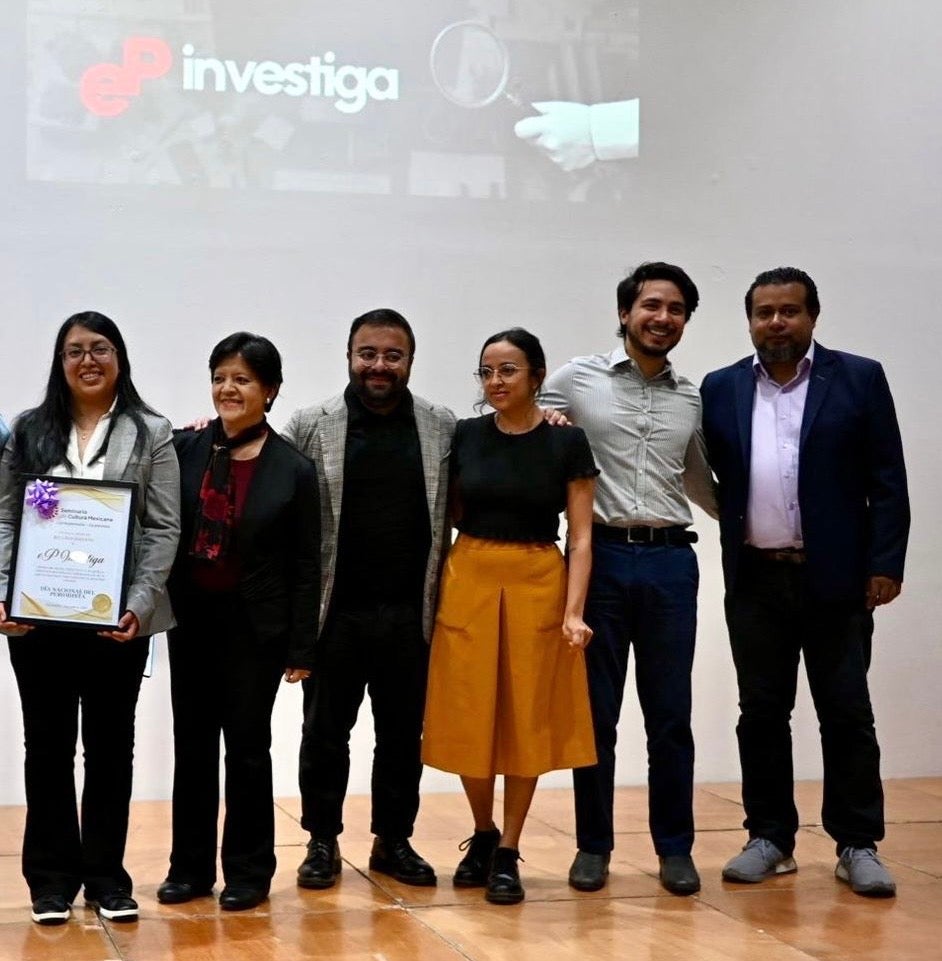
Team from the Guatemalan media outlet eP Investiga, one of only three media outlets from Latin America and the Caribbean to take part in the initiative Safeguarding Women’s Voices. (Photo: Courtesy)
The program, administered by the International Women’s Media Foundation (IWMF) and UNESCO, brings together 11 media outlets from around the world. The other two Latin American outlets have not authorized the publication of their names, according to the IWMF. Participants receive personalized support to develop security protocols tailored to the threats they face —whether at the national level or in their daily coverage— program manager Angelica Mayor told LJR.
The initiative begins with assessments of the vulnerabilities of each newsroom and of existing protection measures, followed by focus groups with participating newsrooms and freelance contributors, as well as training in physical and digital security.
Needs vary widely. Some media outlets face intimidation from public officials; others grapple with the logistical and legal challenges of operating across borders, as is the case with newsrooms in exile, such as eP Investiga.
“When it comes to journalists in exile, there's a lot of compartmentalization because of working with colleagues who are still in the country, but then having colleagues in exile, having the newsroom being kind of a very precarious situation,” Mayor said.
Despite these particularities, initial conversations have enabled the initiative's team to identify global patterns. One such example involves threats from state actors, specifically, surveillance of newsrooms. Criminal groups also engage in this surveillance, now utilizing drones just as state actors do.
The newsrooms also face murders and extortion, as well as exposure to conflict (covering shootings, attacks, etc.).
On the digital front, Mayor said, they encountered numerous cases of phishing (some more sophisticated than others), attacks on their websites and social media platforms, and online surveillance. For instance, cases involving Pegasus and other software constitute some of their greatest concerns.
“A lot of newsrooms don't have the structure of using secure communications,” said Mayor, who included, within this topic, the protection of communication with sources. “So that's one thing that we're working with them on is really ensuring that their communications are secure, that they're using two two-factor authentication, that they are recognizing when personal devices are being used for work and how that could implicate people because of the information that's on their personal devices.
Some newsrooms have their physical addresses linked to those of the journalist or editor. This leads to a greater risk of doxxing and even physical violence.
“There's also online harassment used as a tactic to discourage reporting and that predominantly or disproportionately is targeting women journalists, marginalized journalists. So that further discourages reporting,” Mayor said.
Indeed, a 2021 global study found that 73 percent of women journalists surveyed reported suffering online harassment at some point because of their work. Additionally, the attacks were greater against women who identified as Indigenous and Black.
These cases lead to self-censorship and even to women leaving the field of journalism. And it is precisely for this reason that the initiative seeks to protect these women.
“It does encompass all genders, but we always see a gender-responsive lens because […] we also recognize that, typically in the research we've done, women and non-binary journalists disproportionately receive more threats because of their identity,” Mayor said.
Rodríguez agrees; she, too, has observed how the attacks directed at the women on the team tend to be sexualized and misogynistic—attacks that ultimately lead them to abandon the field of journalism.
For example, Rodríguez said, the case of physical violence against her colleague was particularly “shocking.” In addition to the assault itself, they were concerned that, within the newsroom, they lacked clarity regarding the protocols to follow and where to find the necessary legal assistance.
Something similar occurred with a digital attack, during which the website remained offline for at least six hours. The technical team detected “unusual bot activity” originating from the United States and El Salvador—precisely at the moment they were covering the detention of human rights defender Ruth López in El Salvador.
“There are greater risks for women. The attacks are violent against their person—as individuals,” Rodríguez said. “With this initiative, we hope to be better prepared to address these problems.”
This article was translated with AI assistance and reviewed by Teresa Mioli


