
On March 5, 2025, members of the Guerreros Buscadores de Jalisco collective, dedicated to the independent search for disappeared persons in Mexico, entered Rancho Izaguirre, an abandoned property in the municipality of Teuchitlán, in the state of Jalisco, after receiving several anonymous calls alerting them to the possible existence of human remains at the site.
During the search, they broadcast live on social media what they found: dozens of articles of clothing, suitcases, blankets and personal belongings. Days later, Mexican authorities confirmed that the site had been a forced training center for a drug cartel.
Ángel Abundis, a sociologist and programmer with Tejer.Red, a collective of activists and developers that supports the search for disappeared persons using open-source tools, saw these broadcasts and thought about how to use the material. He downloaded the videos and developed an open-source tool that would allow families to identify clothing belonging to their missing loved ones in the images. However, the low quality of the videos made the task difficult.
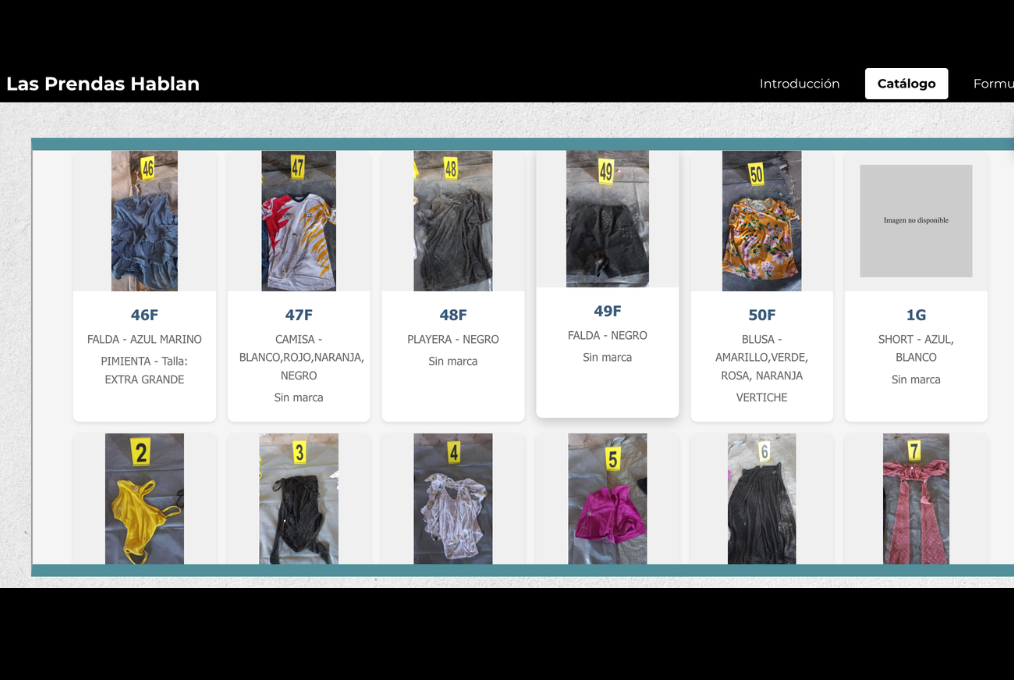
Programmer and activist Ángel Abundis created an online platform to help families of missing persons search for clothing items found at a suspected drug cartel site. (Photo: Screenshot)
When authorities secured the site, the Jalisco Attorney General's Office published a database with descriptions and photographs of nearly 500 recovered garments. Although the information was publicly available, the system didn't facilitate searching: it was necessary to open each link individually. Abundis then developed a second application that downloaded and organized the images into a catalog that allowed users to filter them by garment type, color, size and brand.
“The first and most important thing was the images of the clothing, so that family members could identify them and then filter them to facilitate this search,” Abundis told LatAm Journalism Review (LJR). “This builds on the efforts of the Guerreros Buscadores collective, which involved sharing what they found at this site.”
From that catalog, “Las prendas hablan” (The Clothes Speak) was born. It’s a collaborative journalism project in which journalists, programmers and search collectives joined forces to try to reconstruct stories of disappearances in Mexico based on the clothing found at the ranch. Using technological tools and crowdsourcing methods, the initiative sought to identify potential victims, document patterns of forced recruitment and pressure authorities to clarify what happened at the site.
“The goal is to build memory,” Darwin Franco, information coordinator for the digital investigative journalism outlet ZonaDocs, told LJR. “To understand how these people whose clothing was identified disappeared, where they disappeared and how their belongings ended up at Rancho Izaguirre.”
Franco was also covering the discoveries at the ranch when Abundis sought him out to show him his tool and propose a collaboration. The first thing they did was publish the catalog on ZonaDocs.
“We want the clothing to speak, to tell a story that allows us to know the truth and helps the families searching for their loved ones understand what happened,” Franco added.
Franco invited the digital native media outlet Animal Político and A dónde van los desaparecidos (Where do the disappeared go), an investigative site specializing in the logic of disappearances, to join the nascent project to grow its presence in media and social impact.
The next step was to use crowdsourcing, a methodology that engages the public to gather information for a journalistic piece. The team designed a form so citizens could report whether they recognized any items in the catalog. People were asked to specify which garments they thought they recognized, who they might have belonged to, whether they had contacted authorities about a disappearance, and if they would be willing to share their story.
The team distributed the form among search groups and families, Franco said. Then, starting in August 2025, journalists shared the tools in other settings, such as marches, forums on disappearances, and events for mothers searching for their missing loved ones in various states across the country.
“We did a massive outreach campaign so families could learn about the project and, if they were interested or suspected they recognized a garment in the catalog, they could fill out the form,” Neldy San Martín, an independent journalist and member of the team with “Las prendas hablan,” told LJR. “Based on the responses we received, we followed up on the stories and interviewed the families.”
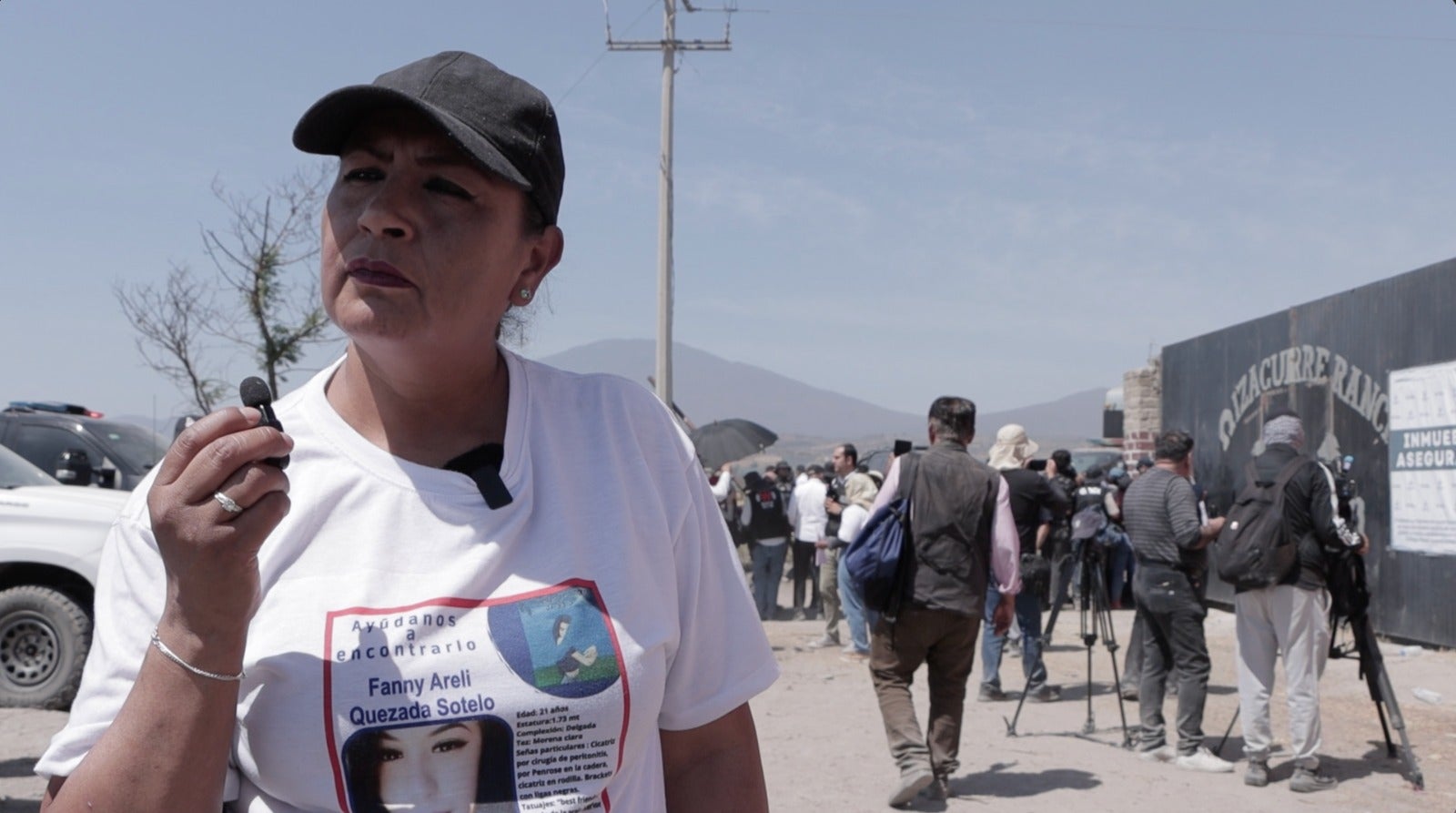
Patricia Sotelo is one of the mothers searching for her missing daughter whose story is featured in the “Las Prendas Hablan” reports. (Photo: Sharenii Guzmán)
As of Feb. 25 of this year, the “Las prendas hablan” catalog had recorded nearly 8,000 visits and almost 60,000 searches for garments. The number of objects in the catalog grew to nearly 1,300 pieces, according to the project’s website.
The idea behind investigating these stories, Franco said, was to monitor whether the government was actually tracking the discovery of the garments, and whether it would allow families to learn the whereabouts of their disappeared relatives through these objects.
However, what they found was very different. The project resulted in seven reports featuring stories of young people who were allegedly victims of forced recruitment by organized crime through fake job offers, San Martín said. And in none of the cases had the families received any cooperation from the authorities, she added.
“Las prendas hablan” presented a broader diagnosis of the role of the authorities in these cases: accountability failed and there was a systematic abandonment of the families by the institutions, San Martín said.
“In every case, these families said, ‘I recognize one or more articles of clothing.’ Yet, the authorities placed obstacles in their path,” San Martín said. “We began to detect a host of failures and omissions on the part of the authorities, as well as a great deal of indifference. The authorities were not paying attention to these demands from the families.”
One of the reports recounts how Carmen Lucía Carrillo, mother of the missing young man Daniel Alberto Velasco, identified a pair of black pants and black boxer shorts in the catalog that she believes belong to her son, as well as a wallet she recognized in Facebook Live broadcasts by the searchers' collective. Carrillo told reporters that officials from the Jalisco Attorney General's Office asked her for a photo of her son wearing those items in order to grant her access to them. The mother replied that she didn't have it.
Another report recounts the case of Rubí García, who found a suitcase and a pair of sneakers in the catalog that apparently belong to her sister, Merari García, who went missing in May 2024. Unlike in the previous case, her family did possess photographs of the young woman wearing those items; yet, despite this, they have still not been permitted to view the objects.
For the team, the project also taught a lesson about the role of journalism in the face of that institutional void.
“From a journalistic standpoint, I believe that its main contribution, in addition to exposing all these systematic omissions, was to show a pattern that we have been suffering from for several years now in this country, that the authorities do not follow up or respond to the families of disappeared persons,” San Martín said.
Mexico faces a persistent crisis of disappearances that has worsened in recent decades, amid violence linked to organized crime, according to Amnesty International. The country's National Registry of Disappeared and Unlocated Persons reports more than 100,000 officially disappeared persons. Organizations have documented structural failures in investigation, forensic identification and victim support, which have contributed to high levels of impunity and uncertainty for thousands of people in the country.
San Martín added that, a year after the findings at Rancho Izaguirre, the authorities have not given the families who identified clothing any type of confirmation or denial that the bone remains found correspond to their disappeared relatives.
Last year, President Claudia Sheinbaum urged the federal Attorney General's Office to take over the investigation, which she said had "many problems." One year later, on March 5, 2026, the federal Attorney General's Office reported that genetic analysis of the skeletal remains has not yielded a "conclusive result that allows for their identification."
Groups like Guerreros Buscadores de Jalisco maintained that at Rancho Izaguirre they also found other evidence, such as charred remains and alleged makeshift ovens, suggesting that the site also functioned as a possible cartel killing ground. However, the Attorney General's Office rejected this version due to a lack of conclusive evidence.
“The families who identified clothing don’t want to be told their son or daughter was there; they want to be told they weren’t,” San Martín said. “But nothing of the sort happened, meaning the uncertainty continues a year later. [...] The matter was forgotten, and they tried to close the case.”
En el rancho Izaguirre se localizaron más de 1,800 prendas.
Ante la falta de claridad oficial se creó un catálogo público que ha sido visitado 59,361 veces.Las familias buscadoras han reconocido algunas prendas, conoce más en #LasPrendasHablan, un proyecto de @pajaropolitico,… pic.twitter.com/iFLSDGoxdE
— Animal Político (@Pajaropolitico) March 5, 2026
In the past year, events have occurred in Mexico that directly or indirectly complicated the journalistic work of "Las prendas hablan.”
The opacity that reporters found with authorities was compounded by the dismantling of the National Institute for Access to Information, the autonomous body that was in charge of guaranteeing the right of access to public data in Mexico.
The team sent dozens of information requests, but authorities rejected them, arguing that the data was part of an ongoing judicial investigation, San Martín said. The team believes that the requested information, which included the total number of garments found and details about the chain of custody during their transfer to the Attorney General's Office headquarters in Mexico City, is information that authorities were legally obligated to disclose, San Martín said.
The journalist added that government offices referred them from one authority to another, and all of them ultimately refused to provide the information. Furthermore, the agencies also denied requests for interviews with officials.
“With the INAI no longer existing, it’s difficult to insist or demand information, because ultimately [now] it’s the government’s own Anti-Corruption Secretariat that decides whether or not to release it,” San Martín said. “Before, it was much easier because we had an INAI that would say, ‘Attorney General’s Office, give them the information. It’s a right.’”
Since the discovery of the ranch, violence has surged in several Mexican states, including Jalisco. The killing in February 2026 of the leader of the Jalisco New Generation Cartel (CJNG), the dominant criminal group in that state, triggered a wave of violence that forced search collectives to halt their activities. San Martín said that, although the event occurred toward the end of “Las prendas hablan” project, the sources and the team felt fear due to the general climate of violence.
Furthermore, the journalist said that although many people consulted the catalog of garments, very few agreed to share their stories. The team attributes this to fear as well.
Given the obstacles and the lack of official information, the work of journalists with the families and search groups was crucial, Franco and San Martín agreed.
“Since the authorities haven’t given a public, detailed explanation of what happened, what we know, almost entirely, comes from the collectives who have been providing us with information because they’ve attended the hearings [about the case],” San Martín said. “When there is so much horror in a country, networks, collaborative work and support for the collectives and the families are ultimately what save us.”
This article was translated with the assistance of AI and was reviewed by Jorge Valencia


