
A certificate program and a platform published on Substack are helping journalists in Paraguay train, collaborate and publish investigations despite newsroom conditions that limit data journalism.
After 36 years at the newspaper Última Hora —one of the signature legacy news outlets in Paraguay— journalist Susana Oviedo reached a turning point. Her career had spanned various stages of the craft, ranging from daily reporting to political analysis; yet, on the threshold of retirement, she found that the journalism industry was evolving rapidly beyond the confines of her own publication.
“I felt overwhelmed by these overly dizzying changes in the acquisition, processing and dissemination of information—changes I saw happening outside, but which I didn’t see us keeping pace with,” Oviedo told LatAm Journalism Review (LJR).
So, when she learned about the call for applications for the first Certificate Program in Data and Investigative Journalism in Paraguay, in 2025, she felt it was her opportunity to take the leap.
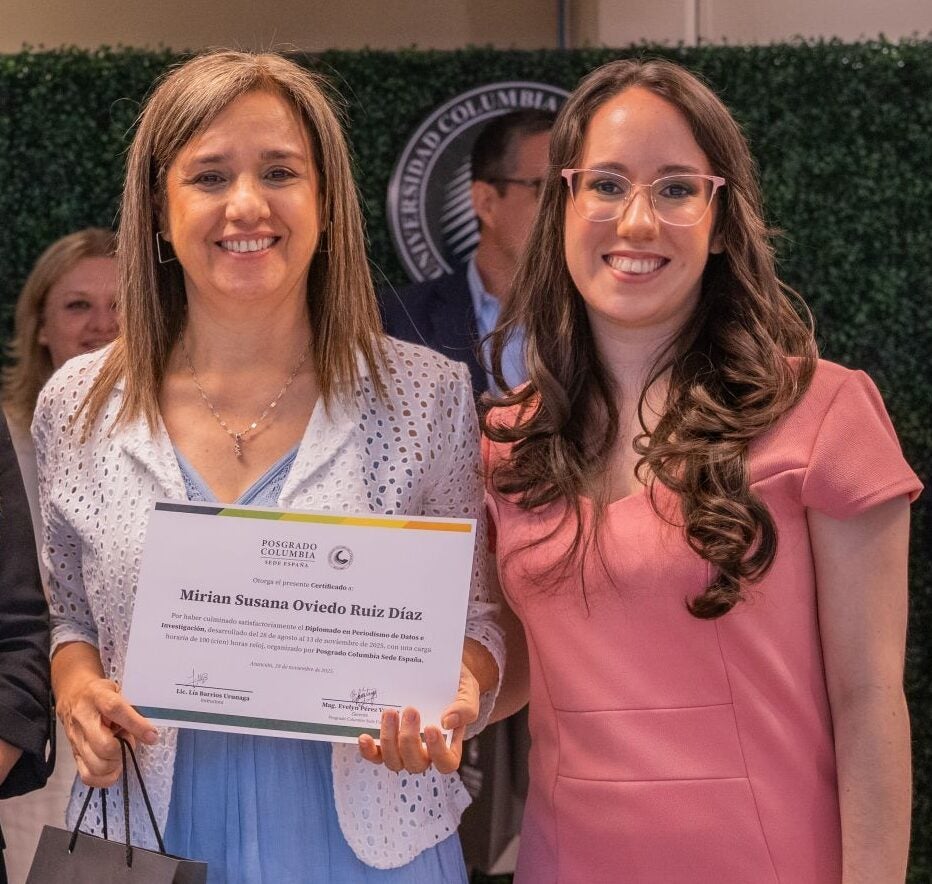
Journalist Susana Oviedo (L), a graduate of the Certificate Program in Data and Investigative Journalism; and Lía Barrios (R), founder and coordinator of the program, during a graduation event. (Photo: Universidad Columbia del Paraguay)
Like Oviedo, other Paraguayan journalists shared that frustration—the desire to learn and practice journalism supported by new technologies, yet lacking the time, tools and funding required to do so at their respective media outlets.
“There is a level of disappointment—and often sheer frustration—with a system that sometimes prevents us from conducting investigative journalism in Paraguay in the way we would love to,” journalist Lía Barrios, creator and manager of the certificate program, told LJR. “We understand that there is a system in place for covering daily news, but as investigative journalists, we want to do something different from that—without, of course, disparaging anyone else’s work.”
Barrios, a pioneer in data journalism in Paraguay, said she created the certificate program as a response to the frustration she herself experienced before becoming self-taught in programming, statistics and data science.
The inaugural edition of the certificate program, which trained 15 professionals, was held virtually in partnership with Universidad Columbia del Paraguay from August to December 2025.
But for Barrios, the certificate program seeks to go beyond simply teaching tools and techniques: it aims to fill gaps in the Paraguayan media ecosystem by offering specialized training, fostering a community of professional support and opening up spaces to produce and publish investigations that traditional newsrooms often cannot sustain.
“It was interesting to see the students who arrived at the certificate program asking: ‘Lía, how are you going about your investigative work? Who are you working with? Who is paying you? Who is helping you? How can I do the same?’” Barrios said. “Most of them had more experience [in journalism] than I did, but they simply needed a connection, a space, an opportunity.”
Graduates of the program learned basic data handling techniques—from acquisition to visualization—including web scraping, database cleaning and analysis, and the use of basic programming.
Following her participation in the certificate program, Oviedo is taking part in a collaborative, cross-border data investigation with the Organized Crime and Corruption Reporting Project (OCCRP)—a global investigative journalism network specializing in corruption and money flows.
For her, retirement does not represent the end of practicing journalism, but rather a foray into the kind of journalism she had not previously been able to pursue.
“I have a great interest in doing this,” she said. “It’s like something I owe to myself. At least to explore as far as I can.”
Data journalism training in Paraguay had been sparse—in a country where journalism and communication programs do not offer that option to specialize, Barrios said.
Personally, she had to seek opportunities abroad when, at the age of 19, she became interested in the data-driven journalism that organizations like OCCRP and CONNECTAS were already doing. Her first exposure to the field came precisely through the latter—specifically via the “Investigatón” it held in partnership with the International Center for Journalists (ICFJ) in 2019.
Subsequently, she took several online data journalism courses through the training program at the Knight Center for Journalism in the Americas, and also taught herself programming.
Ana Lezcano, a digital journalist for newspaper ABC Color and a journalism professor, told LJR that while the major traditional media outlets in Paraguay have engaged in data journalism, they do not do so systematically. Most of the journalists who practice it are self-taught, she added, as media organizations lack the resources and infrastructure to develop this practice.
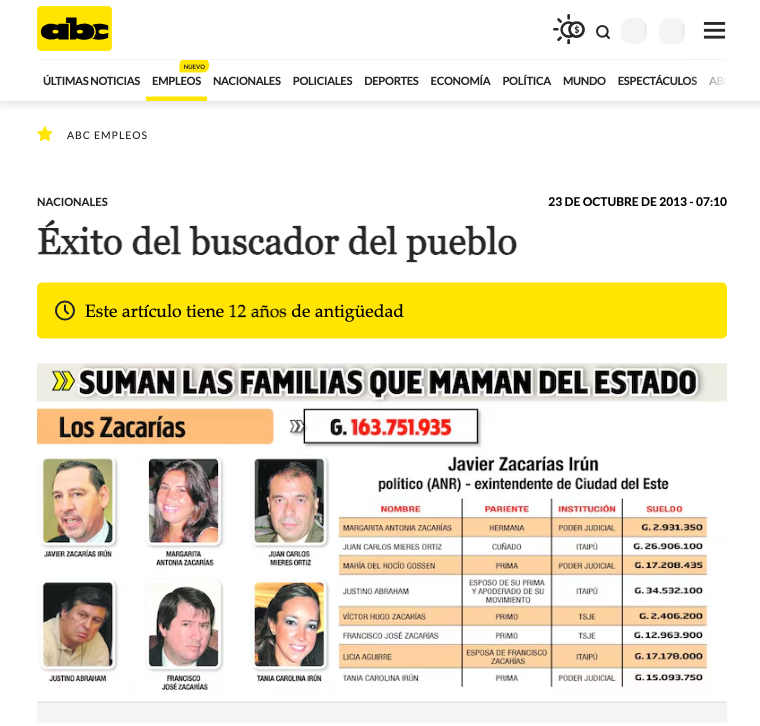
The special report "El Buscador del Pueblo," published by ABC Color in 2013, was one of the first data journalism projects to make an impact in Paraguay. (Photo: ABC Color)
Within that context, Barrios said she founded the certificate program precisely to create a space where Paraguayan journalists could receive formal and academic training in data journalism.
The curriculum includes an introduction to programming in languages like Python and using platforms like Pandas and Google Colab, as well as data visualization using programs such as Flourish and Datawrapper.
Although the certificate program is structured, Barrios said that she sought to encourage students to pursue autonomous, continuous learning in programming—something which, she said, is highly characteristic of the programming community in general.
“Programmers worldwide are constantly learning through self-study,” she said. “Today, journalists can go online—where there is a vast community across forums, platforms and the like—and inevitably find someone who has been trying to do something similar to what they are doing.”
Barrios hopes the certificate program has that same sense of community of collaboration that is a hallmark of data journalism, and that it will open opportunities for graduates to connect with data journalists from other countries and expand their horizons.
The certificate program yielded 12 reporting projects on topics such as corruption, the environment and domestic violence. However, upon the program's conclusion, a challenge emerged: how to sustain that momentum in newsrooms that do not offer the conditions to apply what they learned, Barrios said.
“How do you go to a media outlet to start programming and creating your own materials, and how do you show your results to your editor, if your editor isn’t a data journalist? How are they going to edit your work?” she said.
The solution was to create Paraguay Data, a non-profit data journalism platform hosted on Substack where the reports from the certificate program have been published. The platform aims to become a space where current and future graduates receive editorial guidance during the development of their data-driven projects.
Paraguay Data was co-founded by Barrios alongside journalists Analía López and Juan José Oteiza—the latter two graduates of the certificate program.
The idea behind the initiative, Barrios explained, is to enable journalists working in traditional newsrooms to conduct data investigations alongside their daily work —with guidance from Paraguay Data— and to publish them both on the platform and on their respective media outlets.
In this way, collaboration is fostered— something that she said traditional Paraguayan media are not so accustomed to.
Barrios said investigations from the program are being published in some of the country’s most important traditional media, as well as alternative outlets.
When Juan José Oteiza decided to review the payroll of civil servants in Lambaré —the town where he lives— as part of his certificate project, he encountered an obstacle common to accessing public information in Paraguay: the data was available, but it was unusable.
Oteiza said that public institutions often provide extensive archives containing unstructured information that is difficult to analyze. For this reason, he believes it is essential for journalists to acquire technical skills to transform that information into usable data, and that data, in turn, into relevant stories.
“[The authorities upload the information] in a rather cryptic manner—in an 1,800-row PDF from which one cannot draw any conclusions,” Oteiza told LJR. “Using the tools from [the certificate program], I created a clean, organized and easy to navigate Excel spreadsheet that any citizen can access and browse.”
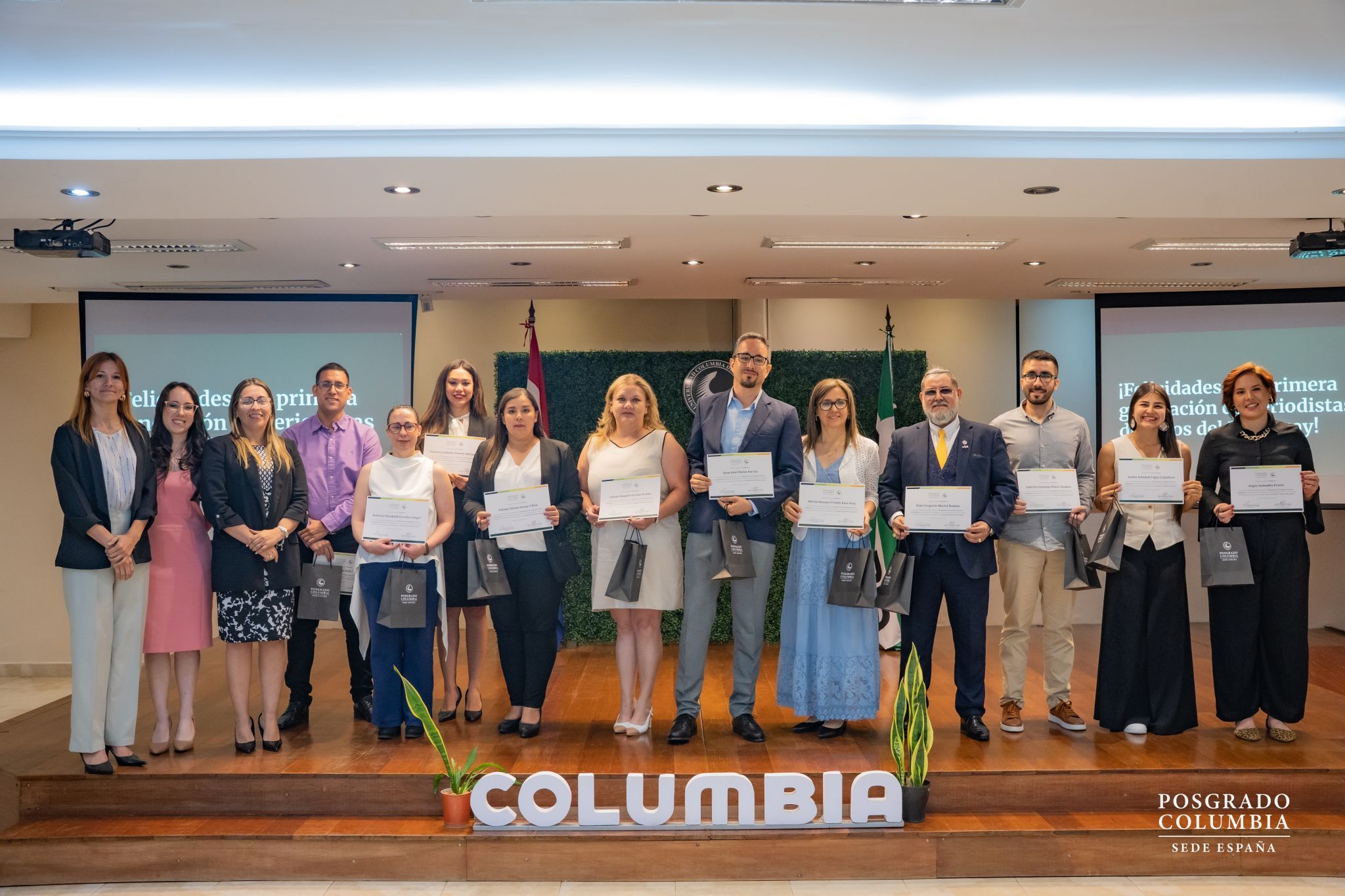
The inaugural edition of the certificate program trained 15 professionals. (Photo: Universidad Columbia del Paraguay)
The work—which took him nearly three months—led to an investigation that revealed inconsistencies in the town’s staff structure and salaries. His findings were picked up by traditional and television media outlets, and also sparked public debate, Oteiza said.
Susana Oviedo added that after completing the certificate program, she realized that many journalists are unaware of the potential that the proper application of data journalism techniques—combined with access to public information—can have for accountability.
“I regret not having had the tools that are available today—most of them free—yet which, in a vast percentage of cases, we do not know how to use or how to capitalize on to handle the sheer volume of data that reaches us daily as reporters,” she said.
Barrios hopes that the journalists participating in the certificate program—the second edition of which will be announced soon and will be open to other countries—will become data editors in their newsrooms and train their colleagues, thereby consolidating data journalism in Paraguay to the level of the region.
“I wonder what would happen if there were a data journalist in every newsroom—or at least one in every department of Paraguay,” Barrios said. “I dream of that. I believe we will achieve it in a few more years.”
This article was translated with AI assistance and reviewed by Teresa Mioli


