
It was around 2:00 a.m. on Jan. 3 when reports of explosions and low-flying aircraft in the city of Caracas began circulating on social media.
Luz Mely Reyes, a Venezuelan journalist in exile and director of the digital media outlet Efecto Cocuyo, quickly learned what was happening. She contacted a group of colleagues, also in exile, via text message, and within minutes they organized a live broadcast to inform their compatriots about what was going on in Venezuela.
Initially, in addition to Reyes, the participants included César Batiz, director of the digital media outlet El Pitazo; Luis Ernesto Blanco, from Runrun.es; and Víctor Amaya, from TalCual; coordinated by Ronna Rísquez, from the network of independent Venezuelan media outlets Alianza Rebelde Investiga (Rebel Alliance Investigates). Throughout the broadcast, others joined, including exiled journalist César Miguel Rondón.

The collaborative broadcast began just minutes after the first explosions in Caracas and continued until after President Trump's press conference. (Photo: Screenshot)
“In the early hours of Jan. 3, a colleague of mine told me, ‘There are bombings in Caracas,’ and we all sprang into action in the small virtual newsroom we have,” Reyes told LatAm Journalism Review (LJR). “Those of us who were awake immediately decided, ‘Let’s go on the air,’ and we started the broadcast, which was historic.”
What began as a live stream to report on the explosions in Caracas turned into a 10-hour and 48-minute broadcast that reported, explained and verified step by step the military operation that ended in the capture and transfer to the United States of the Chavista leader Nicolás Maduro, who until that moment had governed Venezuela for more than 12 years.
The broadcast surpassed 300,000 viewers on YouTube at times, and also served as a source of information for several international media outlets, Rísquez said.
Batiz said that streaming was the only platform that provided the most complete and continuous information about the events in real time, in a country with a years-long information blockade that prevents traditional local media from covering information critical of the regime.
The coverage of Maduro's capture demonstrated how independent Venezuelan journalism, operating from exile and in alliance with reporters who remain in the country, once again managed to break through that information blockade.
“This project [...] has to do with collaborative journalism and was possible because there are journalists who are currently outside of Venezuela and can disseminate information, speak out and appear on camera to tell what is happening,” Rísquez told LJR. “We have the will and understand the need to do this, to continue informing not only Venezuelans, but also people abroad, and to explain what is happening in Venezuela.”
Although the events took the group by surprise, they weren't caught unprepared. For several weeks beforehand, they had been jointly analyzing possible scenarios for Venezuela, following the ultimatum that U.S. President Donald Trump gave Maduro in November to relinquish power peacefully. Reyes said that it was then that they created this "virtual newsroom," which was activated on Jan. 3, where each member shared information from their respective sources, from their places of exile.
“The situation certainly came as a surprise. It surprised us, but we were prepared because as soon as it started happening, we were able to act,” Reyes said. “Since the end of November, we had formed a very ad-hoc group of journalists who have good sources because we expected that something could happen at any moment.”
In December, with tensions between the U.S. and Venezuela rising, media outlets began collaborating on streamed panel discussions. “La Conversa,” the debate program hosted by the directors of Runrun.es, Tal Cual and El Pitazo, merged with “Con la Luz,” Efecto Cocuyo's online interview show. Thus, “La Conversa Con la Luz” was born.
Other media outlets in exile, such as Cazadores de Fake News and Caracas Chronicles, also joined this new online program.
Runrun.es, Tal Cual and El Pitazo have been collaborating for more than a decade. Alianza Rebelde emerged in 2017 as a commercial alliance and later, in 2019, evolved into an editorial alliance in order to confront the persecution and repression that the press in Venezuela was facing at that time.
In parallel, the members of Alianza Rebelde have teamed up on journalistic projects and collaborative initiatives, such as the recent "Venezuela Vota" and "Operación Retuit," the latter of which won the King of Spain Award in 2025.
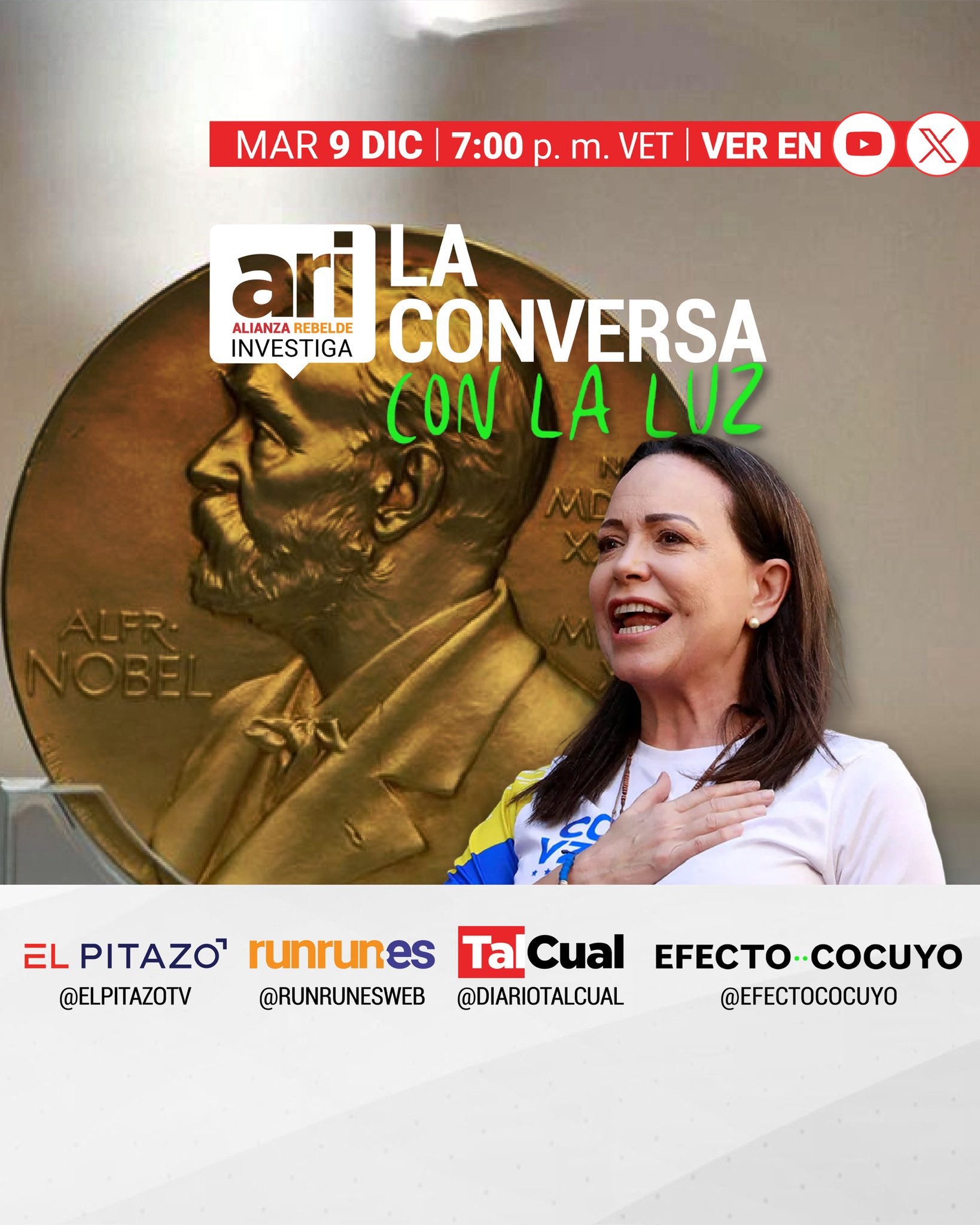
Since December, independent media outlets in exile have been collaborating on analysis panels streamed online under the title “La Conversa Con la Luz” (Photo: Alianza Rebelde Investiga)
Batiz said that, without them realizing, all of this collaborative work over the past decade had been preparing them for this moment.
“This wasn't something we just came up with one day and said, ‘Let's join forces.’ There are precedents, there are foundations, there are elements of shared experiences,” Batiz told LJR. “We also need to value the trust we have in each other as journalists, as people who have worked together or who know each other, and the fact that we've had other opportunities to interact.”
Reyes said that independent Venezuelan media outlets have built bonds of trust in recent years as a result of converging in restricted, authoritarian spaces. This trust, she added, was fundamental for jointly covering the historic operation that led to the capture of a president, which involved sharing information from sensitive sources and exchanging communications in an encrypted manner.
“Regardless of the fact that we each belong to different media outlets, we have faced similar challenges. We have all been persecuted, we have all been blocked, and we have all been subjected to public ridicule,” Reyes said. “Each of us has unique skills, abilities and competencies, and all of that came together to provide a great example of journalistic synergy.”
Reyes, Batiz and Rísquez agreed that the reporters in Venezuela who, despite the risks, continued working to gather, verify and confirm information, played a fundamental role in this coverage.
“A crucial element of this alliance, of this collaborative journalism, are the journalists who are in Venezuela, who cannot sign their articles because they are afraid, who cannot appear on camera because they could be detained, because there is censorship, because there is repression, because there is persecution,” Rísquez said. “They are our eyes inside Venezuela, and I believe our commitment is also to them.”
Batiz said that, weeks before the operation, El Pitazo had assembled a team of independent journalists, former collaborators of the outlet and reporters from allied media outlets in different parts of Venezuela who would send information in the event of a scenario like the one that occurred.
“It worked perfectly. I think the hour didn't help us, because we didn't have time to activate everyone, but we did get information from key people who were able to tell us where the attacks were, and where there weren't any attacks, for example,” Batiz said.
The newspaper El Tiempo, from Anzoátegui state in northeastern Venezuela, employed a similar strategy. The newsroom had also anticipated for the past couple of months that an imminent US operation could take place at any time.
However, with a team that had lost nearly two-thirds of its members in the last year due to the press crisis in the country, the editors sought out independent journalists from different areas of the state and from Caracas to collaborate in reporting on what might happen.
“The [newsroom] coordinator started contacting teams so they could report from the areas where they lived,” María Alejandra Márquez, president of El Tiempo, told LJR. “[Those reporters] then started contacting their sources so they could monitor the localities remotely.”
Marquez said that in the first hours of the US operation, the newspaper's coverage was limited to monitoring and verifying reports from the internet, partly due to the time of day and partly because the newspaper's journalists expressed fear of going out to cover the events on the ground.
“When everything happened, we experienced a situation that had only happened to us during the post-election period in July 2024, which is that the journalists were genuinely very afraid to go out,” Márquez said. “Until now, of course, we have largely left it up to the journalists to manage the risk and decide what they want to cover or not.”
#Política #Venezuela (Varias detonaciones sacuden Caracas en medio tensiones con EEUU) - https://t.co/aFZJOqA5hA pic.twitter.com/eWVXfvZbn8
— El Tiempo (@Diario_ElTiempo) January 3, 2026
Marquez added that, given the fear and uncertainty of what might happen, the newsroom prioritized service-oriented coverage for the audience instead of political coverage.
“Little by little, after there were more reports that nothing was really happening after the surgical operation, what we did was go out and do, for example, a survey of how the gas stations, markets, streets and food centers were doing,” she said.
Hours after Venezuelan Vice President Delcy Rodríguez was sworn in as interim president on Jan. 5, social media users reported shootings and drone activity around the Miraflores Presidential Palace that night. Given the risk and uncertainty, the El Tiempo team in Caracas limited itself to verifying the reports with sources in the surrounding area, Márquez said.
“We were able to report that residents of the area confirmed that there had indeed been gunshots, but they didn't know where they came from. In other words, we couldn't clarify exactly what happened, but we were able to confirm that it did happen,” Márquez said. “That's kind of how we do it when we don't have the capacity to verify everything.”
Given the uncertainty, Luz Mely Reyes said that rigorously following the journalistic code of ethics was key to covering the events.
“Everything happened in the heat of the moment. And in those critical moments when everything happens so quickly, we clung very tightly to those principles, the guiding principles of journalism: the search for information, the issue of verification and the telling and understanding of the historic moment we were experiencing,” she said.
Journalists who covered Maduro's capture reported that, following the military operation, a wave of disinformation swept across social media. This included not only the numerous false news stories and AI-generated images that went viral within hours of the arrest, but also an alleged campaign that has instilled fear among Venezuelans, preventing them from celebrating or expressing their opinions about what happened.
“There has been a disinformation campaign, which is believed to be coming from State counterintelligence agencies, that is spreading a lot of fear on social media to prevent people from going out or sharing information,” Márquez said. “They are telling people that the government is setting up a super sophisticated system to monitor what is being posted.”
Batiz said that rumors are circulating that people's phones are being tapped and that authorities have access to their WhatsApp conversations. Although this is a recurring hoax during times of crisis in the country, this time, Batiz said, it has gained more credibility following the declaration of a state of emergency issued by the Venezuelan government after Maduro's capture.
The decree establishes, among other things, the search for and capture of anyone involved in promoting or supporting the U.S. operation. This includes setting up checkpoints to inspect people's cell phones, and forcing people to get out of their cars to be searched.
“Indeed, because of that decree, they are reviewing people's phones to see what information they contain, whether you have any documents, photos or messages celebrating Maduro's capture,” Batiz said. “That is happening. What isn't happening is that they can find out what you put on your phone.”
Es falso que Nicolás Maduro fue fotografiado con el uniforme carcelario color naranja
Las tres imágenes fueron creadas con Inteligencia Artificial. El origen sintético se revela a través de artefactos como la incoherencia numérica en la escala de estatura, errores anatómicos en… pic.twitter.com/DglpYtuVdh
— Cazadores de Fake News (@cazamosfakenews) January 5, 2026


