
Belgian journalist Arthur Debruyne had been a correspondent in Mexico for about three years when, in May 2019, he read the news that young Mexicans had been arrested in Moerdijk, a small village just over an hour from Amsterdam in the Netherlands, in an operation at a methamphetamine lab inside a boat.
Shortly afterward, he learned that this same year, another group of Mexicans had been arrested at a different drug lab in Wateringen, near The Hague. Everything seemed to indicate that the Mexicans in question had been brought to Europe to work under temporary contracts as crystal methamphetamine “cooks” for criminal networks in the Netherlands and Belgium.
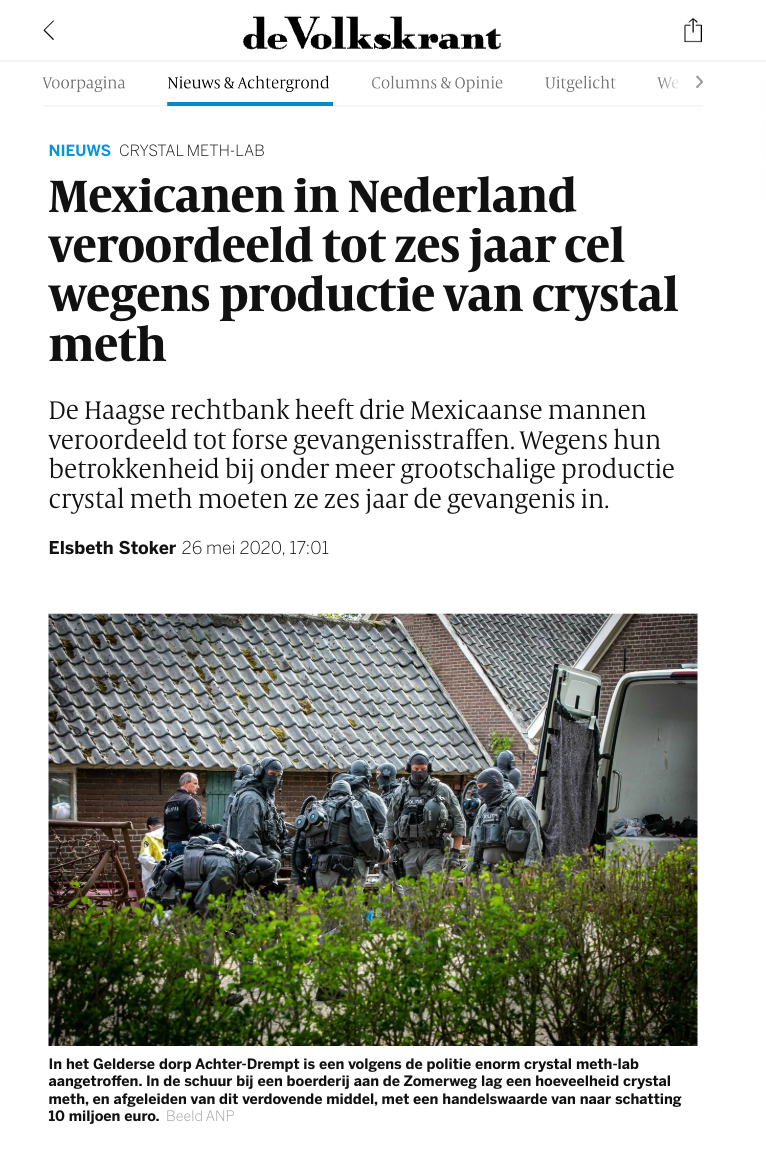
Dutch media reported since 2019 the arrests of Mexicans allegedly operating drug labs in the Netherlands. (Photo: Screenshot from the news media outlet De Volkskrant)
The presence of these Mexican “experts” in Europe caught Debruyne’s attention, so he decided to investigate the matter thoroughly. He discovered that Mexican cartels had mastered a technique for utilizing methamphetamine production waste that European criminal organizations were unaware of. This technique allowed them to maximize product yield and reduce the amount of waste.
Debruyne had come to Mexico to report on migration, but “inevitably,” he said, he ended up covering organized crime, first as a freelancer and then for the Dutch newspaper Het Financieele Dagblad. He said he had long wanted to do an in-depth investigation for a book, and found the news stories about the alleged “cooks” to be the perfect subject.
“The journalistic work that gives me the most pleasure, that interests me the most, is the work where I can delve deeper,” Debruyne told LatAm Journalism Review (LJR). “It felt like a big story [...]. I was immediately hooked and said to myself, ‘I really want to get to the bottom of this.’”
Through a combination of letters, prison visits, building trust and freedom of information requests, Debruyne approached drug trafficking in Mexico from the perspective of this case abroad. This approach, he said, allowed him to explore less documented layers of organized crime as a global phenomenon.
The result was an investigation captured in the book "Mexican drug trafficking in Europe. Mexican cooks in the Netherlands: the new global face of drug trafficking,” published in October 2025.
By 2020, the issue of Mexican "cooks" in Europe had exploded. Around 50 drug labs had been discovered in the Netherlands and Belgium, and nearly 20 Mexican citizens had been arrested.
Debruyne was clear that he didn't want to write a book based solely on police and judicial sources. He knew that to conduct a thorough and solid investigation, it was imperative to include the testimonies of the detained Mexicans.
He began by approaching Dutch authorities and the detainees' lawyers. Receiving little response, he decided to travel to the Netherlands and Belgium at his own expense to attend the first trials in these cases.
“In the Netherlands, they really take their time; the judges talk, they ask the suspects questions, so these were good opportunities to see these Mexicans up close, to learn more about them,” Debruyne said. “During those trials, they mentioned the full names of these Mexicans, where they were from, their date of birth and they always said where they were imprisoned.”
The journalist set about writing letters in Spanish, using pen and paper, to the detained Mexicans. In them, he explained who he was and expressed his desire to interview them.
“There are so many stories in prison. It’s worth going to trials, spending a day in court. It’s a path that has been very fruitful in my investigations,” he said. “I feel like it’s not done enough. Prisons are somewhat forgotten.”
For months he heard nothing. But one day, back in Mexico, he was informed that a letter had arrived at his home in Belgium. It was a reply from one of the Mexicans detained in the operation on the boat, who very politely thanked him for his interest but refused to speak for fear of drawing attention to his case.
However, the journalist continued corresponding with him until one day he received a call from the man in prison. After speaking for a few minutes, he agreed to meet.
Debruyne flew back to the Netherlands. That first meeting was followed by others until he finally secured a formal interview. The same thing happened with other imprisoned men, both Mexican and Dutch, who also responded to his letters.
Those interviews, he said, became the common thread in the narrative of his report.
“Surprisingly, you can achieve a lot just by writing a letter. It’s something I’ve recommended to colleagues and in talks with journalism students,” he said. “I was able to see several Mexicans in jail just with those letters. I ended up writing, I don’t know, several dozen. Many didn’t reply, but several did.”
Debruyne attributes the success of his letters to the fact that the isolation of prisons makes some incarcerated there, especially those who are in a different country than their own, more inclined to want to talk to someone from the outside, and in their own language.
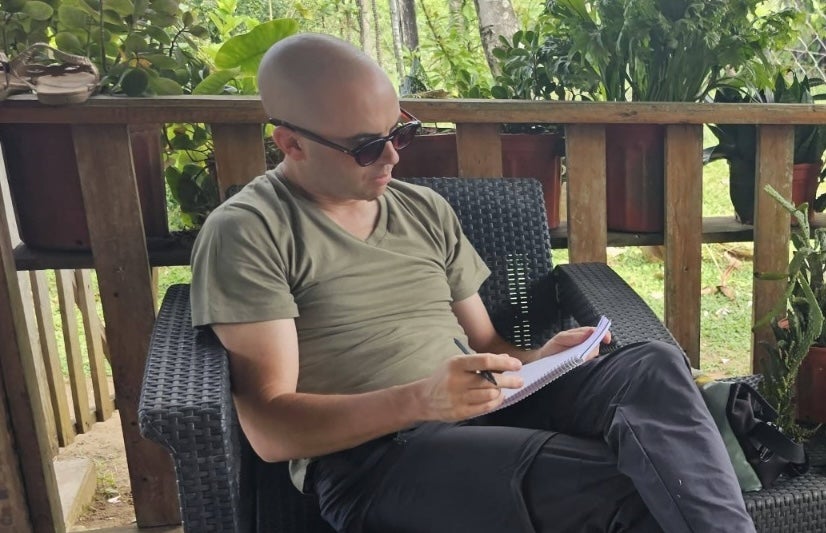
Journalist Arthur Debruyne wrote dozens of letters to incarcerated individuals as part of his reporting. (Photo: Aris Mariota)
However, he said, it's also true that those incarcerated are generally not like other sources accustomed to speaking with the press, so journalists have to work on building trust. That's achieved, he added, by setting aside the professional aspect for a moment and approaching them from a human perspective.
“As a journalist, you have your own interests. You feel there’s an interesting story to tell, and you have to convince them [...]. I knew I wanted to see these people many times; I wanted to build a relationship of trust,” he said. “Don’t underestimate [the first visits]; it’s an approach, a delicate task. [...] Speak to them as a human being, ask them how they are in prison, where they’re from, and assure them that you’re not interviewing them, you’re just getting to know them.”
Something similar happens with judicial sources. Debruyne said that although Dutch authorities are usually open to speaking with the press, they tend to provide only the bare minimum of information, and even then, only sparingly. The journalist said it took him time to gain the trust of the police officers investigating the case of the alleged Mexican "cooks," as well as the prosecutor in charge.
But he realized that the authorities began to be more cooperative when they learned of his advanced work on the case and that he had spoken with some of the accused.
“The prosecutor’s office and the police don’t give you all the information from the first meeting,” he said. “They were interested in the fact that I had made contact with the Mexicans. But I had to be careful not to share too much information, not to jeopardize the Mexicans’ cases. It was sometimes hard work maintaining good source management, protecting sources.”
On the other hand, Debruyne ran into a brick wall when he asked for the Mexican authorities' position. He said he tried to speak with the Mexican Embassy in the Netherlands, but they refused.
It was then that Debruyne turned to Mexico's access to information laws. The journalist requested information on the matter through the National Transparency Platform, the digital system that allowed access to public data, which was later dismantled by the government of the current President Claudia Sheinbaum.
Debruyne thought there might be reports from the Embassy to the Ministry of Foreign Affairs in Mexico about the detained Mexicans, so he requested all communications between the two institutions through the platform.
“I received quite a bit of information, many communications from the Embassy addressed to the Foreign Ministry in Mexico. They didn't want to say anything officially, but I did obtain a lot of material through that other channel,” he said. “I have an entire chapter based on those documents and also on an interview I eventually got with a source in Mexican diplomacy. It's one of the chapters I'm most proud of.”
The chapter in question, entitled “Image,” narrates the diplomatic crisis faced by the Mexican embassy after the discovery of drug labs linked to Mexicans, and how the State reacted —with paralysis, silence and failed narrative control strategies— to the damage to its international image.
Debruyne admits he had certain preconceived notions when he first came into contact with the detained Mexicans. He said he expected he might encounter criminals like those portrayed in narco-series or movies. However, after their initial conversations in prison, he realized that not all members of a criminal organization are violent or dangerous.
“I can’t deny that, especially at the beginning, I was somewhat paranoid,” he said. “Those ‘cooks’ are part of a specific group [within drug trafficking]. They aren’t gunmen, they aren’t hitmen, they aren’t in charge of disposing of bodies. They were always very courteous; I never had a hostile experience.”
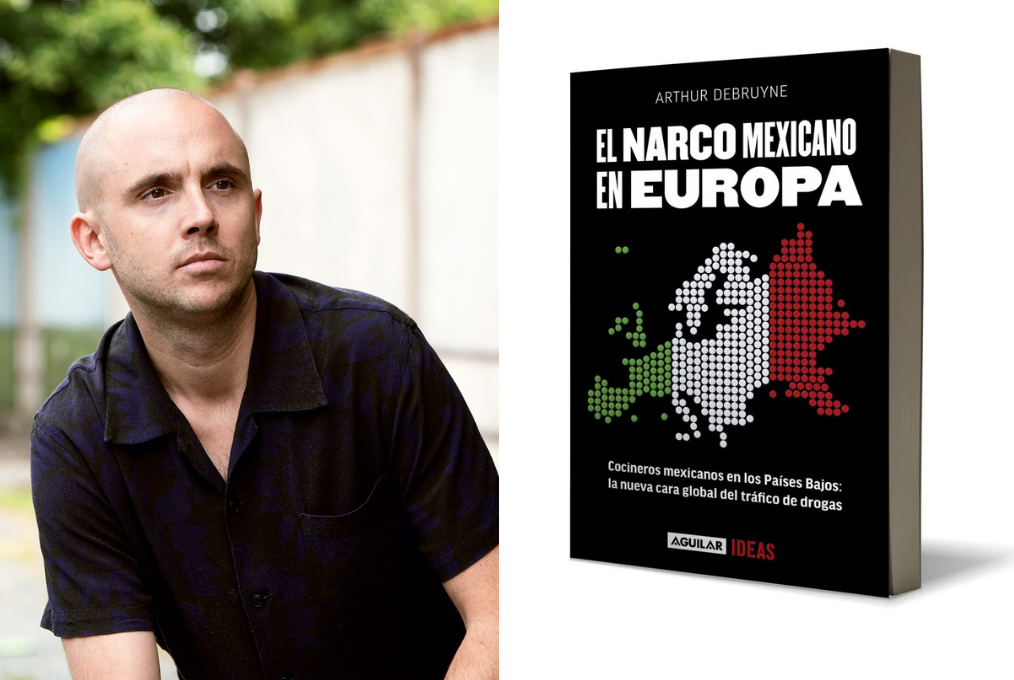
Debruyne's book was published in October 2025. (Photo: Bert Wisse and Penguin Random House)
That taught him that, without underestimating any risks, journalists should rid themselves of those prejudices as much as possible when coming into contact with criminal sources.
“You must not allow those prejudices to prevent the rapprochement between journalists and sources,” he said.
The journalist said that during his investigations into drug trafficking he realized that in states like Sinaloa, approaches to criminal sources are usually made through intermediaries who are in charge of putting cartel members in contact with journalists from international media, usually in exchange for payment.
“Anyone who has worked in Sinaloa knows about this. Sources who accept being interviewed by foreign media, who are used to giving interviews, demand money. It ends up creating a micro-industry. They tell you, ‘I’ll give you the interview, but you pay me a thousand or two thousand dollars,’” he said. “Some criminal sources often even like talking to the press. Giving an interview to, for example, The New York Times or something like that, gives them a certain importance.”
Debruyne said that such practices undoubtedly compromise the reliability and veracity of the interview, and also endanger reporters.
The journalist said that his investigation for “Mexican Drug Trafficking in Europe” taught him that approaching lower-ranking or peripheral members of criminal organizations, such as the “cooks” of drug labs, can offer little-known perspectives on the world of drug trafficking.
“Those lower-level players also teach you things,” he said. “They have a lot to teach you about how organized crime works.”
Debruyne said that, while he is aware of how dangerous it is to cover organized crime in Latin America, as a foreign correspondent he has advantages that provide him with some protection, such as writing in other languages and publishing in media outside the continent.
Furthermore, he said, the focus of a journalist who publishes in a foreign media outlet is much more general, and their coverage rarely touches on the interests of powerful people, which is what usually puts local reporters in danger.
“Reporting in Spanish, in Veracruz, Tamaulipas, Sinaloa, Michoacán and Chiapas, about links between organized crime and politics is one of the riskiest things you can do,” he said. “I wasn’t exposing corrupt politicians, I wasn’t revealing links between businesspeople or politicians and organized crime. What I did at the Dutch newspaper was very general.”
Debruyne, who now lives in Argentina and works as a Latin America correspondent for Het Financieele Dagblad, said he is aware that the region is the most dangerous in the world for journalists outside of conflict zones, especially for local reporters. For this reason, he dedicated his book to his colleagues in Mexico, given the perilous conditions under which they carry out their work.
“My book is actually dedicated to my Mexican colleagues precisely because of that, because of all the risks they face doing their work in Mexico,” he said. “I have several Mexican reporter friends who have been threatened, who have even had to leave the country for a while because of those threats.”
This article was translated with AI assistance and reviewed by Teresa Mioli


