
Sharmelí Bustíos Patiño describes the decision by Peru’s Constitutional Court to annul the conviction of retired military officer and former minister Daniel Urresti, previously sentenced for her father’s murder, as an affront to her decades-long struggle for justice.
“With the stroke of a pen, they erased the sentence,” Bustíos Patiño told LatAm Journalism Review (LJR). “They don’t care at all about the consequences, the damage it can cause, the suffering of the family. Hugo Bustíos wasn’t just a journalist. He was a father of four, and he left them completely orphaned when they were all of school age.”
Bustíos Saavedra, a correspondent for Caretas magazine in Ayacucho, was killed on Nov. 24, 1988, during the country’s internal armed conflict.
Urresti was sentenced to 12 years in prison on April 13, 2023, as one of the masterminds behind the murder of Bustíos Saavedra. The Transitional Criminal Chamber of the Supreme Court of Justice upheld the sentence in August 2024 and said the crime “constitutes, without the slightest doubt, a serious violation of human rights, which by its nature impacted humanity and in compliance with conventional law, cannot be left uninvestigated and punished.”
The 2023 and 2024 rulings classified the violence perpetrated against Bustíos Saavedra as a crime against humanity, which meant those held responsible were not eligible to claim the statute of limitations.
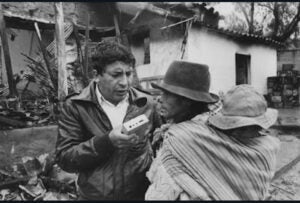
Hugo Bustíos Saavedra interviewing a peasant woman. As a Caretas correspondent, he documented the most brutal events of the conflict. Ayacucho was one of the areas hardest hit by the violence. (Photo: Caretas)
However, in a Feb. 20 decision, the Constitutional Court considered Law 32.107, which says offenses cannot be crimes against humanity if they occurred before 2002. Taking into account the commonly named “Impunity Law” meant that Bustíos’ murder would be prosecuted under the country’s criminal code and, according to the Bustios family lawyer Carlos Rivera, couldn’t be punished after 2018.
“If they talk so easily about the statute of limitations for a crime, we, the family members, wish our pain were subject to a statute of limitations as well,” Bustíos Patiño said after Urresti was released from prison on March 3. “That doesn’t happen. On the contrary, it deepens the pain, deepens our suffering because we don’t even have the right to finish grieving, we don’t even have the right to live in peace.”
The day he was released, Urresti announced he intended to return to politics. In fact, José Luna, the presidential candidate for the Podemos Perú party, was present when he was freed from prison. They also announced that, if elected president, Urresti would serve as Minister of the Interior.
The Bustíos family wasn’t alone in its rejection of the ruling. Experts say this constitutes a breach of international agreements, and also has implications for other crimes committed during the armed conflict.
“It’s a horrible, devastating message that’s being sent,” Rivera, who works for the Institute of Legal Defense, told LJR. “The Bustíos case was the most advanced in Peru in terms of achieving justice. After a struggle that has lasted almost 40 years to finally obtain justice, this is all for nothing.”
The International Federation of Journalists (IFJ for its initials in Spanish) and the National Association of Journalists of Peru (ANP) added that the decision “does not declare the convicted man innocent nor question the existence of the crime,” and instead places Peru in violation of international treaties. Reporters Without Borders (RSF) described it as a “grave legal setback.”
One concern relates to the impact on other journalists’ cases that occurred within the context of the conflict, some of which have already resulted in convictions and others that are currently on trial. For example, the case of Melisa Alfaro, murdered with a letter bomb, which is currently on trial; the massacre of eight journalists and two others in Uchuraccay; and the enforced disappearance of Jaime Ayala Sulca, which resulted in a landmark ruling in 2024.
According to the National Association of Journalists of Peru (ANP) figures, at least 54 journalists were killed in the country from 1980 to 2000. According to the Truth Commission there were almost 70,000 murders, and also violations of human rights committed by Sendero and Armed forces.
“This seriously affects the other cases and events that occurred during the armed conflict,” Juan José Quispe, lawyer for the Ayala Sulca family, told LJR. “The Urresti case has become an open door for other convicted military personnel who have been sentenced under the category of crimes against humanity, but under the Peruvian Penal Code are now requesting that this law be applied.”
Quispe and Rivera believe that within the Peruvian legal framework, the solution lies in judges applying the principle of conventionality control. That is, ensuring that domestic laws and decisions are compatible with international treaties. Along these lines, the experts say, Law 32.107 should not be applied.
Sharmelí Bustíos Patiño and Rivera said they will not stop fighting and announced they will take the case to international bodies. Back in 1997, the Inter-American Commission on Human Rights (IACHR) declared the Peruvian state responsible for the murder and demanded a new and impartial investigation.
In 1988, Bustíos Saavedra was local president of the ANP in the province of Huanta, in addition to working with Caretas.
On Nov. 24, 1988, along with photojournalist Eduardo Rojas Arce, he was heading to the village of Erapa to cover the murders of two people whom the Shining Path guerrilla group had accused of being traitors. However, they were kept from entering the area by a military patrol.
After several attempts to obtain permission to enter the area, including returning to the Castropampa military base (responsible for security in Huanta) to request it, Bustíos and Rojas were ambushed by armed men hiding by the road back to the village. They were shot multiple times, with Bustíos fatally wounded and Rojas critically injured. The attackers then detonated an explosive device on Bustíos's body. Rojas managed to escape.
The initial investigation into the crime, conducted by the military courts, concluded the perpetrators were members of Shining Path. No military personnel were convicted. The path to the first genuine investigations opened after the Inter-American Commission on Human Rights' decision and when, in 2002, the Supreme Court repealed an amnesty law that protected members of the military.
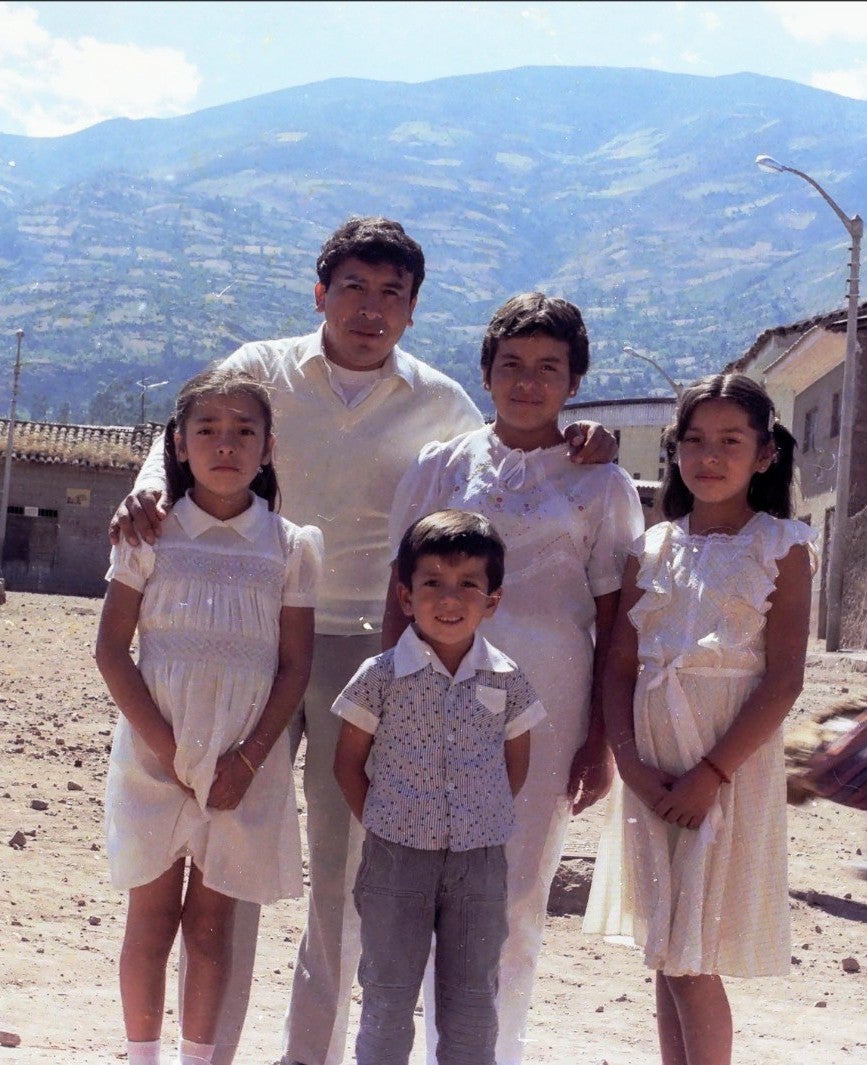
Hugo Bustíos Saavedra and his four children, who were orphaned after he was murdered on November 24, 1988, by Armed Forces. The journalist was 38 years old. Here with his children Sharmelí, Patricia, Celia and Hugo. (Photo: Family archive)
In October 2007, the court sentenced the commander of the army base in Huanta, Víctor La Vera Hernández, for planning the killing of Bustíos, and officer Amador Vidal Sanbento, for participating in the murder.
In 2011, Vidal Sanbento implicated Urresti, who at the time of Bustíos’ murder, was head of intelligence at the Huanta base. In 2015, Urresti was formally charged with murder. Despite an initial acquittal, the Supreme Court overturned the decision in 2019 and ordered a new trial. It was in this second trial that he was sentenced to 12 years in prison.
Sharmelí, Bustíos’ oldest daughter, was 14 years old, while her younger brother was 8, when their father was murdered. Their mother, Margarita Patiño, widowed at 36, led the fight for justice until her death 10 years ago, without ever seeing it.
“My family has been hit hard by tragedy, and on top of that we’ve had to deal with a justice system that is completely evasive. This is a very serious setback and a serious human rights violation. And it puts you in a very dangerous situation, because what message does it send? That you can kill a journalist and nothing happens,” Bustíos Patiño said. “The impunity creates this perverse stalemate where it’s the same whether you’re the perpetrator or the victim.”
This article was translated with AI assistance and reviewed by Teresa Mioli


