
Sociologist Juan Villoro argues journalists must counter AI’s oversimplification by bringing empathy and emotion to the table.
Mexican sociologist, writer and journalist Juan Villoro is a scholar of culture and communication.
That means he has observed how the role of digital technologies – and artificial intelligence in particular – shape the way people consume and make sense of information.
“We have another kind of universe in which reading has become atmospheric,” Villoro recently told a crowd at the University of Texas at Austin’s Teresa Lozano Long Institute of Latin American Studies.
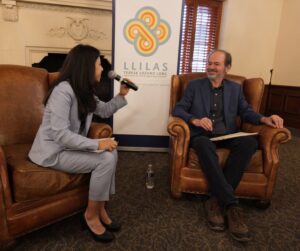
Juan Villoro speaks to Celeste González de Bustamante, chair of the Mexico Center in the Teresa Lozano Long Institute for Latin American Studies at UT Austin. (Photo: Susanna Sharpe/LLILAS Benson)
Atmospheric because information is everywhere. On the screens of our phones, computers, and digital advertisements—or produced by AI chatbots—we become informed about the world without deliberately choosing the information that reaches us; and this “fragmented” reading—via notifications or social media posts—has fostered a binary mindset and a binary approach to interpersonal relationships, Villoro said.
“The speed of information and the need to provide an instant response foster a polarized attitude in us—one where we are either for something or against it—and it would seem that there is nothing in between,” Villoro told LatAm Journalism Review (LJR). “Nuances, reconsiderations, amendments and a host of other considerations are lost in favor of a very precise outcome; and that, of course, is oversimplifying the decision-making process.”
Villoro –a professor at some of the world’s most renowned universities and a columnist at Mexican newspaper Reforma– argues that, in this environment, journalists bring empathy to the table and are able to foster “informational consciousness,” which is essential to preserving culture.
Culture as a form of communication
The risk of binary conditioning, Villoro said, is the loss of complex thought—especially given AI’s reliance on synthesizing and explaining reality. By contrast, making sense of the “story-within-a-story” narratives in Don Quixote, interpreting a painting or preserving the teachings of an oral tradition—that is culture.
For Villoro, culture is the way of representing the world in a broad sense, and thereby exposes the human being to interpreting its complexity, ambiguity and contradictions.
“The most important character in a book is the reader because that's the only moment in which a book comes alive and has a real meaning. The interpretation of the book is as important as the writing of the book. And this is one of the lessons culture gives to us,” Villoro said. “It's not a unilateral commentary of reality. It's not an instruction. It's a way of understanding the universe in a variety of ways.”
Interpreting a culture—or way of life—to another provides a benefit of solidarity that technology simulates containing. While gaining followers does not necessarily lead to gaining friendships, nor does being connected online alleviate loneliness. For Villoro, culture leads to community, because it can only exist in density.
“Culture exists only as a network. If you read one author, you will read another. If you like that author, you recommend them to someone else,” Villoro said. “No one uses culture as a form of isolation. It is always a form of communication.”
Villoro views community as a tangible expression of culture, at whose center lie shared values, affection and empathy.
For this reason, he said, sociologists delineate a distinction between society and community: whereas a society may prioritize individualistic advancement, a community calls for a notion of solidarity regarding progress.
And that vision of helping others is the common thread of journalism.
“Journalism requires empathy,” Villoro said. “That bridge is decisive for establishing an emotional connection. Why is emotion important? Because the profound purpose of journalism is the transformation of the reader.”
In particular, it’s the transformation the reader feels—the impulse to act and respond.
Creating “informational consciousness”
Factual information is “unequivocal and exact,” Villoro said; however, delving into the societal response—and shedding light on those harmed and those who benefit—calls for the values a journalist brings to the task. Rather than suppressing empathy, a journalist is powerful precisely to the extent that they appeal to the emotion inherent in what they see, feel and communicate.
Villoro explained it through a theological parable.
“Jesus—regardless of whether someone is religious or not—was a great storyteller,” Villoro said. “And one of his stories is the Parable of the Good Samaritan.”
The story of the Good Samaritan is about a man who falls victim to a crime. He lies wounded and nearly dead by the side of a road. Two priests of different religions pass by him and decide to ignore him. His salvation came in the form of a stranger – the Samaritan – who, upon seeing him, did not hesitate to help him and show him compassion.
“He is a Samaritan because he comes from Samaria—where is he found? On the road between Jerusalem and Jericho; that is where the events take place. He has nothing to do with the situation, for he comes from a distant city,” Villoro said. “He is a foreigner, he is a migrant, he is the Other. Thus, being someone who has no business being there, he is the one who becomes a neighbor. That is the journalist.”
The journalist is one who, while a stranger to the place, takes an interest, draws near and becomes involved. This stance of solidarity inherent in the profession is what generates a culture’s “informational consciousness.” For Villoro, this consciousness is essential for human survival—or, at the very least, for what is good within it.
“We can become slaves to all digital platforms, dedicating ourselves exclusively to destroying one another and making money; we can imagine that this constitutes the human horizon,” Villoro said. “But if we believe that human beings possess a positive destiny of self-preservation—if we acknowledge that they have accomplished formidable things and can still look forward to a positive future—then that reserve lies within culture.”
Villoro concluded his talk with a poem by Octavio Paz. In the extract he read from “Sunstone,” there is an implicit struggle with the reality of living in isolation, and the poet realizes that he can only truly be himself to the extent that he moves toward a notion of community. And although there is no definitive answer as to what that destiny might be, what prevails is the question—and the possibility of something more.
"I am not an expert in anything I have just said, but one of the very important advantages of journalism is that you can write about what you don’t know at first because you write in order to find out,” Villoro said.
*Marisela Pérez Maita, from Maracay, Venezuela, is a journalism major at the University of Texas at Austin, expected to graduate in 2026 with a minor in social work. She has a background in civic strategy and storytelling.


