
Journalists at La Silla Rota in Mexico developed a tool that cross-references metrics and trends to decide what to cover and how.
Every day at 7 a.m., Mariluz Roldán, manager of the specialized health site SuMédico.com, receives an email containing a list of trending topics that might resonate with her audience, recommended angles for covering them and suggestions as to which of her reporters are best suited for each topic.
Roldán arrives at her morning editorial meeting with a clear idea of which stories might be worked on that day—something that previously took her up to two hours of reviewing websites and social media, but which now takes her nearly half that time.
“This already gives us an important baseline so we don’t start the day from scratch—we just have to fill in the gaps,” Roldán told LatAm Journalism Review (LJR).
That email—generated using artificial intelligence (AI) tools and automated workflows—is helping to optimize editorial decision-making, by transforming it from a process that is intuition-driven in most newsrooms into work that is systematic and data-driven.
The project was developed by a team led by Graciela Rock, former director of La Cadera de Eva —a gender-focused site that, like SuMédico.com, belongs to La Silla Rota Group, headquartered in Mexico City. Its aim was to explore ways to leverage AI to make its site’s operations simpler and more efficient.
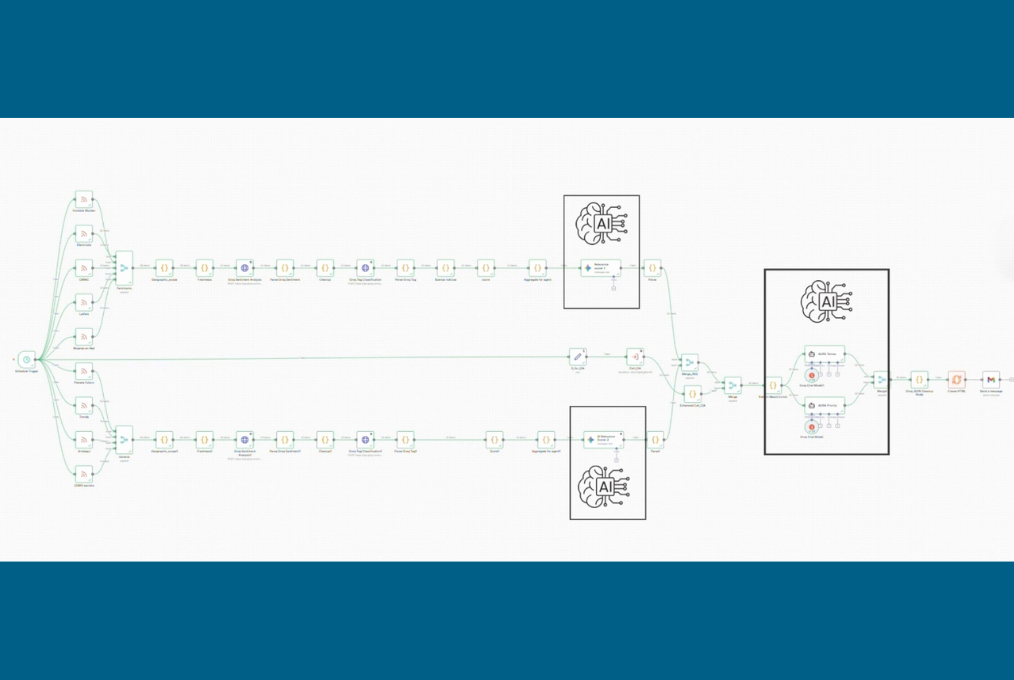
The automated workflow of La Silla Rota's tool begins with the extraction of data and metrics, and ends with the generation and sending of an email. (Photo: Screenshot)
“We concluded that what we needed was to make our editorial decision-making more precise,” Rock told LJR. “We have such limited resources that we had to strive to be as precise as possible when choosing what works for us.”
Rock, alongside Scarlett Lindero, editor at La Cadera de Eva, and Daniel Venegas, from the digital marketing team at La Silla Rota, participated in two AI training initiatives for newsrooms: LATAM Newsroom AI Catalyst, organized by the World Association of Newspapers and News Publishers (WAN-IFRA) and OpenAI; and the JournalismAI Skills Lab, organized by the British organization JournalismAI.
The team developed a prototype using the workflow automation tool n8n, which connects applications to automate repetitive tasks without the need for advanced programming knowledge. They fed this prototype with metrics from La Cadera de Eva, sourced from Google Analytics and Smartocto, an editorial analytics platform that enables the user to measure an author’s performance.
The system utilized AI agents to generate a ranking of articles and another of top-performing authors. Subsequently, another AI agent analyzed both rankings to identify patterns. Finally—using the RSS feeds from media outlets monitored by La Cadera de Eva—the tool identifies relevant topics and, based on criteria such as geographic reach and gender focus, assigns them a score.
The tool delivers the results in the email that editors receive every morning.
“The tool has been helping us better allocate the resources we have,” Rock said. “You allocate that resource—time—to doing journalism, to reporting.”
The team is currently expanding the tool to other media outlets within the group. SuMédico.com and two sections of the site La Silla Rota, which covers general news, began using it in February. Rock said they expect the system to be implemented across most of the group by mid-2026.
Rock said that every editor has different criteria for deciding which topics their publication covers. For this reason, the final tool is designed to enable the creation of customized automated workflows.
At La Cadera de Eva, “our strength isn’t that we’re read by hundreds of thousands of people, but rather that the people who read our articles stick around—and that from one article, they move on to another,” Rock said. “There are other sections that tell me: ‘What I want are the articles that have generated the most clicks.’ So, in the ranking module, we adjust the agent.”
La Silla Rota’s tool utilizes AI models from OpenAI, the company behind ChatGPT. Usage is billed based on “tokens”—units of text counted each time the system processes or generates information. To reduce costs, Rock said, the team also turned to Groq, a platform that enables the use of equally efficient open-source AI models.
But for Rock, the biggest challenge was the team realignment that allowed her, Lindero and Venegas to dedicate themselves fully to the training programs and the development of the tool.
“When we saw that this was working, the leadership made a decision: ‘These three people are going to stop doing the other things they were working on to focus on this,’” Rock said. “I believe that, truly, that is the major investment—that the decision-makers have to believe, at the very least, that it is worth a try.”
As a result, Rock stepped down from her position as director of La Cadera de Eva. Now, together with Venegas —and with the guidance of the external technology consultancy 7Gats— she is building a nascent innovation team at La Silla Rota that will oversee this and future automation projects.

Daniel Venegas participated in the AI training for the creation of La Silla Rota's tool. (Photo: Claudia Báez)
Among these future projects, Venegas added, is the development of a user-friendly interface that allows editors to independently adjust the tool's analysis criteria. They also plan to integrate social media monitoring into the automated workflow and develop AI-based tools to generate reports on other metrics, such as digital revenue and Google Search Console data.
“Undoubtedly, the biggest challenge [of introducing AI into a media outlet] is organizational culture. I’m not speaking about where I work, but rather about the industry in general,” Venegas told LJR. “There is resistance to change.”
Venegas said the initial reaction of several editors upon learning about the tool was one of concern regarding the ethical risk involved in having a machine intervene in editorial decision-making. However, he added, that concern dissipated when they realized that what the tool actually does is not make the decisions, but rather free up their time.
Roldán agreed, saying that although the tool has proven to yield accurate results, editorial decisions at SuMédico.com continue to rest with her and the site’s editor.
“We don’t follow it to the letter,” she said. “The human factor remains important from the perspective of reviewing the agenda.”
This article was translated with AI assistance and reviewed by Teresa Mioli


