
The feeling is bittersweet. It’s the first Oscar nomination for Colombian American photojournalist Juan Arredondo. But it comes for a documentary that tells the story of his friend and colleague Brent Renaud, who on March 13, 2022, became the first foreign journalist to die in the war in Ukraine.
“I wish we could have shared this moment with Brent,” Arredondo told LatAm Journalism Review (LJR).
Arredondo and Craig Renaud, Brent’s brother, decided to make the documentary “Armed With a Camera: The Life and Death of Brent Renaud” as part of a process of healing and grieving after his death. The film also became a tribute to journalists killed around the world.
The year 2025 ended as one of the most violent for journalism. According to the Committee to Protect Journalists (CPJ), 129 journalists were killed worldwide last year. And Latin America has not escaped this reality with the CPJ counting 13 journalists murdered in 2025, six more than the previous year.
“Amid the deadliest time on record for the press, ‘Armed Only with a Camera’ underscores the lengths conflict journalists go to report the news,” said Jodie Ginsberg, CPJ’s CEO. The organization has supported the film’s distribution. “Brent Renaud was a fearless documentarian who dedicated his life to telling the stories of people caught in the crosshairs of global crises.”
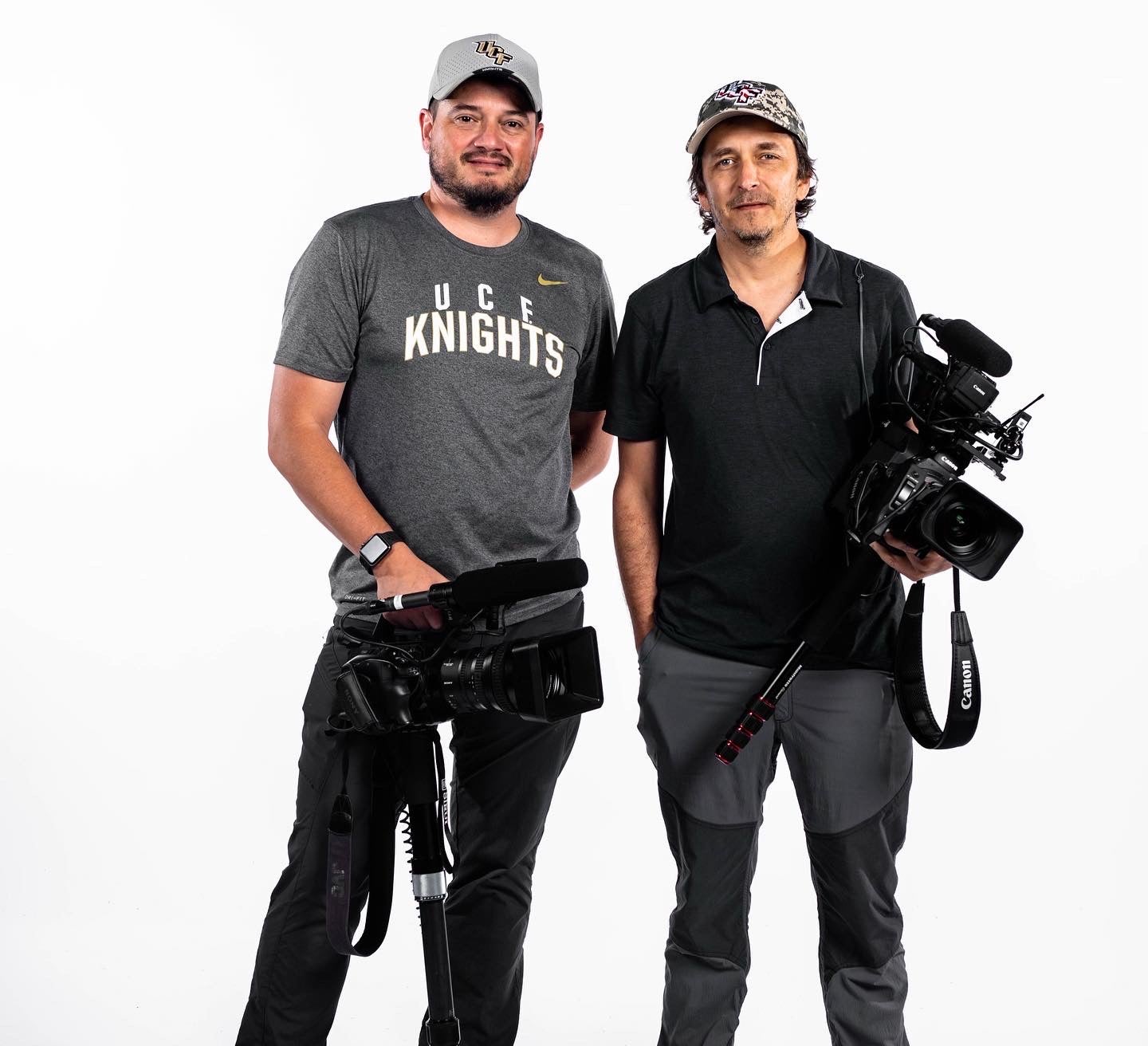
Juan Arredondo and Brent Renaud. (Photo: Courtesy)
Arredondo was born in New Jersey but grew up in Pereira, Colombia. He returned to the U.S. to complete his undergraduate studies at Rutgers University and later earned a Ph.D. in organic chemistry from Carnegie Mellon University, until one day he decided to leave the laboratory for the camera. Now he hopes the documentary, nominated for best documentary short, can also highlight the importance of journalism for democracy and even for peace and reconciliation.
Much of his training as a photojournalist took place in Colombia, focusing on post-conflict issues after working as a freelance photographer with The New York Times. He spent a year at Colombia’s National Center for Historical Memory, an institution that preserves and documents the country’s armed conflict. Later, as an independent journalist, he focused on stories such as child combatants in the ELN guerrilla group and the peace process with the FARC guerrilla group.
He holds a master’s degree in journalism and documentary film from Columbia University, was a Nieman Fellow at Harvard University in 2019 and has won awards including World Press Photo.
In the attack that killed Renaud, Arredondo was also seriously wounded. He underwent 13 surgeries and a long period of physical therapy before he could walk again. In an interview with LJR, he spoke about the mental health toll on journalists who cover conflict, attacks on the press and growing public distrust of the media.
This interview has been edited for length and clarity.
LJR: You met Brent when you were both Nieman Fellows, which led to years of working together. How did your friendship and professional relationship develop?
JA: Brent was unique. As we mention in the documentary, he had been diagnosed with autism, Asperger’s syndrome. It’s a form of high-functioning autism. He was extremely intelligent but also socially withdrawn.
In the first days of the fellowship I thought he was a strange person — quiet, reserved, sometimes missing the events organized for us. One weekend he called me because he had locked himself out of his apartment and he stayed at my place. That’s when we started talking and getting to know each other.
I realized he had a very different personality and way of being, but we bonded over our love of photography. He loved photography, made photos, enjoyed developing film. Our shared passion for photography brought us together. We even took a class on photography and war.
In some ways I became the person who dragged him to social events, because socializing was difficult for him. Later, when I met his brother Craig, I realized that both of us had played that role for him.
LJR: How did you decide to travel to Ukraine and what was the original goal?
JA: The project aimed to document refugees in different parts of the world. It was going to be a series for Time Studios, a division of Time Warner. We started in Central America, in Mexico and Guatemala. That first phase focused on gender, particularly LGBTQ communities affected by migration. Then we were in Greece, at the second-largest refugee camp. On Feb. 24, Russia invaded Ukraine, and we decided to include that in the series. Brent and I traveled to Ukraine on March 7, 2022.
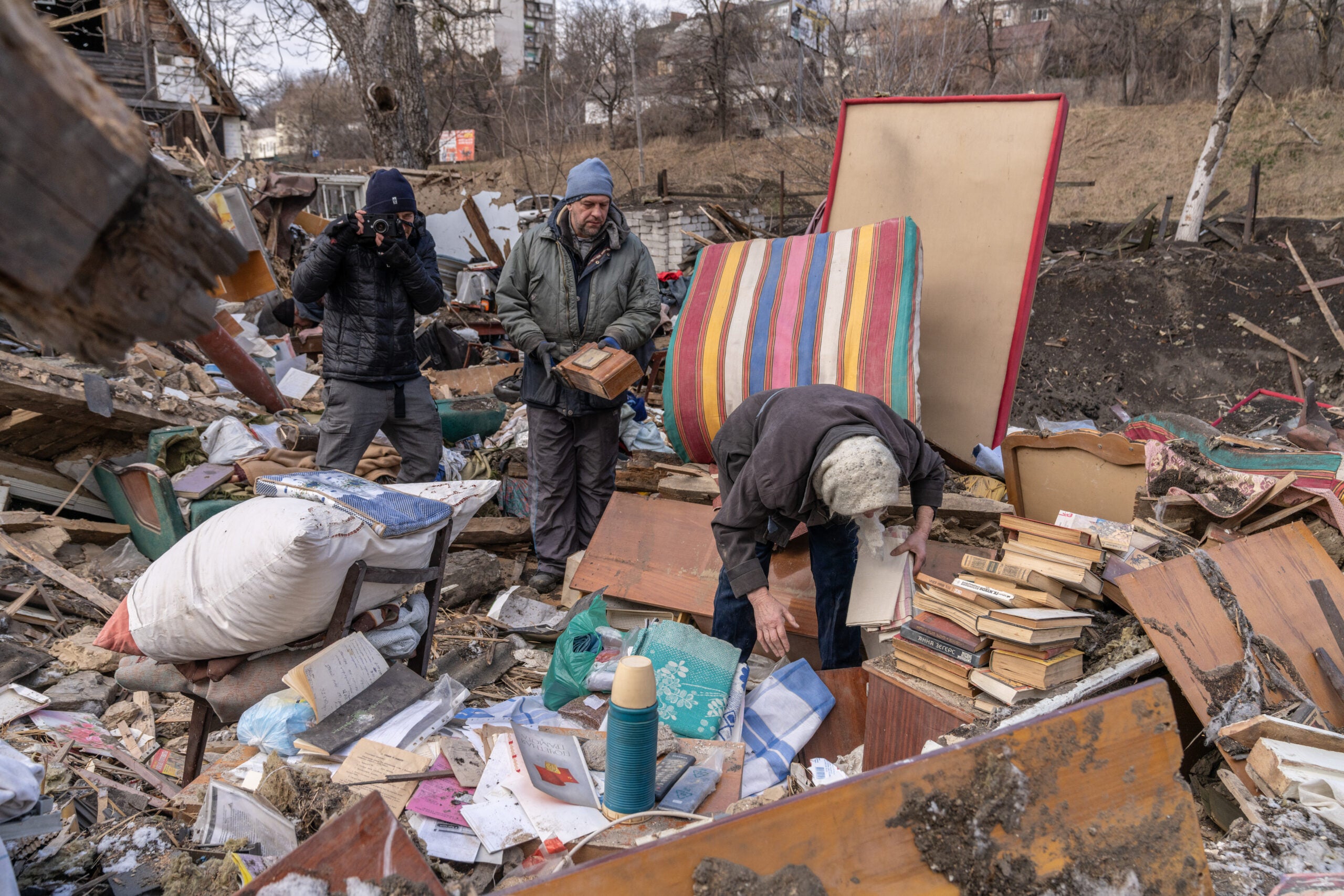
Brent Renaud covering the war in Ukraine. (Photo: Juan Arredondo)
LJR: You weren’t in the most violent part of the war. How did the attack happen?
JA: We arrived in Lviv and saw people arriving by train, bus and car. We wanted to see where this displacement was coming from. People told us many were coming from Kyiv. So we began that journey with the goal of reaching Kyiv and seeing what was happening in the capital.
It took us nearly a week, and during that time we saw the bombing of some military installations, but many times they were bombing civilian areas: apartment buildings, bus stations, train stations, refineries. By the time we reached Kyiv, the city had become a transit point. There were no refugee camps there, people were just being immediately sent west.
While we were there, we saw caravans of civilian cars arriving with white flags and signs made with tape or graffiti saying “children on board” or “civilians on board” in Ukrainian. But many of those cars had bullet holes.
People told us: “They’re shooting at us. The Russians aren’t respecting that we’re civilians.” They were fleeing areas outside Kyiv called Irpin and Bucha. On Sunday morning, March 13, we decided to go see that displacement ourselves. There is a bridge connecting Irpin and Kyiv that the Ukrainians themselves destroyed to prevent Russian troops from advancing into the capital.
We got there, got out of the car because it couldn’t get through, and started walking toward Irpin to see the evacuations. After about 40 minutes several cars stopped to ask where we were going. We didn’t speak Russian or Ukrainian, but one driver, Vladimir, spoke English. He said he was a volunteer evacuating people and could take us closer. We got in the car. I sat in the back seat, Brent next to the driver. About 10 or 15 minutes into the trip I looked out the left window and saw two soldiers come out of a trench. The one closest to the road raised an AK-47 and pointed it at the car. I shouted, “They’re going to kill us. They’re going to shoot.” I threw myself onto the floor of the back seat for cover. That’s how the gunfire started.
The car shook me around, pushing me toward its sides, made a U-turn trying to go back, and that put us directly in the soldiers’ line of sight. That’s when they ambushed us. It lasted only a few minutes, but it felt like an eternity. I remember feeling the impact in my left glute — a sharp, painful blow. I shouted, “I’ve been shot,” but no one answered. The car was already damaged, and when it finally stopped, I got up from the floor and saw Brent bleeding from the neck. I tried to stop the wound, but by then Brent had already died.
Vladimir got out and helped me pull Brent from the car. We laid him on the sidewalk. That’s when I realized my own wound was very serious. I started to faint and was bleeding heavily. Luckily, another evacuation vehicle came by and we managed to stop it and they took me. I made it back to the bridge, and the only thing I remember is grabbing my cameras, taking a few steps and collapsing.
When I woke up I was in an ambulance. I kept asking what happened to Brent, where he was, whether he had died, but nobody answered. They evacuated me to Kyiv. During that trip I called Brent’s brother and told him, “We were shot. Brent is seriously wounded. I’m wounded too. I’m going to a hospital.”
LJR: From your description, you weren’t even given a chance to identify yourselves as press and civilians.
JA: Not at all. We had bulletproof vests, helmets and press tags. But from what we had seen in the days before, the Russians weren’t respecting these rules of war, the protections for civilians under the Geneva conventions and the Rome Statute. We had already seen them shooting at civilian cars.
Now, why did they attack us? It was investigated, but they could never figure it out. However, it was established that they were Russian troops because weeks later mass graves were discovered in Bucha, where many atrocities and massacres had taken place.
LJR: After surviving an attack like that and recovering physically, how do you go back to doing journalism? Did you seek help?
JA: It was a process of looking for the best mental health support. It has also been a process of experimentation because it hasn’t been easy. There are too many different forms of therapy. At first the university put me in contact with a group. I felt that was a very clinical kind of treatment. I found that the best way was through therapy. But I feel that this profession is not very open to that kind of trauma. There’s a lot of macho culture, that toxic masculinity where you’re supposed to be tough and you don’t share your feelings. There is also this kind of caricature, a stereotype of the war photographer who is chasing adrenaline, who is an alcoholic, and none of that is true. I don’t think Brent was like that, nor were we.
So we have to fight against that a little bit. I started noticing that some members of the community approached me and asked if I wanted to talk, and that helped me a lot. I was able to talk with several photographers who had been in similar or worse situations, and that helps a lot to process what happened, to understand it and overcome many of the traumas.
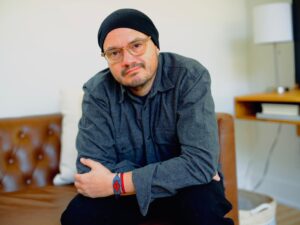
Photojournalist Juan Arredondo. (Photo: Courtesy)
One of them is survivor’s syndrome, which leaves a very deep mark. That hit me very hard because I felt like a bad friend, like “what a terrible thing I did,” leaving my friend there, feeling guilty. That day becomes like a movie that repeats itself over and over. You start to doubt: Why did I sit in the back? What if I had sat in the front? What if we had been delayed that day? And so on.
I think it’s a wound that never heals. It always stays there, and you have days that are harder than others. Making this documentary helped us heal a lot. I grew closer to his brother. It allowed both of us, at least, to heal, to understand what happened and to give ourselves purpose.
That helps a lot: working on a project because it gives us a purpose. How do we do it? How do we deal with this pain and this grief? And the answer was to make this documentary.
A tribute to Brent, but also what we wanted was to make a tribute to all these [fallen] journalists, because the past three years have been the most violent, with the most murders of journalists.
LJR: Even though the investigation into the attack against you did not lead to conclusions, do you think the documentary and the footage of the crime could serve as legal evidence at some point?
JA: The decision to record was because we have always had a pact—Brent and Craig had it as brothers, and we still have it—that if something happens to us we won’t stop filming and, as much as possible, we will try to recover the other person: if they are kidnapped, if they are killed. Craig’s response was, “I’m going to film this. I don’t know what for, but I’m going to film it.” Later, when he returned and the wake had passed, we sat down to see what we were going to do with all this material. Then HBO approached us and asked how they could help, and that’s when Craig proposed making a documentary.
We came to the conclusion that what we wanted was to make a tribute to Brent, to show his work, his body of work, but also a tribute, as I said, to journalists precisely because of what was happening.
We felt it was very important to incorporate everything he had done, his trajectory. One of the challenges we had was trying to find Brent’s voice in all these archives.
LJR: Covering violence as it happens in Mexico or Colombia is often compared to covering a war. What advice could you give journalists who cover these topics regarding their mental health? How can things improve in this area?
JA: Through this documentary and the talks we have held, I’ve noticed that there is indeed a very big gap and deficit in the training and preparation of journalists to cover that type of conflict. I say this because I’ve gone to journalism schools where students are not taught how to do this.
The normal practice is that you buy a plane ticket, go to a conflict zone and try to find work from there.
We don’t talk much about independent people who are going to do this kind of work and how one prepares for it. I feel that more resources are needed, not only to prepare people for these kinds of conflicts but also for the consequences they leave behind, because those accumulate.
And I’m not going to generalize, but the issue of mental health in Latin America is complicated and still carries a certain stigma. I don’t know how it is addressed at the workplace level, but I do feel there is a gap because it’s not talked about.
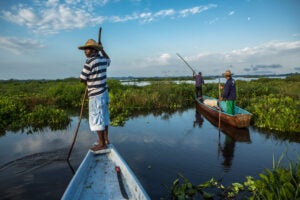
Work of Juan Arredondo in Colombia. This photo was taken in Bocas de Barbacoas, Antioquia, on February 13, 2017. (Photo: Juan Arredondo)
And those gaps need to be filled, especially because right now we are seeing that journalism is under attack not only in conflict zones but in many other ways: intimidation, self-censorship. We have colleagues in El Salvador who are reporting from exile. In Colombia we also have issues of self-censorship. In Mexico many colleagues are being harassed by cartels.
LJR: With the documentary you are trying to pay tribute to journalists in general and the role they play, especially in wars and conflicts. At the same time, journalism faces attacks from different fronts, as you said, as well as mistrust from audiences who do not see that importance. How can that trust be rebuilt?
JA: Yes, that’s a complicated question. The problem we have is that we are not the protagonists. This is the first time I feel like I’m in front of a camera, and usually I feel the public doesn’t know that. And that has been the reaction when people watch the documentary: “We didn’t know you get that close to danger.”
There are parts where you see how Brent is ambushed in Iraq, the story of the largest car bomb that exploded that year in Somalia. People don’t go there to see how reporters work in these places. As visual reporters, you have to be right there beside it. Hopefully, the documentary will generate some awareness and interest among people in understanding what a journalist does in a conflict.
But I don’t know how trust is won back. Obviously right now we’re in a battle against disinformation. We’re increasingly seeing authoritarian governments trying to discredit the reporting that comes out. But I believe that careful, rigorous journalism that follows all these principles of verification is the only thing we have right now, because everything else is opinion. Our role as journalists is precisely that: to resist and to inform people about the careful work that journalism actually is.
It is also an act of recording history, of documenting history, of having a record, of having something that becomes historical.
Trust is earned by doing careful journalism, not sensationalist, lazy journalism done from a distance. I didn’t give a concrete answer, but that is the challenge I think we are all facing right now: how do we win back the public’s trust amid so many attacks?
LJR: What does the nomination and potentially winning this Oscar represent?
JA: For me it has always been, speaking as Juan, a mixed feeling. On the one hand, this was not the documentary we wanted to be celebrated for, with this honor they are giving us and these awards. Neither his brother nor I imagined this would be the documentary that would bring us all this attention. It’s difficult because I wish we could have shared this very moment with Brent. There is always that mixture of feelings: It makes me happy, then it makes me sad.
When we started the documentary, obviously it was never a goal to get to this level. What we wanted was to make a tribute, to remember him, to heal. And what we have now is to continue his legacy, to keep working the way we used to work, to keep telling the stories that interest us and that we feel are important to tell, especially stories that are barely covered in the media. That was the goal.
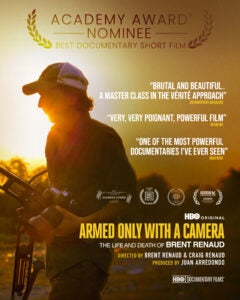
Poster Documentary Armed Only with a Camera, Oscar nominee.
Still, reaching this stage is already a source of pride. We never imagined it, and we wanted to immortalize Brent’s name and his work a little bit, and we achieved that, right? Now we wait for the results of the ceremony.
LJR: Which you will all attend…
JA: Yes, of course. Everyone, the whole family. We’ll all be rooting for it. I tell people that my mom lights candles, her friends ask her where they can vote, and I tell her, “Mom, this isn’t Colombia’s Got Talent” [laughs]. But I think it’s very sweet. If we win, it would make history as the first Colombian, but it goes beyond that, it’s about making our work known.
What matters now is that people understand the importance of journalism, especially in countries where it’s being heavily affected.
It’s not only that we were attacked; it’s that there are constantly no budgets, newsrooms are being affected. In the United States we’re seeing news deserts, places where journalism no longer exists, where there is no newspaper, where there is no reporter going to the courthouse to see what the mayor is doing, what kind of shady deal the mayor is pulling.
All of that is part of what allows a democracy to function in a healthier way.
This interview was translated with the assistance of artificial intelligence and reviewed by Jorge Valencia.


